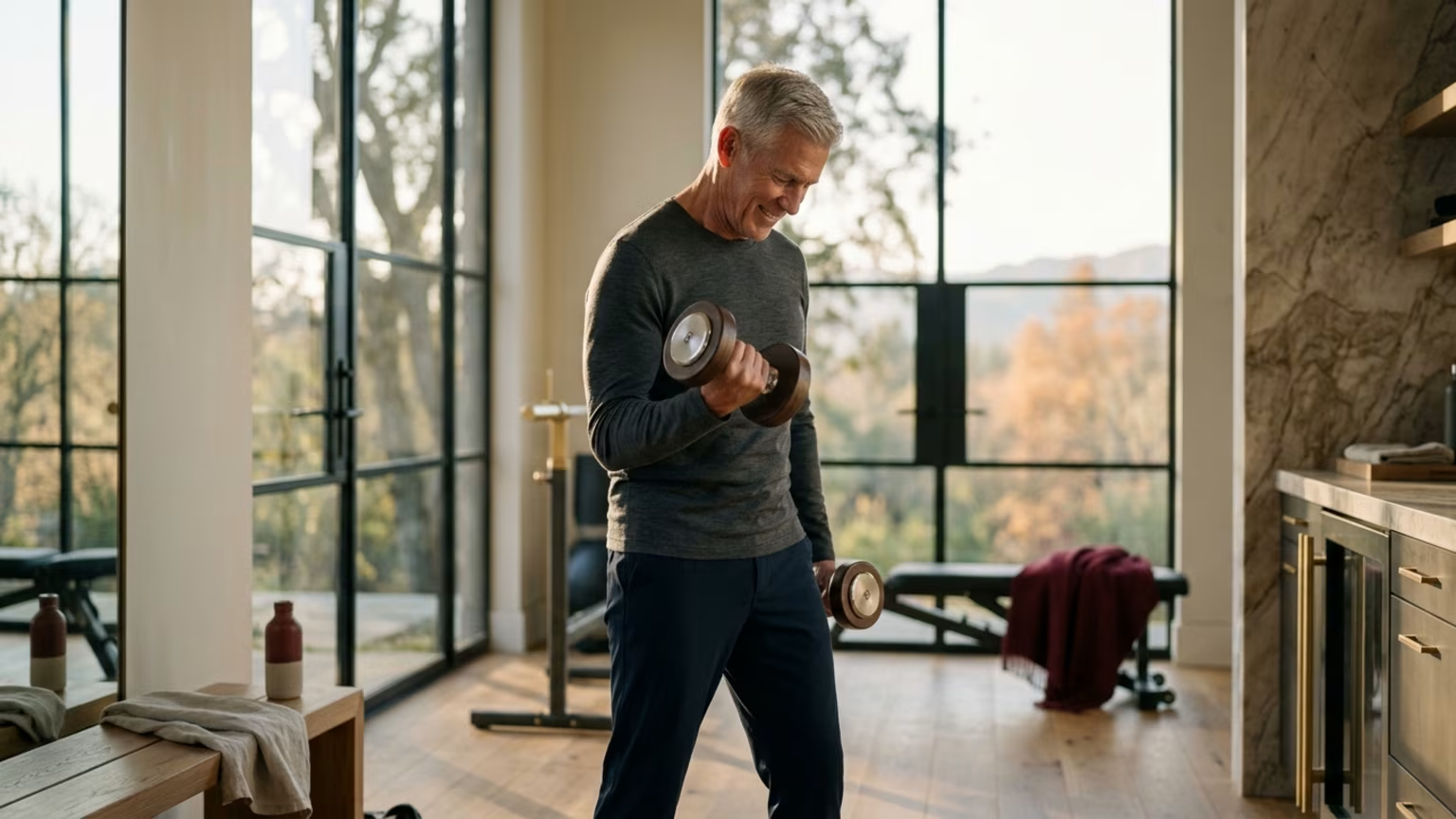

A 2026 feature on active ageing highlights how progressive resistance training and aerobic habits preserve physical independence and travel capability after 40.





On September 9, 2026, Women's Health UK published a compelling feature about active ageing. The article profiled a seventy year old fitness coach who credits her lifelong mobility to progressive resistance training. For active adults who want to maintain their physical independence, the piece underscores a critical reality. We must prioritise lower body and core strength now to preserve our capacity for demanding travel and sport later in life.
The recent feature highlights that strength is a long-term capacity investment rather than a short-term weight management tool. A 2022 systematic review published in Sports Medicine looked closely at this exact premise. The review found significant improvements in muscle strength and bone mineral density among adults aged 65 and older following progressive resistance training.
This concurrent adaptation creates a structural foundation that can handle the sheer physical force of daily life. It protects your joints and your skeletal system simultaneously. Another meta-analysis focused on adults aged 65 and older offered equally specific and encouraging findings. It showed that supervised resistance training significantly increased knee-extensor muscle size and muscle-fibre area.
These specific adaptations in the legs are exactly what active adults need for demanding activities. They allow you to safely navigate steep stairs, hike mountain trails, and rise from low seats without relying on your arms. Stronger knee extensors directly translate to a more stable stride, better joint protection, and greater confidence during physical exertion.
Interestingly, you do not need massive muscle growth to see meaningful physical benefits from lifting weights. A separate meta-analysis examined older adults aged roughly 66 to 83 with sarcopenia. It found significant improvements in handgrip strength, knee-extension strength, gait speed, and Timed Up and Go performance. Crucially, it found no statistically significant improvement in muscle mass outcomes.
This shows that the nervous system and existing muscle fibres can become much more efficient without massive visual changes. The evidence base is becoming much more precise about this difference between muscle mass and functional capacity. Getting stronger is about capability, not just aesthetics. You can improve your functional capacity significantly just by training your nervous system to recruit muscle fibres properly.
This distinction is incredibly reassuring for adults who want to perform well without spending hours trying to build visible bulk. The recent feature also cited a systematic review involving more than 2000 adults over 70. That review associated aerobic exercise with improvements in cardiovascular fitness, metabolic health, and physical function. It also noted better cognitive performance, which is an increasingly critical focus for active adults. Research clearly shows that protecting your mind requires physical effort, just as combining strength training with cognitive games can significantly reduce dementia risk.
You need both strength and stamina to thrive, as neither can fully replace the other. The WHO recommends 150 to 300 minutes of moderate-intensity aerobic activity weekly. Alternatively, adults can perform 75 to 150 minutes of vigorous activity. They also recommend muscle-strengthening work involving all major muscle groups on at least two days per week.
For older adults, the WHO specifically suggests multicomponent activity emphasising functional balance and strength on three or more days per week. Following these guidelines provides a comprehensive approach to physical longevity. It ensures that you are building the raw force production needed to move well. It also guarantees that you have the endurance necessary to enjoy those movements for hours at a time.
A meta-regression of resistance-training frequency in adults over 60 provides further clarity on scheduling your sessions. It found that maximal-strength gains increased modestly with additional weekly training days. However, training frequency had no significant effect on muscle hypertrophy. Two well-designed weekly sessions are a completely defensible baseline for active adults who want to maintain their schedule. It is better to stick to a realistic schedule than to abandon a perfect but unsustainable plan.
The Women's Health UK piece featured Carrie Sisson, a 70 year old fitness coach. Sisson began taking strength training seriously in her 30s because she wanted to feel good long term. She describes herself as strong, mobile, and physically well today. She attributes that position primarily to consistently prioritising strength over many years.
Sisson characterises muscle as an "insurance policy for ageing" in the published feature. She argues that repeated training builds stronger bones, preserves muscle, and supports a body capable of keeping up with daily life. She believes that strength should matter more to future independence than fitting into a smaller clothing size. This perspective shifts the focus from physical appearance directly to physical capability and freedom.
Her five core recommendations focus entirely on capability and sustainable habits rather than extreme interventions. She advises readers to focus on lifting capacity rather than body weight. She recommends building muscle and including cardio without relying on it exclusively. Finally, she suggests avoiding letting age define your activities and supporting mental wellbeing alongside physical training. Her central point is that independence at 70 is the result of accumulated small deposits of healthy habits rather than a sudden intervention.
The strongest practical case for resistance training is purely functional. Lower body strength directly helps with walking speed, rising from a chair, and climbing stairs. It also assists with carrying luggage and maintaining general mobility. For worldly adults, these are the exact movements required for international travel and outdoor sport.
Carrying heavy bags through airport terminals requires exceptional grip strength and core stability. It demands a physical reserve that you must actively build and maintain well before you need it. The Women's Health UK article cites a 10-week study of mobility-limited adults with an average age of 85. That specific study reported 7 to 11 percent improvements in functional performance alongside increased leg muscle mass.
While this result belongs to a specific mobility-limited cohort, it proves that strength remains trainable late in life. Building these capacities early ensures you can handle the physical stress of long trips, unfamiliar environments, and unexpected delays. Travel recovery is heavily dependent on maintaining a resilient body and a smart, proactive routine. Physical strength is only one part of the equation when managing demanding environments and aggressive time zone changes.
Environmental stressors can easily drain your energy if your body is not prepared for the transition. Our team at WealthAtPlay knows firsthand how travel stress can compound if you rely on willpower alone to get through a trip. "After a grueling thirty hour transit to Tokyo, I realized my old strategy of just powering through was no longer working. I felt foggy for three days. I started digging into circadian biology and realized that timing my light exposure and fasting during the flight could completely shift my recovery."
"Now, I never board a long haul flight without a precise schedule for when to eat and when to put on an eye mask. It is the difference between losing a week of your trip and hitting the ground running." Building your capacity for these demands requires a structured approach to your physical preparation throughout the year. You should track safe improvements in fundamental movements like squats, hinges, and step-ups. You also need to measure progress in pulling and pressing motions.
These are the functional patterns that directly translate to skiing, hiking, and racket sports. We strongly recommend reading our guide on concurrent training recovery to safely integrate strength and cardiovascular work. You must also integrate balance training into your preparation to handle uneven terrain with confidence. Single leg control, stepping, and getting down to the floor safely are critical skills for any active traveller.
You can review our minimalist protocol for capable travel to start building a resilient base on the road. This physical base ensures you can adjust to altitude changes, navigate cobblestone streets, and recover faster from long days outdoors. Proper execution of these movements requires focus, coordination, and excellent breathing mechanics. You should always use professional coaching when appropriate, especially for heavier loading or complex lifts.
If you are learning to manage heavier weights, learning how to breathe and brace for strength is absolutely essential. The ultimate goal is participating fully in the activities you love without worrying about physical limitations holding you back.
Active adults should immediately begin a sustainable weekly routine of progressive resistance training, aerobic conditioning, and balance practice to secure their future physical independence.
Stay connected for research and practical guidance on longevity, strength, recovery, energy and active living. New ideas to help you stay capable, curious and ready for more.



Explore practical guidance on strength, recovery, energy, travel and longevity for a life that stays active.
explore the Blog