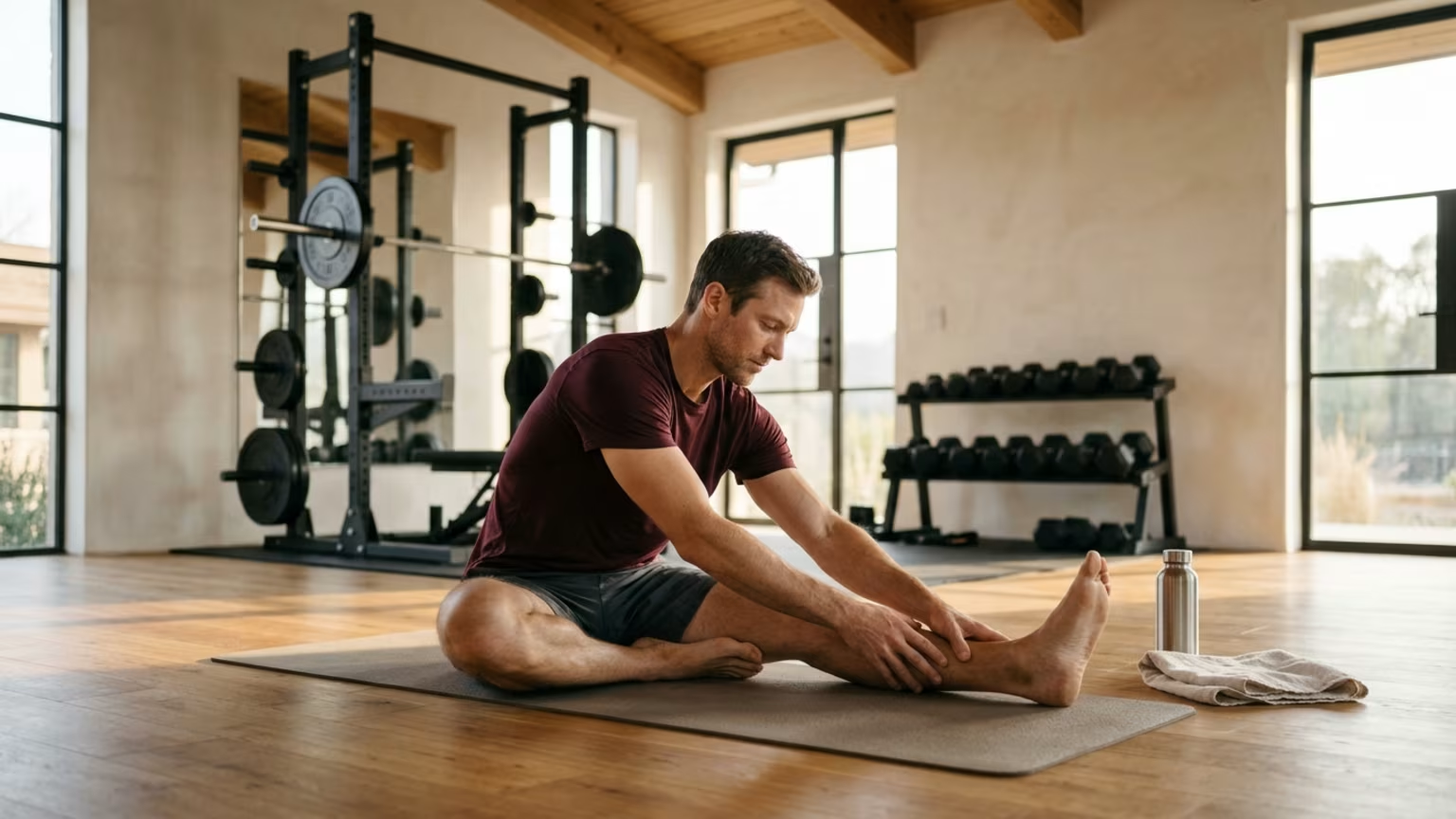

A November fitness report links prolonged static holds before heavy exercise to temporary performance loss. Here is the practical warm-up lesson.





On November 16, 2026, a Men’s Journal report by Madison Freeman examined evidence that prolonged static stretching immediately before heavy or explosive exercise may temporarily reduce strength and power. If you value being ready for a demanding gym session or an active holiday, the useful message concerns the order of your preparation: movement first rather than long stationary holds.
Republished on Yahoo Health and updated November 17, the story brings earlier research into a timely discussion about warm-ups. It is a new fitness report rather than a new scientific study. Its practical relevance is straightforward: flexibility work and preparation for forceful movement are not interchangeable.
The report distinguishes between remaining still in a stretch and moving continuously through a joint’s range of motion. The first describes static stretching. The second describes dynamic stretching, with leg swings and walking lunges among the examples given.
That distinction matters because the concern is about what happens immediately before demanding exercise. According to the report, prolonged static holds may temporarily impair the strength and power available for the effort that follows. The relevant question is therefore not simply whether stretching belongs in an active life, but what job it is doing at that moment.
For a capability-focused reader, this is a distinction between working on flexibility and preparing to perform. A long hold may be part of a familiar routine. Familiarity alone does not make it the most suitable preparation for a heavy lift or an explosive movement.
Freeman’s report attributes its main estimate to a 2019 review in Frontiers in Physiology. As summarized by the outlet, static stretching for more than 60 seconds per muscle group was associated with strength and power performance reductions of about 4% to 7.5%.
Those figures are review-reported findings, not a forecast for your next workout. Their value is in identifying a potentially unhelpful combination: a prolonged hold followed immediately by an effort in which force or power matters. The duration and timing belong together when interpreting the finding.
A separate health report also identifies static stretching over 60 seconds before exercise as a possible strength concern. This reinforces the narrow question at issue rather than supporting a general argument against stretching.
The practical interpretation is about sequencing, not calculating a personal performance penalty. There is no useful reason to estimate how much weight you might lose from a lift based on the reported average. The more relevant decision is whether long static holds should occupy the place reserved for preparation.
The Yahoo Health story is secondary coverage of earlier research. It does not supply the full methods needed to assess the review’s numerical estimates independently. It also provides no age-stratified results, so the findings should not be presented as especially established for adults over 40.
Nor does the report establish that brief static stretches have the same effect or that every stretch before every activity is harmful. Its warning concerns prolonged static stretching immediately before heavy or explosive effort. That is the boundary to keep intact when turning the headline into a practical decision.
Courtney Smith offers the report’s clearest recommendation: “warm up with movement first.” The story identifies her as a registered dietitian and certified personal trainer with a master’s degree in exercise physiology. She recommends leaving static stretching until after exercise, when muscles are warm.
Smith also explains that static stretching does not raise muscle temperature or increase blood flow in the same way as dynamic movement. That is practitioner commentary reported by the outlet. It supports the story’s central distinction without requiring a complicated explanation of nerves or muscle tissue.
In plain terms, movement-based preparation involves doing something rather than remaining stationary. The report’s examples include leg swings, walking lunges, and arm circles. They make the recommendation concrete without establishing a compulsory sequence for every person or sport.
The useful next step is selection rather than accumulation. A warm-up need not become a collection of every mobility drill you know. Our guide to matching preparation to the activity ahead addresses that same practical question: how to give preparation a clear purpose.
Smith’s suggestion to stretch afterward should also remain a choice rather than a new obligation. The report does not provide a detailed comparison of post-workout stretching outcomes or establish that everyone needs to add it. Moving a preferred habit is different from prescribing an additional task.
For travel recovery and sustained energy during skiing or hiking, the implications require a careful distinction. This report does not demonstrate faster recovery after a flight, better altitude adjustment, or improved endurance across a mountain day. Its useful contribution is narrower: how to organize preparation before an effort where immediate strength or power matters.
That still has practical relevance to an active holiday. Heavy strength training undertaken in preparation for a trip falls directly within the report’s focus. Applying the same movement-first principle to a ski morning or demanding hike is a practical extension, not a measured result from those activities.
The report’s examples offer a starting point without supplying a universal routine. Leg swings and walking lunges illustrate moving through range rather than holding still. Arm circles illustrate the same principle for the upper body. Choosing among them should reflect the activity rather than a desire to complete a fixed list.
For someone preparing for heavy lifting, the main adjustment is clear: do not rely on prolonged stationary stretching as the entire warm-up. The report supports movement-based preparation instead. It does not require turning a familiar session into an elaborate performance project.
For skiing or hiking, keep the same distinction between general flexibility work and preparation for the immediate task. Treat the warm-up as preparation, not as a promise of all-day energy. That keeps the advice useful without asking stretching research to answer questions about every aspect of mountain performance.
This is also where exercise choice deserves more attention than novelty. Our resource on choosing movements around a clear physical goal provides a broader framework for that decision. The relevant question here remains simple: does the movement suit what comes next?
The most realistic response to the report is not to replace an entire routine. It is to reconsider the position of long static holds. If they currently form the whole preparation before demanding strength work, movement-based preparation deserves that place instead.
That is a manageable change whether training at home or using a hotel gym. The principle travels more easily than a complicated checklist: prepare through movement before the forceful effort. Keep any longer flexibility work separate from that immediate performance window.
There is no need to turn the reported duration into a personal stopwatch rule. More than 60 seconds per muscle group describes the research summarized in the story, not an individualized prescription. The practical action is to change the emphasis of the warm-up rather than test the boundary of the finding.
Questions involving pain or rehabilitation belong with a qualified clinician rather than a general fitness headline. For routine performance preparation, however, the report offers a clear priority without demanding an overhaul: make movement the opening act.
Before heavy or explosive effort, prioritize movement-based preparation and leave longer static holds until afterward if you choose to include them, treating this as a sensible sequencing adjustment rather than a reason to abandon flexibility work.
Stay connected for research and practical guidance on longevity, strength, recovery, energy and active living. New ideas to help you stay capable, curious and ready for more.


Explore practical guidance on strength, recovery, energy, travel and longevity for a life that stays active.
explore the Blog

