
Catching yourself during a sudden stumble requires reactive power, which structured plyometric progressions restore through safe force absorption.





Picture yourself stepping off a cobblestone curb in Florence or reacting to a sudden loose rock on an alpine descent in Chamonix. Your foot slips by three inches, your center of gravity tilts, and your body must make an instantaneous correction. In that fraction of a second, raw muscle strength is not what keeps you upright. What saves you from a fall is power, the rapid expression of force and quick elastic recoil within your tendons.
Many active adults spend years building a foundation of traditional strength through squats, deadlifts, and presses. While this heavy lifting protects muscle mass, it trains force production at relatively slow velocities. Over time, the nervous system can lose its ability to recruit motor units instantaneously. Tendons can gradually lose their spring-like stiffness.
Plyometrics bridges this critical gap. When designed with intelligent progressions, plyometric training restores rate of force development, sharpens balance, and reinforces bone density. It is not about reckless jumping onto high platforms. It is about systematically training the body to absorb, transfer, and express force safely at any age.
Plyometric training refers to exercises that use the stretch-shortening cycle of muscle and tendon tissue to produce rapid force. For adults past 40, the objective is not maximal jump height or extreme fatigue. The primary goal is developing tissue tolerance, landing control, and reactive capability.
Research demonstrates that power declines nearly twice as fast as maximal strength during normal aging. A person may possess the strength to lift a heavy barbell slowly, yet lack the speed to recover from a stumble. Structured power training restores fast-twitch muscle fiber recruitment, improves joint stability, and enhances athletic performance across sports like tennis, skiing, and running.
Safety in plyometric training depends on progressive tissue exposure. The training continuum moves deliberately from force absorption to low-amplitude elasticity, bilateral jumping, unilateral hopping, and finally reactive drills. Volume is measured in ground contacts rather than standard repetitions, allowing precise control over cumulative mechanical stress.
When implemented with adequate recovery, plyometrics provides an exceptional stimulus for healthy aging. Active adults can gain significant improvements in power, agility, and dynamic balance without placing excessive wear on joints.
To train power effectively, you must understand the underlying physiology of the stretch-shortening cycle. The stretch-shortening cycle describes an active muscle lengthening followed immediately by a rapid concentric shortening. This mechanism functions like a mechanical spring, storing strain energy in tendons and releasing it quickly.
The process consists of three distinct phases. The first is the eccentric phase, where the muscle-tendon unit lengthens while absorbing incoming kinetic energy. Next comes the amortization phase, which represents the brief transition period between lengthening and shortening. The final stage is the concentric phase, where stored elastic energy combines with active muscle contraction to produce explosive movement.
The efficiency of this cycle depends heavily on the speed of the transition. If the amortization phase is too long, the stored elastic energy dissipates as heat rather than contributing to propulsion. In novice trainees over 40, the immediate priority is mastering the eccentric phase. You must first develop the capacity to absorb force softly and evenly before attempting to minimize the transition time.
As we age, several physiological changes alter this system. Type II fast-twitch muscle fibers, which generate rapid force, experience greater age-related atrophy than slow-twitch Type I fibers. Tendons can also undergo structural remodeling, altering their natural stiffness and compliance. These changes reduce the rate of force development, which is the speed at which your nervous system can recruit muscular force.
Targeted plyometric work reverses these tendencies. Rapid contractions send potent neurological signals that recruit high-threshold motor units. Simultaneously, the mechanical loading stimulates collagen remodeling within the tendon matrix, preserving dynamic elasticity.
A valuable metric in sports science is the reactive strength index, which measures jump height divided by ground contact time. A high reactive strength index indicates that an athlete can produce substantial vertical force while spending minimal time on the ground. For mature adults, improving reactive strength enhances the ability to change direction effortlessly and navigate unpredictable terrain. Exploring our strength and physical performance resources can provide further context on building these foundational capacities.
Plyometrics is not a single exercise, but a spectrum of distinct movement categories. Each category presents unique mechanical demands, joint impact levels, and coordination requirements. Understanding these differences allows you to select the right drill for your current physical readiness.
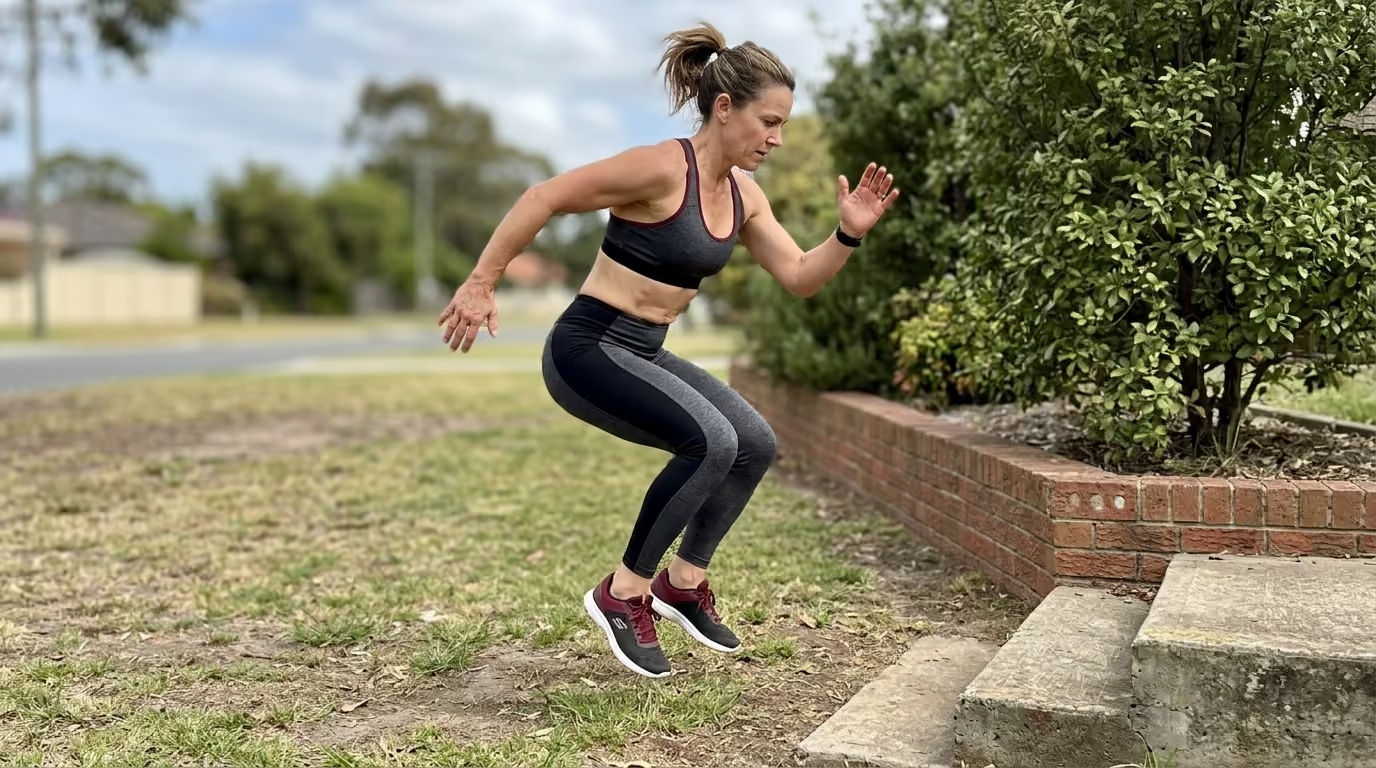
Jumping involves taking off and landing on both feet simultaneously. It distributes ground reaction forces evenly across both legs, making it the safest starting point for vertical power development. Common variations include squat jumps, countermovement jumps, and low box jumps.
When using box jumps, the primary purpose is reducing landing stress. Jumping onto a stable, low platform reduces the downward deceleration force on your knees and hips. However, you should always step down carefully rather than jumping backward off the box. Box height should challenge your hip extension, not force you into deep, compromised spinal flexion upon landing.
Hopping involves taking off and landing on the same single leg. This pattern increases the peak ground reaction force on the active limb and places high demands on the calf, Achilles tendon, and foot complex. Examples include single-leg ankle hops, lateral line hops, and low mini-hurdle hops.
Because hopping exposes muscular imbalances between limbs, it is invaluable for rotational athletes and runners. However, single-leg impacts place concentrated loads on connective tissue. A structured base of bilateral jumping and unilateral strength must always precede extensive hopping protocols.
Bounding represents an exaggerated, powerful running stride where the athlete projects their body forward and upward from one leg to the other. Alternating bounds, power skips, and lateral speed bounds fall under this category. Bounding combines high horizontal velocity with rapid deceleration upon ground contact.
Due to the complex interaction of speed, momentum, and unilateral landing, bounding represents an advanced plyometric category. It requires excellent hip stability, core control, and robust calf tolerance. Adults over 40 should only introduce bounding after demonstrating flawless mechanics in static jumping and linear hopping.
Medicine ball throws provide an outstanding method for training upper body and rotational power without lower-limb landing impact. Exercises such as overhead backwards throws, chest passes, and rotational scoop tosses train the stretch-shortening cycle through the trunk, shoulders, and hips.
A lighter ball between two and four kilograms permits high movement velocity, which is ideal for neurological speed development. A heavier ball shifts the focus toward force production. Rotational throws are particularly beneficial for golfers, tennis players, and skiers who rely on rapid kinetic energy transfer through the core.
Low-impact drills develop neurological speed and rhythm without subjecting the joints to high ground reaction forces. Examples include fast line taps, low-amplitude pogo jumps, rapid calf pulses, and band-assisted jumps.
In band-assisted jumps, an overhead resistance band supports a portion of your body weight. This reduces impact upon landing while allowing your nervous system to experience rapid eccentric-to-concentric transitions. Research in older adults shows that body-mass-supported power training significantly improves sit-to-stand speed and stair-climb performance without joint irritation.
Before adding explosive movements to your routine, you must establish an honest baseline of movement quality and tissue tolerance. Chronological age is an unreliable indicator of physical capacity. A well-conditioned 55-year-old may tolerate moderate jumping easily, while a sedentary 42-year-old may require several weeks of foundational preparation.
A safe self-assessment begins with basic mobility and lower-body stability. You should be able to perform twenty controlled bodyweight squats to parallel without knee discomfort or balance loss. You should also demonstrate thirty seconds of stable single-leg balance on each foot with eyes open.
Next, assess your calf and Achilles complex. Perform twenty continuous single-leg calf raises on a flat surface through a full range of motion. If your calf fatigues or aches prematurely, your lower leg lacks the baseline capacity needed for repeated elastic impacts.
Finally, evaluate your landing mechanics using a simple snap-down drill. Stand on your toes with arms overhead, then rapidly drop into a quarter-squat position while driving your arms down and sticking the landing. Your landing should be virtually silent, with your knees tracking over your midfoot and your torso remaining upright and braced.
Certain situations require medical clearance or tailored physical therapy before beginning plyometrics. If you have active knee osteoarthritis, a history of Achilles tendinopathy, recent joint surgery, or diagnosed osteoporosis, seek professional guidance. Power training can often be adapted for these conditions using low-impact or water-supported drills, but unmanaged impact can aggravate existing joint pathology.
A safe plyometric progression follows a strict biological timeline. Connective tissues adapt more slowly than muscular and nervous systems. By progressing from force absorption to elasticity, propulsion, and reactive speed, you allow tendons and bones to remodel without inflammatory setbacks.
The first stage builds structural landing mechanics. Before you generate height, you must prove you can absorb ground contact forces quietly and evenly. The body learns to distribute kinetic energy through the hips, knees, and ankles simultaneously.
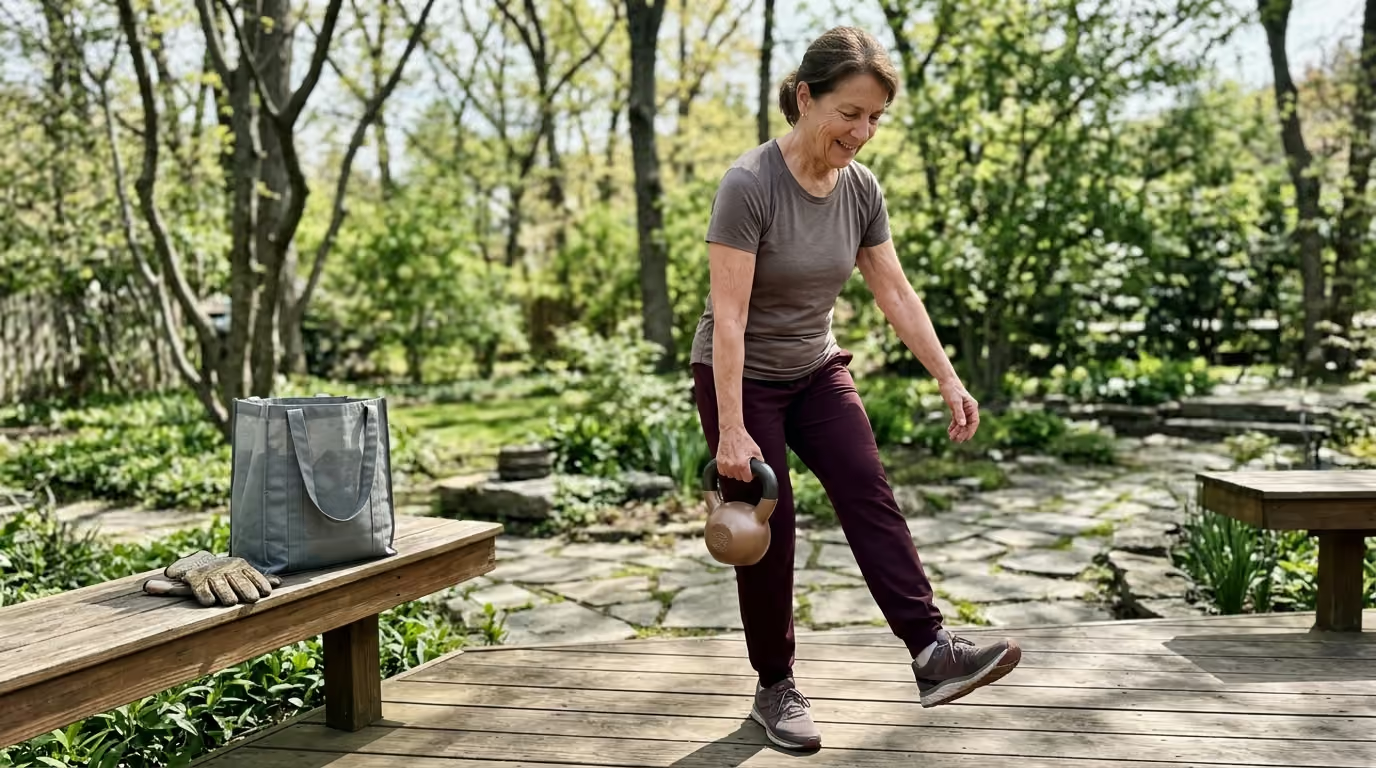
Begin with double-leg snap-downs and low step-offs. Stand on a two-inch platform, step forward without jumping, and catch your bodyweight in a balanced athletic position. Hold the landing for two full seconds before resetting. Perform two sets of five repetitions twice weekly for three weeks.
Once landing positions are stable, you can introduce low-amplitude elastic recoil. This stage trains the Achilles tendon and plantar fascia to act as resilient springs while keeping joint displacement minimal.
Utilize bilateral ankle pogos, low line jumps, and rapid calf pops. The movement should come primarily from the ankles, keeping the knees slightly soft and unlocking rapid, rhythmic ground contacts. Perform three sets of ten to fifteen contacts with full recovery between sets. Focus entirely on staying light on your feet.
Stage three introduces true explosive force production. Here, you maximize vertical or horizontal propulsion while maintaining the sound landing mechanics developed in earlier phases.
Implement countermovement jumps, squat jumps, and forward broad jumps to a stick landing. In a broad jump to stick, jump forward for moderate distance and focus on absorbing the landing instantly without taking extra adjustment steps. Keep the volume low, using three to four sets of three to five maximal efforts.
Real-world athletic movement rarely happens in a single straight line on two feet. Stage four develops single-leg force production and side-to-side stability.
Introduce lateral skater hops, single-leg box step-ups with explosive drive, and forward mini-hurdle hops. In skater hops, bound laterally from your right foot to your left foot, holding the landing on the left leg for two seconds before bounding back. This exercise builds exceptional dynamic stability for skiing and trail running.
The final stage introduces rapid, unpredictable stimuli to simulate sport conditions. Here, ground contact times are minimized, and movements respond to external cues rather than self-selected timing.
Examples include reactive line hops guided by a partner, rapid hurdle hops with continuous bounce, and medicine ball drop-and-catch drills. This stage fine-tunes motor coordination and sharpens reactive balance during high-velocity movements. Maintain strict stopping rules to ensure fatigue never compromises movement quality.
Structuring a plyometric program requires a different mindset than traditional hypertrophy or endurance training. Plyometrics is an expression of neurological quality, not metabolic exhaustion. Every repetition must be executed with crisp intent, high velocity, and pristine mechanics.
In plyometric training, mechanical volume is calculated by counting total foot contacts with the ground. This provides an accurate measure of cumulative impact stress on connective tissue.
For adults over 40 starting power training, an introductory session should total between twenty and forty ground contacts. As your tissue tolerance improves over several months, a moderate training volume settles between sixty and eighty contacts per session. Elite athletic guidelines sometimes reference 100 to 120 contacts, but such volumes are rarely necessary for health and recreational performance.
Tendon collagen synthesis and neurological recovery require significant time following high-velocity loading. Mature connective tissue benefits from extended rest periods to prevent microtrauma accumulation.
One to two plyometric sessions per week is the ideal frequency for most active adults. Schedule at least 48 to 72 hours of recovery between explosive lower-body workouts. You can seamlessly integrate these drills into your existing routine by placing them immediately after your dynamic warm-up and before heavy lifting. You can learn more about balancing workouts in our performance and fitness section.
Rest between individual sets must be generous. Take 60 to 90 seconds of rest between short jumping sets, and up to two full minutes between maximal bounding or reactive drills. If you feel winded or your landing becomes noticeably louder, your rest period was too short.
The surface you train on plays an important role in load management. Hard concrete provides zero shock absorption, increasing stress on joint cartilage. Conversely, overly soft surfaces like thick gymnastics mats absorb too much elastic energy, increasing ground contact time and blunting the stretch-shortening cycle.
Ideal training surfaces include sprung wooden gym floors, firm natural turf, compact dirt trails, or dense rubber gym flooring. Wear supportive athletic shoes with a secure heel counter and moderate cushioning. Avoid training in worn-out footwear or minimalist shoes until your foot musculature has adapted to dynamic loading.
To see how these principles apply across varied backgrounds, consider how power training can be customized for specific athletic goals and injury histories.
This individual has ten years of consistent barbell training experience. They possess strong back squats and deadlifts, but feel sluggish when playing recreational pickleball.
Their primary need is developing movement velocity rather than force capacity. Their program emphasizes lightweight jump squats at thirty percent of their one-rep max, low pogo hops, and rotational medicine ball throws. Over eight weeks, this shifts their nervous system toward rapid motor unit recruitment, directly improving their court agility.
This individual played collegiate soccer thirty years ago. They have good athletic memories and natural coordination, but have spent the last decade working a desk job.
Their primary danger is a mismatch between their brain's memory of athletic capability and their current tendon tolerance. Starting with advanced drills could cause an Achilles strain. Their program begins strictly in Stage 1 and Stage 2, spending six weeks on snap-downs, low line hops, and eccentric calf strengthening before any maximal jumping is permitted.
This individual wants to preserve independence, maintain bone density, and improve balance for mountain hiking. They have mild knee stiffness and avoid high-impact jumping.
Their program utilizes low-impact, high-reward drills. They perform explosive chair sit-to-stands, band-assisted jumps to reduce landing impact, and medicine ball chest passes. This stimulus builds functional power, improves stair-climbing speed, and reinforces bone mineral density without causing joint irritation.
This individual runs twenty miles per week and experiences recurrent calf tightness after hill workouts. They want to use plyometrics to improve running economy.
Running already imposes thousands of low-level impacts per week. Adding high-volume jumping would overload their calves. Their program uses low-volume, high-quality ankle stiffness drills, limited to thirty total contacts twice a week, performed on non-running days. They monitor morning tendon stiffness closely to ensure complete tissue recovery.
The true value of plyometric training becomes apparent when you take your fitness into demanding outdoor environments. Dynamic outdoor sports require constant, reactive force adjustments that traditional gym machines simply cannot replicate.
Consider downhill skiing in the Alps or Rockies. Skiing over variable snow and moguls requires continuous, high-velocity eccentric force absorption. Every time your skis hit a compression, your quadriceps and glutes must lengthen under load while keeping your torso stable. Without power training, your legs fatigue quickly, leading to poor edge control and increased injury risk.
Similarly, navigating technical singletrack trails requires rapid lateral stability and continuous micro-adjustments. When you descend a rocky path, your foot makes contact with angled rocks for only a fraction of a second. A well-trained stretch-shortening cycle allows your ankles and hips to react instantaneously, stabilizing your center of mass before an ankle roll can occur.
Power training provides the dynamic braking capacity required for these adventures. By conditioning your neuromuscular system to absorb sudden decelerations, you build an internal reserve of joint protection. This physical resilience allows you to explore demanding terrain with complete confidence. For those interested in optimizing travel capability, our travel and adventure articles offer further insights.
Despite the extensive research supporting power training for mature adults, several pervasive myths continue to circulate in fitness culture.
Social media often portrays plyometrics as jumping onto waist-high platforms. In reality, landing on an excessively high box forces the hips and spine into extreme flexion, creating joint strain while offering little power benefit. True power training is about takeoff velocity and landing control, not landing in a contorted squat atop a fragile box.
Some conventional fitness advice suggests that anyone over 40 should stick exclusively to low-impact, slow-tempo exercises. However, completely avoiding impact accelerates the loss of fast-twitch muscle fibers and reduces bone loading signals. When progressed responsibly, jumping is not only safe for mature adults, but essential for long-term functional vitality.
An outdated guideline states that your knees should never translate forward past your toes when landing from a jump. In dynamic human movement, forward knee translation is natural and necessary to distribute force evenly across the ankle, knee, and hip joints. The focus should be on overall balance, quiet contact, and preventing the knees from collapsing inward toward each other.
Treating plyometrics as cardiovascular conditioning destroys power output. When fatigue sets in, movement speed drops, ground contact times lengthen, and form breaks down. Performing thirty continuous box jumps in a state of exhaustion trains your nervous system to move slowly and increases injury risk. Keep repetitions low and rest intervals long.
While landing quietly is an excellent cue for reducing impact forces, sound alone does not tell the whole story. An athlete can land silently while still displaying excessive knee valgus, spinal twisting, or uneven weight distribution. Visual alignment and stable posture are just as important as auditory feedback.
Maintaining physical power becomes particularly challenging during periods of heavy international travel. Long flights, disrupted sleep, and unfamiliar hotel facilities can leave your nervous system feeling sluggish and disconnected.
In our experience, travel fatigue degrades fast-twitch motor unit recruitment long before it affects basic endurance. After a grueling thirty hour transit to Tokyo, I realized my old strategy of just powering through was no longer working. I felt foggy for three days, and my athletic responsiveness vanished. I started digging into circadian biology and realized that timing my light exposure and fasting during the flight could completely shift my recovery. Now, I never board a long haul flight without a precise schedule for when to eat and when to put on an eye mask. It is the difference between losing a week of your trip and hitting the ground running.
When you arrive at your destination, a concise, low-volume power routine can quickly restore neuromuscular readiness. You do not need a commercial gym or specialized equipment to maintain your reactive elasticity while on the road.
A simple hotel room routine can be completed in less than ten minutes. Begin with a light mobility warm-up to open the hips and ankles after hours of seated travel. Follow this with three sets of five rapid snap-downs to activate your core and landing mechanics. Next, perform two sets of ten low-amplitude line hops using a seam in the carpet, focusing on rhythm and crisp ground contacts. Finish with five explosive bodyweight jump squats onto a firm rug, resting one minute between efforts.
This brief session delivers an effective neurological stimulus without generating systemic fatigue. It keeps your connective tissues conditioned and your nervous system primed for whatever adventures your itinerary holds. To discover more about physical restoration during transit, visit our recovery and sleep resources or check out the broader WealthAtPlay educational library.
The effectiveness and safety of plyometric training for mature populations is well documented across exercise science and sports medicine literature. Systematic reviews consistently show that explosive resistance and jump training produce significant improvements in functional performance.
A comprehensive systematic review led by Vetrovsky and colleagues examined the safety and efficacy of lower-limb plyometric training in older adults. The researchers concluded that structured, supervised plyometric exercise is safe and leads to significant gains in muscle strength, jump height, physical performance, and dynamic postural stability. The review noted that properly managed impact loading also provides positive osteogenic signals for bone health.
Position statements from the National Strength and Conditioning Association emphasize that power training is a vital component of physical conditioning for older adults. The NSCA recommends incorporating high-velocity concentric movements using moderate loads, typically between forty and sixty percent of one-rep max. The guidelines specifically advise stopping sets well short of fatigue to preserve movement speed and force quality.
Additional clinical studies have evaluated modified power training in clinical and recreational settings. Research on body-mass-supported treadmill plyometrics demonstrated substantial improvements in stair-climb power and chair sit-to-stand speed over eight weeks. These findings confirm that unloading a portion of body weight allows individuals to train the neuromuscular components of power while minimizing joint impact stress.
Across the scientific literature, a clear consensus emerges. Power is a trainable quality throughout the entire human lifespan. When designed around sound biomechanics, conservative volume management, and progressive loading, plyometric training is one of the most effective tools available for preserving dynamic capability and lifelong physical freedom.
Revisit this guide at the start of every new training season, when preparing for demanding mountain adventures, or when returning to exercise after an extended layoff. Use the assessment battery periodically to ensure your landing mechanics, ankle stiffness, and reactive balance remain sharp and resilient.
By prioritizing quality over volume and mastering force absorption before chasing height, you build a powerful, athletic body that remains capable across every decade of life.
Stay connected for research and practical guidance on longevity, strength, recovery, energy and active living. New ideas to help you stay capable, curious and ready for more.


Explore practical guidance on strength, recovery, energy, travel and longevity for a life that stays active.
explore the Blog