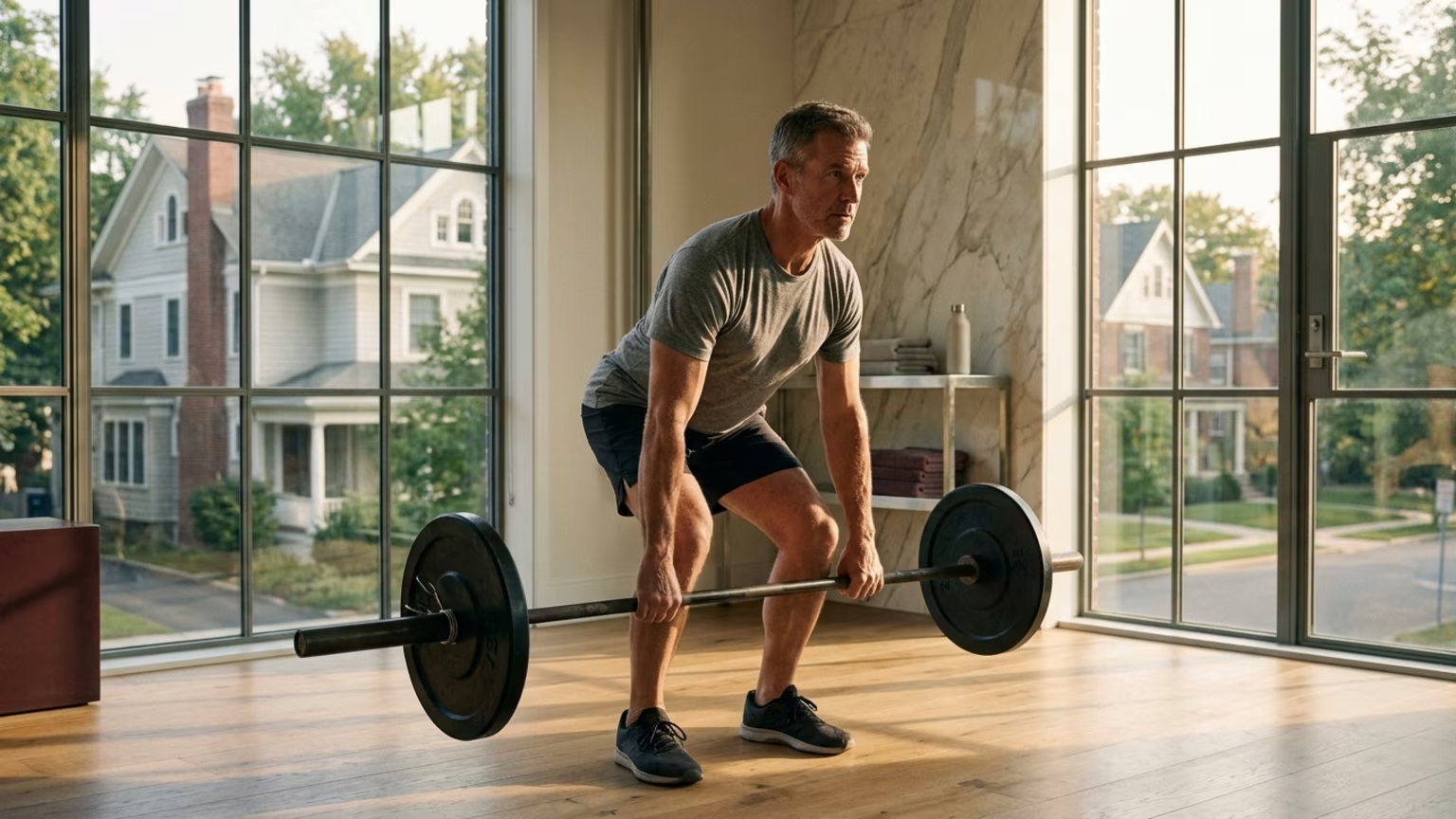

A September 2026 meta-analysis shows concurrent training improves aerobic capacity. Learn how a classic barbell complex efficiently supports active travel.





On September 28, 2026, Men's Journal reported on a September 2026 meta-analysis examining how concurrent training affects physical capacity. The research evaluated the combination of resistance and endurance exercise in single sessions. Findings suggest that combining both modes produces improvements in VO2 max and skeletal-muscle mitochondrial adaptations similarly to endurance training alone. For active adults over forty, this research addresses a longstanding question about managing limited time. We want to preserve cardiovascular health and maintain functional strength for lifelong independence. The reported data indicates that mixing these training modes does not automatically compromise endurance gains. This means we can efficiently build physical resilience without spending countless hours in a gym. You can challenge your heart and your muscles simultaneously.
Doing so creates a robust physical foundation that supports demanding travel, outdoor sports, and everyday activity. Many older adults worry that adding heavy weights will reduce their cardiovascular fitness over time. Conversely, some fear that too much cardiovascular work will slowly erode their hard-earned muscle mass. The September 2026 findings help alleviate these common concerns by highlighting the synergistic potential of concurrent training.
The core concept of concurrent training is highly practical for busy adults. It blends strength movements with cardiovascular demands to create a highly efficient physical stimulus. According to Men's Journal, a meta-analysis in Sports Medicine found that this combined approach generally did not compromise whole-muscle hypertrophy. The same review noted that maximal strength was also preserved despite some nuances at the muscle-fiber level.
The overall takeaway is highly reassuring for anyone seeking balanced fitness. You do not have to choose between keeping your muscles strong and keeping your heart efficient. The biological mechanism centers on how our bodies adapt to overlapping physical stress. Men's Journal notes that combining resistance and endurance work produces cellular adaptations matching dedicated aerobic training.
Specifically, this training method improves the efficiency of your skeletal-muscle mitochondria. Mitochondria are the energy centers of your cells. Their operational efficiency largely dictates your physical endurance during demanding activities. Better mitochondrial function translates to better energy production during sustained physical effort.
This makes concurrent training a highly practical tool for maintaining baseline capabilities as we age. When your cells process energy efficiently, every physical task becomes inherently less taxing. You gain a wider buffer against everyday fatigue. Circuit-style resistance training offers a related path to these valuable aerobic benefits.
The Men's Journal publication cites a systematic review of 45 studies focusing specifically on resistance-circuit training. This extensive review found an average VO2 max increase of 6.3 percent across the analyzed studies. VO2 max measures the maximum amount of oxygen your body can utilize during intense exercise. Participants in these studies also experienced measurable improvements in muscle mass, overall strength, and cardiorespiratory fitness.
These figures suggest that continuous, varied movement patterns provide a robust stimulus for the cardiovascular system. However, it is vital to apply these findings with precision and realistic expectations. Men's Journal explicitly states that barbell complexes and combined workouts should not replace dedicated cardio. Furthermore, these mixed sessions are not a complete substitute for targeted, heavy strength work.
Instead, they serve as an efficient bridge to maintain broad physical competence when time is limited. When you integrate concurrent methods correctly, you reinforce a foundation of health that supports an active lifestyle. If you ever struggle with fatigue after these sessions, learning to read post-workout soreness or injury signals is essential for long-term progress.
The history of combining these training modes predates many modern fitness trends by decades. Men's Journal traces a popular barbell-complex method back to weightlifting coach Istvan "Steve" Javorek in 1967. Javorek originally designed his sequence as a time-saving way to enhance athletic performance and make training more enjoyable. His original complex featured a consecutive series of eight specific barbell movements.
This intense sequence included deadlifts, hang cleans, front squats, and hang snatches. It then moved immediately into overhead squats, presses, rows, and Romanian deadlifts. Moving continuously through these compound exercises places massive demands on the cardiovascular system while simultaneously loading the muscles. Executing a continuous sequence like this requires careful attention to form and personal safety.
Strength coach Doug Briggs, PhD, offered highly practical guidance in the Men's Journal report. He cautions that exercise technique matters above all else when attempting a loaded complex. As Briggs points out, "There are no bad exercises, only bad exercise techniques." This perspective is crucial for active adults who want to train consistently without risking physical setbacks.
Proper form ensures that the targeted muscles do the work while protecting your joints from unnecessary stress. Selecting the right weight is the single most important variable in a barbell complex. Briggs advises choosing a load based entirely on your weakest movement in the entire sequence. If your overhead press is lighter than your deadlift, you must use the press weight for the entire circuit.
This conservative approach prevents you from struggling dangerously during the weaker portions of the workout. Briggs also notes that complexes can produce muscle hypertrophy, with the chosen weight acting as a determining factor for muscle growth. Fatigue management is another essential component of this demanding training style. The Men's Journal article explicitly warns against turning every complex into an all-out exhaustion test.
Experts recommend starting conservatively and always stopping a round before fatigue degrades your technique. Prioritizing movement quality over sheer repetition volume ensures that you build capability rather than risking unnecessary strain. Pushing past technical failure offers rapidly diminishing returns for your physical fitness. Instead, you should focus on executing each repetition with absolute control and precision.
Maintaining simultaneous strength and aerobic capacity fundamentally changes how you experience demanding travel schedules. After a grueling thirty hour transit to Tokyo, I realized my old strategy of just powering through was no longer working. I felt foggy for three days. I started digging into circadian biology and realized that timing my light exposure and fasting during the flight could completely shift my recovery.
Now, I never board a long haul flight without a precise schedule for when to eat and when to put on an eye mask. It is the difference between losing a week of your trip and hitting the ground running. When you optimize your sleep schedule, a highly capable physical baseline allows you to maximize your recovered energy. Concurrent training perfectly prepares your body for the unpredictable physical demands of international travel.
Whether you are navigating massive airport terminals or adjusting to sudden altitude changes, your body relies on mitochondrial efficiency. The adaptations noted in the September 2026 meta-analysis directly support sustained energy output in these varied environments. You can easily manage heavy luggage and long walking tours without feeling physically depleted. When traveling, you can even maintain this stamina by utilizing hotel room fitness workouts that blend resistance and aerobic challenges.
This physical readiness is equally critical for demanding outdoor sports like skiing and mountain hiking. A long day on the mountain requires explosive leg strength for sharp turns and high aerobic capacity to recover quickly. By incorporating barbell complexes or resistance circuits at home, you effectively mimic the mixed physical demands of these outdoor sports. You build the specific stamina required to enjoy the final run of the day just as much as the first.
This enduring physical capacity allows you to engage fully with your natural surroundings rather than focusing on your own fatigue. Efficient training methods also leave you with more precious time to actually enjoy your life. If you can maintain both strength and cardiovascular fitness with strategic concurrent sessions, your weekly schedule opens up. You spend far less time isolated in a gym and more time applying your physical capability in the real world.
This balanced, practical approach is the true value of adapting historical fitness protocols for modern lifestyles. The ultimate goal is always to enhance your experiences outside the gym walls. Furthermore, concurrent training helps you adapt smoothly to different climates and unexpected physical stressors. Improved skeletal-muscle mitochondrial adaptations mean your body utilizes oxygen more effectively during sustained exertion.
This metabolic efficiency is a massive advantage when hiking at high elevations or visiting challenging, humid environments. Your heart and lungs simply do not have to work as hard to sustain a moderate, steady walking pace. Consequently, you feel significantly more reassured and optimistic about taking on ambitious travel itineraries later in life. Proper recovery remains crucial, making full day protocols highly beneficial for active travelers.
Active adults should view concurrent training complexes as an efficient tool to combine movement demands, not as a complete replacement for targeted strength and cardiovascular programming.
Stay connected for research and practical guidance on longevity, strength, recovery, energy and active living. New ideas to help you stay capable, curious and ready for more.



Explore practical guidance on strength, recovery, energy, travel and longevity for a life that stays active.
explore the Blog