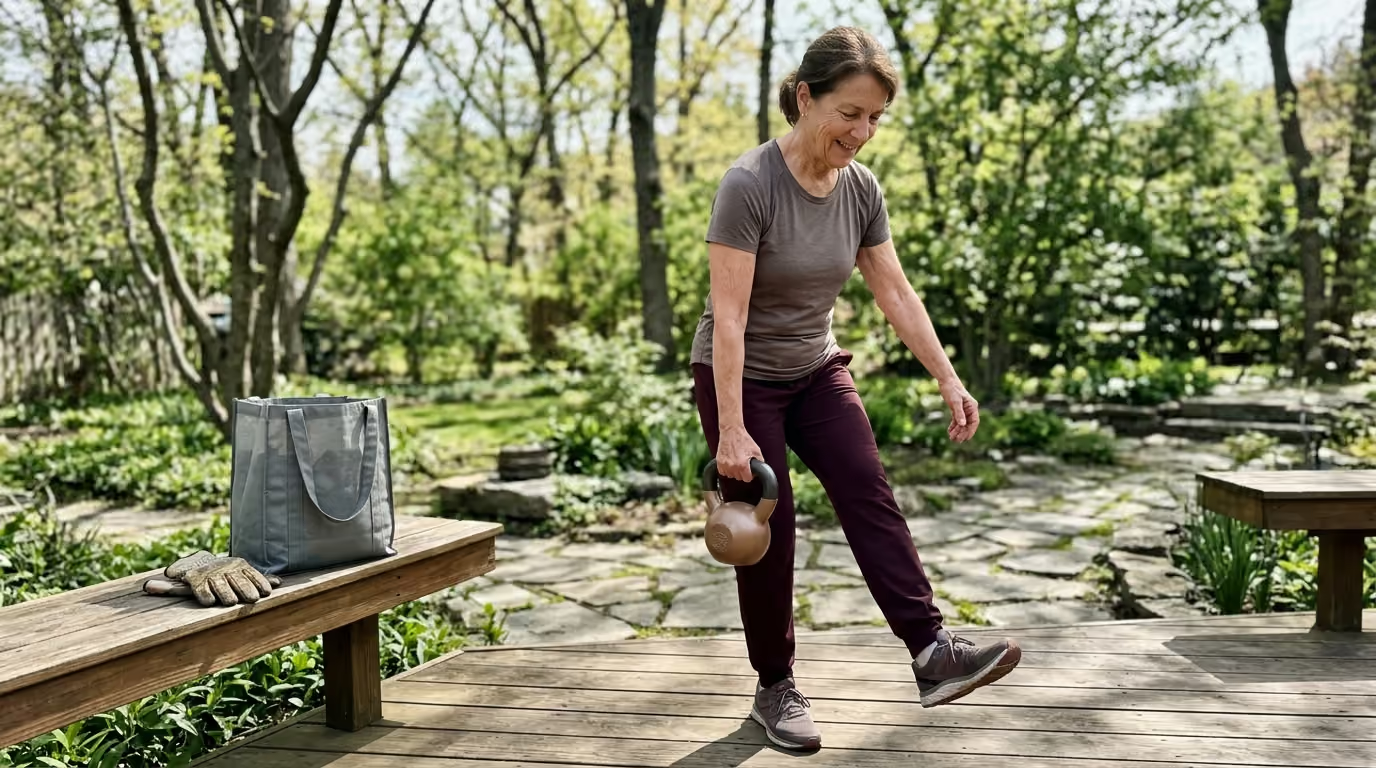

Cardiovascular fitness seems like the key to staying active, but building functional strength provides the true physical reserve needed for lifelong independence.





Most people believe that physical decline in later decades begins with joint stiffness or low stamina. In reality, the loss of independence begins quietly when the force required for daily life approaches your maximum physical limit. Lifting a heavy suitcase, stepping off a high curb, or getting up from the living room floor should never require ninety percent of your maximum strength. When common tasks demand near-maximal output, even a slight misstep or sudden fatigue can lead to injury or immobility. Building a deep reservoir of functional strength is the most reliable way to protect your freedom, your active lifestyle, and your capacity for adventure.
Physical autonomy is fundamentally an engineering problem of reserve capacity. In our work with healthy aging and living well, we define physical capacity as what you can produce under controlled testing conditions. Performance is what you actually do in your daily life. Capability reserve represents the protective margin between the demands of your environment and your absolute maximum ability.
When your capability reserve shrinks, ordinary tasks become risky. If standing up from a low sofa requires eighty percent of your leg strength, you will naturally avoid low seating. If carrying a travel bag down a flight of stairs demands your peak balance and grip capacity, you become vulnerable to a catastrophic fall. Maintaining a wide gap between what you can do and what daily life requires is the cornerstone of enduring physical autonomy.
According to data from the Centers for Disease Control and Prevention, more than fourteen million adults aged sixty-five and older report falling each year. That equates to roughly one in four older adults across the United States. About thirty-seven percent of those who fall experience an injury that requires medical treatment or restricts their activity for at least one full day. Furthermore, falls account for approximately three million emergency department visits and over one million hospitalizations annually.
These incidents rarely happen because someone lacked general cardiovascular fitness. They happen because of a sudden failure in balance, muscular power, joint braking capacity, or physical reserve. Progressive resistance training changes this trajectory by systematically expanding your physical safety margin.
To build functional capacity, we must target several distinct strength qualities:
True functional training prepares your body for the physical demands of independent living. Rather than performing arbitrary gym exercises, your training should target five fundamental movement challenges.
Rising from the floor tests your full-body integration. It requires deep knee and hip flexion, ankle mobility, core stiffness, dynamic balance, and pushing strength through your arms. It also demands rotational coordination as you transition through multiple planes of movement.
Researchers studying musculoskeletal fitness in adults aged fifty-one to eighty observed that floor-rise performance serves as a powerful indicator of physical reserve. In studies evaluating the sit-and-rise test, each one-point increase in the sitting-rising score was associated with a twenty-one percent improvement in survival after adjusting for age, sex, and body mass index. This test does not mean that the movement itself extends life directly. Rather, it serves as a practical window into overall musculoskeletal integrity, mobility, and functional reserve.
Getting up from the floor is a complex motor skill that changes based on joint health and body mechanics. A robust floor-rise strategy might involve transitioning to a half-kneeling position, using a hand on the lead thigh, or pivoting smoothly through a seated side-plank position. The goal is having multiple reliable pathways to stand up safely without panic or excessive strain.
Stair navigation is one of the most demanding bilateral and unilateral activities you encounter daily. Climbing stairs requires substantial relative lower-body strength, single-leg hip extension power, and cardiovascular support. However, descending stairs places an even greater demand on your eccentric braking capacity.
When you step down, your quadriceps and calf complex must absorb up to three times your body weight while lengthening. If your eccentric control is compromised, your body drops heavily onto the lower step, placing extreme stress on the knee joint and threatening your balance. Research shows that progressive resistance training systematically improves stair climbing speed, balance, and single-leg stability in aging adults. Training must address both the upward push and the controlled downward step.
Real life rarely presents us with balanced, perfectly knurled barbells. Daily life requires carrying luggage through train stations, moving heavy grocery bags from the car, or hauling gear across uneven ground. Carrying is an active gait assessment under load.
Loaded carries demand high grip strength, rotator cuff engagement, scapular stabilization, lateral hip control, and intense isometric core bracing. When you carry a heavy load on one side, your opposite obliques and hip abductors must fire continuously to prevent your torso from tilting. If these stabilizing muscles fatigue, your gait breaks down, your spine compensates, and your risk of tripping increases dramatically. Building dedicated carry capacity preserves your walking mechanics under load.
Storing a carry-on bag in an airplane overhead bin or lifting heavy cookware onto a high shelf requires whole-body coordination. Overhead placement demands upward scapular rotation, thoracic spine extension, shoulder mobility, and strong rotator cuff stabilization. It also relies on a stable lower body to transfer force upward from the floor through your core.
Many adults lose the ability to place objects overhead because of stiff thoracic spines, weak shoulder stabilizers, or fear of shoulder impingement. Training the overhead pattern through progressive, joint-friendly variations restores the functional range of motion needed for daily household and travel tasks. It ensures that lifting an awkward box onto a top shelf remains a simple task rather than an injury risk.
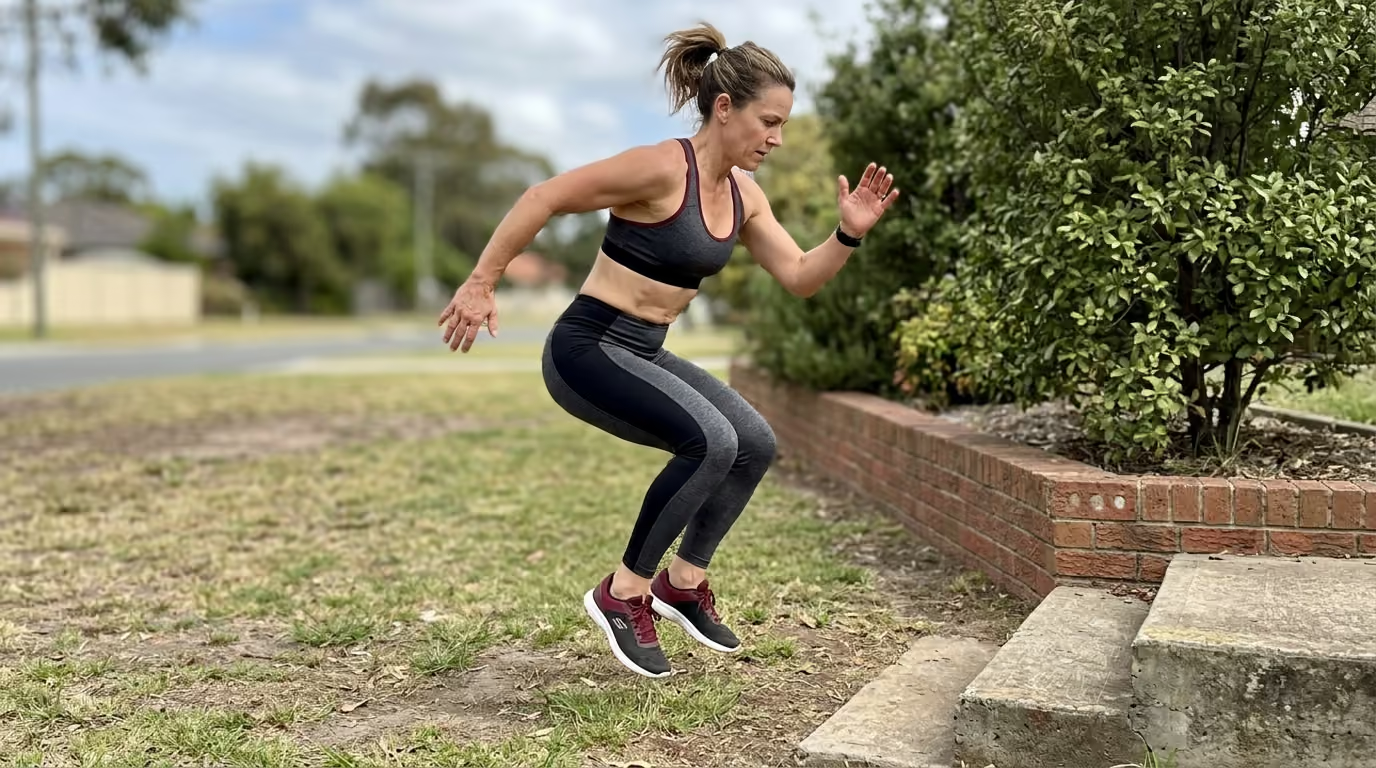
When you catch your foot on an uneven cobblestone or slip on a slick floor, maximal strength alone cannot save you. Preventing a fall requires rapid force production, known as muscular power. You must detect the perturbation, swing your recovery leg forward instantly, and plant your foot with sufficient braking force to arrest your momentum.
A meta-analysis published in physical therapy research examined twelve studies involving 478 older adults and concluded that power training produced superior improvements in fall-risk functional capacity compared to traditional slow resistance exercise. If your nervous system cannot recruit muscle fibers within milliseconds, high maximal strength cannot prevent a fall. Training for independence must include rapid, controlled force production alongside traditional strength training.
To build an effective strength and physical performance routine, you must first establish an accurate baseline. Objective assessments remove guesswork and help you identify specific weak links in your physical reserve.
The European Working Group on Sarcopenia in Older People established standardized reference cutoffs to identify low physical performance. These thresholds serve as useful warning signs that your capability reserve needs immediate attention:
These numbers are screening markers rather than absolute limits on your potential. Falling below these metrics simply indicates that your muscular reserve has eroded to a level where everyday tasks become difficult.
You can track your functional capacity at home using simple, standardized field tests:
Standardize your testing setup carefully. Use the same chair height, wear the same footwear, and perform the tests at the same time of day. Track your trends over months rather than obsessing over day-to-day fluctuations.
Building functional capacity requires clear thinking and evidence-based training methods. Unfortunately, the fitness world is filled with myths that steer active adults toward ineffective or dangerous routines.
Walking is wonderful for cardiovascular health, mental clarity, and metabolic function. However, global fall prevention guidelines emphasize that walking alone is insufficient to prevent physical decline or falls.
Walking does not provide the progressive overload required to maintain fast-twitch muscle fibers, build bone mineral density, or enhance rapid braking strength. To preserve your independence, you must supplement your walking routine with structured resistance and balance training.
Many adults over forty are told to lift weights only in a slow, continuous tempo. While slow eccentrics build tendon health and muscular control, training exclusively at slow speeds ignores your fast-twitch motor units.
When you stumble, your muscles must contract in a fraction of a second to catch your falling mass. Incorporating controlled, intentional speed into the lifting phase of your exercises trains your nervous system to fire rapidly when life demands it.
A common fitness dogma claims that machine-based training is non-functional because it stabilizes the load for you. However, a systematic review and meta-analysis of machine-based resistance training in older adults, examining seventeen studies and 614 participants, revealed significant improvements in both absolute strength and real-world functional performance.
Machines allow you to safely apply progressive overload to large muscle groups without being limited by balance or joint pain. A balanced training plan combines machine stability with free-weight and bodyweight movement patterns.
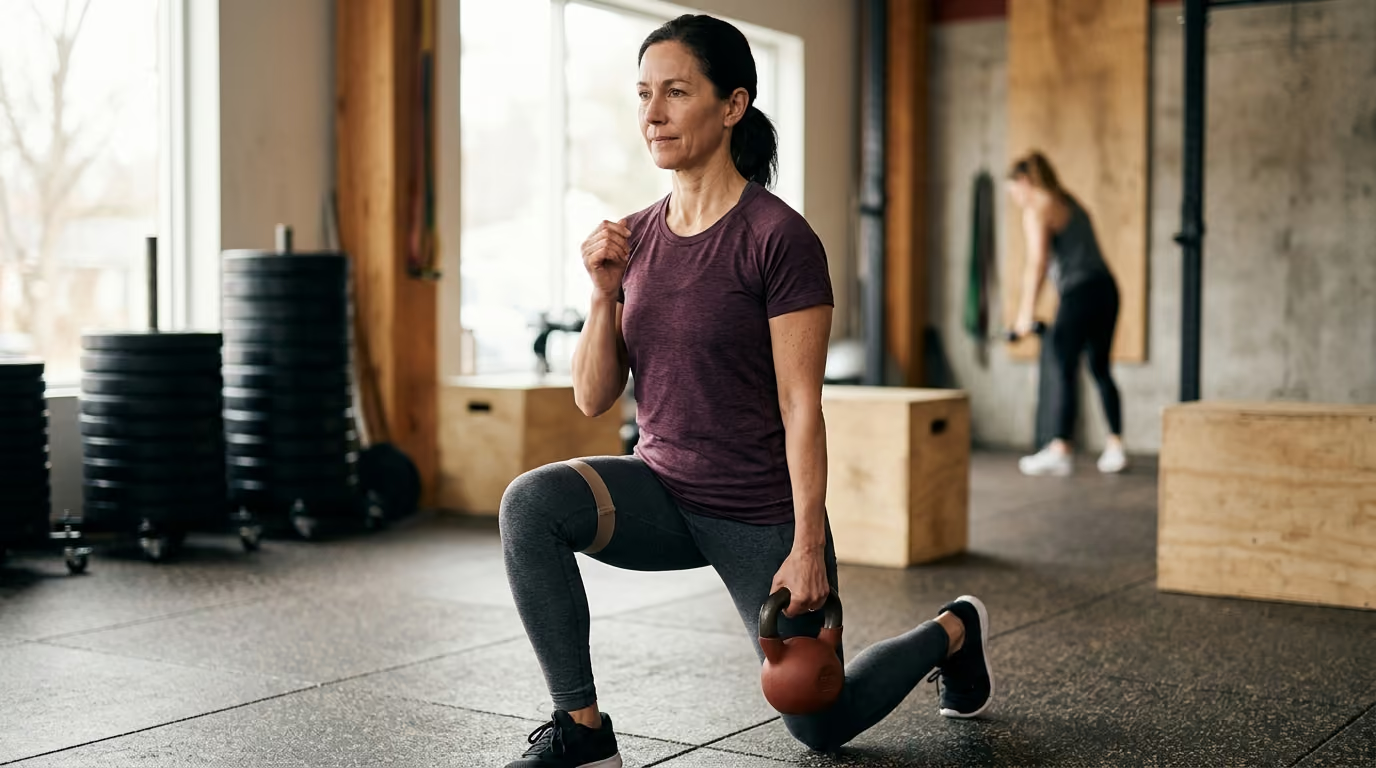
Standard gym routines often consist entirely of forward and backward movements on two legs, such as bilateral leg presses, bicep curls, and bench presses. Real life happens across multiple planes and often on one leg at a time.
If you never train lateral lunges, rotational core bracing, or offset carries, your body remains unprepared for sudden lateral slips or twisting loads. Real-world capability requires multi-directional strength.
You do not need to spend hours in the gym every day to achieve exceptional functional strength. The World Health Organization recommends muscle-strengthening activities involving all major muscle groups at least two days per week. For older adults, they also recommend multicomponent physical activity that emphasizes functional balance and strength on three or more days per week.
To build maximal strength and muscular reserve, work within a range of fifty to eighty percent of your one-repetition maximum for two to three sets of six to ten repetitions. To develop muscular power, perform concentric movements with light to moderate loads, around thirty to sixty percent of your maximum, focusing on explosive intent while maintaining a controlled eccentric lowering phase.
A high-yield weekly structure fits easily into a busy schedule:
For optimal recovery between sessions, explore our dedicated guides covering recovery and sleep strategies to support tissue repair and maintain your energy levels.
The following training templates translate these principles into practical routines. Choose the level that matches your current baseline and progress gradually over several months.
Perform this full-body routine two non-consecutive days per week. It develops fundamental joint control, core stiffness, and functional strength.
Perform this program two to three days per week once you have mastered the foundational movements. It integrates rapid force production, unilateral loading, and overhead placement.
If getting down to and up from the floor feels intimidating, use this staged roadmap. Progress to the next step only when you can complete the current movement comfortably and without joint pain.
Review our library of healthy aging and performance resources to find additional exercise breakdowns and progression strategies.
Building functional strength must be tailored to your unique medical and joint profile. Modifying your training ensures steady progress without aggravating underlying conditions.
Osteoarthritis does not mean you must avoid resistance training. Cartilage and joint structures thrive on controlled, progressive loading. However, you should modify movement depth to stay within a pain-free range of motion.
If deep squats aggravate your knees, switch to box squats at a height that feels comfortable. Emphasize isometric holds and slow eccentric movements, which build muscular strength around the joint while keeping joint irritation to a minimum.
If you have osteoporosis or low bone mass, progressive resistance training is essential for preserving bone mineral density. However, you must prioritize spinal alignment.
Avoid combining deep spinal flexion with rapid twisting, such as weighted sit-ups or aggressive rotational machine work. Focus instead on neutral-spine lifts like Romanian deadlifts, goblet squats, loaded carries, and supported row variations. These exercises stimulate bone remodeling through your hips and spine without exposing vertebrae to shear stress.
Peripheral neuropathy, vestibular disorders, or changes in vision can impair balance independently of your muscular strength. When sensory feedback from your feet is reduced, you must rely more heavily on your visual and vestibular systems.
Perform balance and power drills near a wall or sturdy support. Use stable shoes with wide toe boxes and firm, thin soles that maximize ground feel. Incorporate dual-task drills, such as counting backward while practicing weight shifts, to build coordination under real-world conditions.
The psychological fear of falling can be just as limiting as physical weakness. When people feel anxious about their balance, they often stiffen their gait, shorten their stride, and avoid stairs, which accelerates physical deconditioning.
Overcome this cycle by training within a predictable, secure environment. Begin with supported balance drills and low-height steps where success is guaranteed. As your movement competence and confidence expand, gradually introduce more dynamic tasks.
The ultimate reward for building functional strength is the freedom to travel, pursue mountain sports, and explore the world on your own terms. International travel is an athletic event that tests every dimension of your capability reserve.
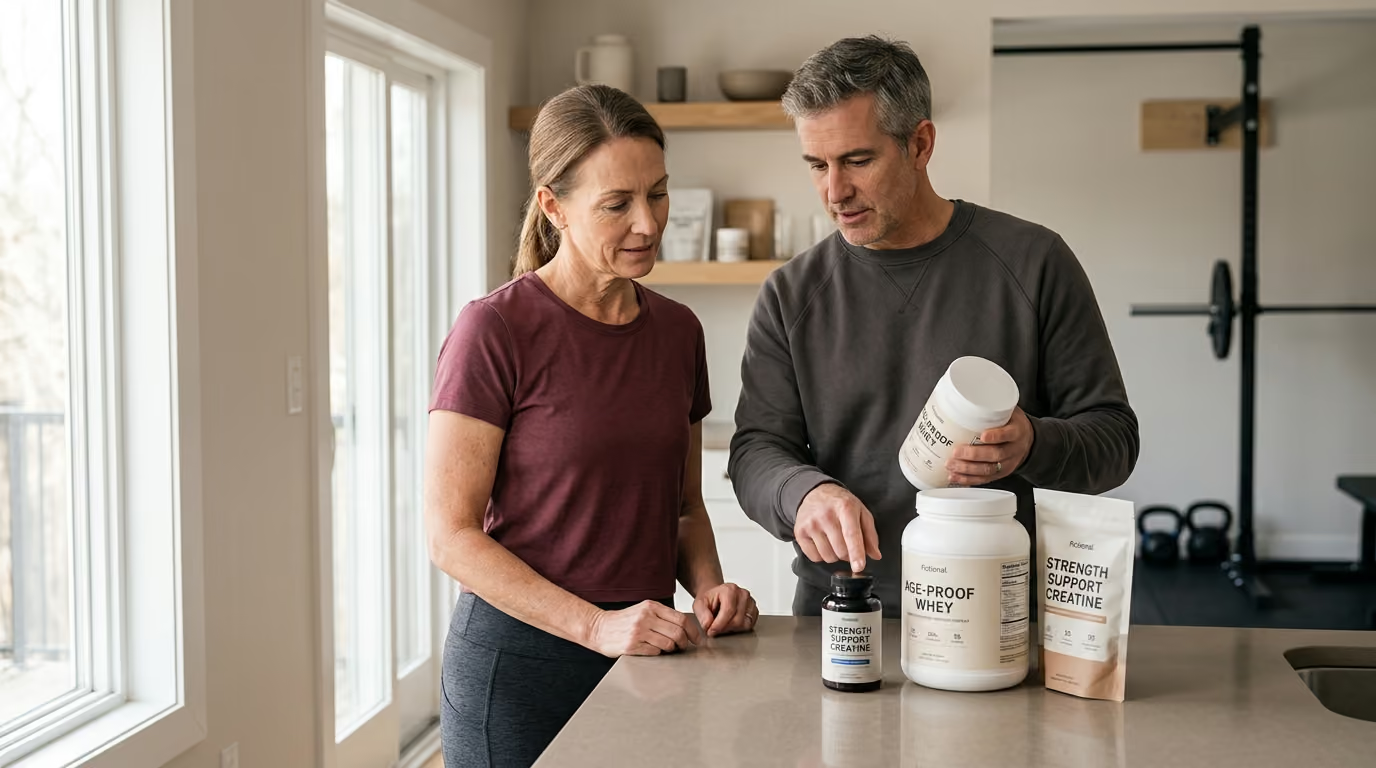
Last winter in Chamonix, I noticed something striking among the active travelers on the slopes and in the village. It was not high altitude that forced many of my peers back to the lodge by noon. It was a lack of rotational strength, poor eccentric braking on the descents, and slow recovery from long flights. We spend so much time debating complex supplements, yet we neglect the foundational strength required to fully enjoy our travels. That trip changed how our team approaches physical training. We stopped training for aesthetics and started training exclusively for real-world capability.
To prepare your body for international travel, tailor your workouts to match the demands of your itinerary:
To build specific physical preparation for demanding itineraries, explore our resources on travel and human performance.
Preserving physical autonomy is a deliberate, lifelong practice. Independence is not lost overnight. It erodes gradually when physical capacity falls below the demands of daily life. By viewing your body through the capability reserve framework, you can take control of how you move and age.
Focus on mastering the five functional benchmarks: rising from the floor, climbing and descending stairs with control, carrying asymmetrical loads, placing objects overhead, and developing the rapid muscular power needed to recover from a stumble. Train these qualities consistently with progressive overload, intelligent recovery, and high-yield movement patterns.
By building a deep reservoir of strength, you ensure that daily activities remain effortless. You protect your ability to hike alpine trails, travel the world, handle unexpected physical challenges, and live on your own terms for decades to come.
Building functional strength is the single most effective investment you can make to safeguard your capability, freedom, and passion for adventure throughout your life.
Stay connected for research and practical guidance on longevity, strength, recovery, energy and active living. New ideas to help you stay capable, curious and ready for more.


Explore practical guidance on strength, recovery, energy, travel and longevity for a life that stays active.
explore the Blog