A supervised strength-and-balance trial found small advantages on two cognitive tests. Here is what the evidence means for active adults and travel training.





On November 7, 2026, a randomized trial published online in the Journal of Nutrition, Health and Aging reported small advantages on two cognitive tests after a supervised strength-and-balance program. If staying independent for travel and sport matters to you, the finding deserves a close look: researchers compared two structured exercise programs in older adults with probable mild cognitive impairment.
The program paired progressive resistance exercise with balance challenges introduced later. Its practical interest lies in that combination and in how carefully the researchers adjusted the challenge to participants’ abilities. For an active adult thinking about future hiking trips or ski holidays, those details are more useful than a sweeping brain-health headline.
Researchers enrolled 162 community-dwelling adults aged 65 and older who were physically independent. Participants met the study’s criteria for probable mild cognitive impairment, or MCI. Their mean age was 70.4 years and 75% were women.
The trial was randomized and assessor-blinded. Researchers assigned 80 participants to instability resistance training and 82 to an active-control exercise program. The comparison therefore concerned two different approaches to organized activity.
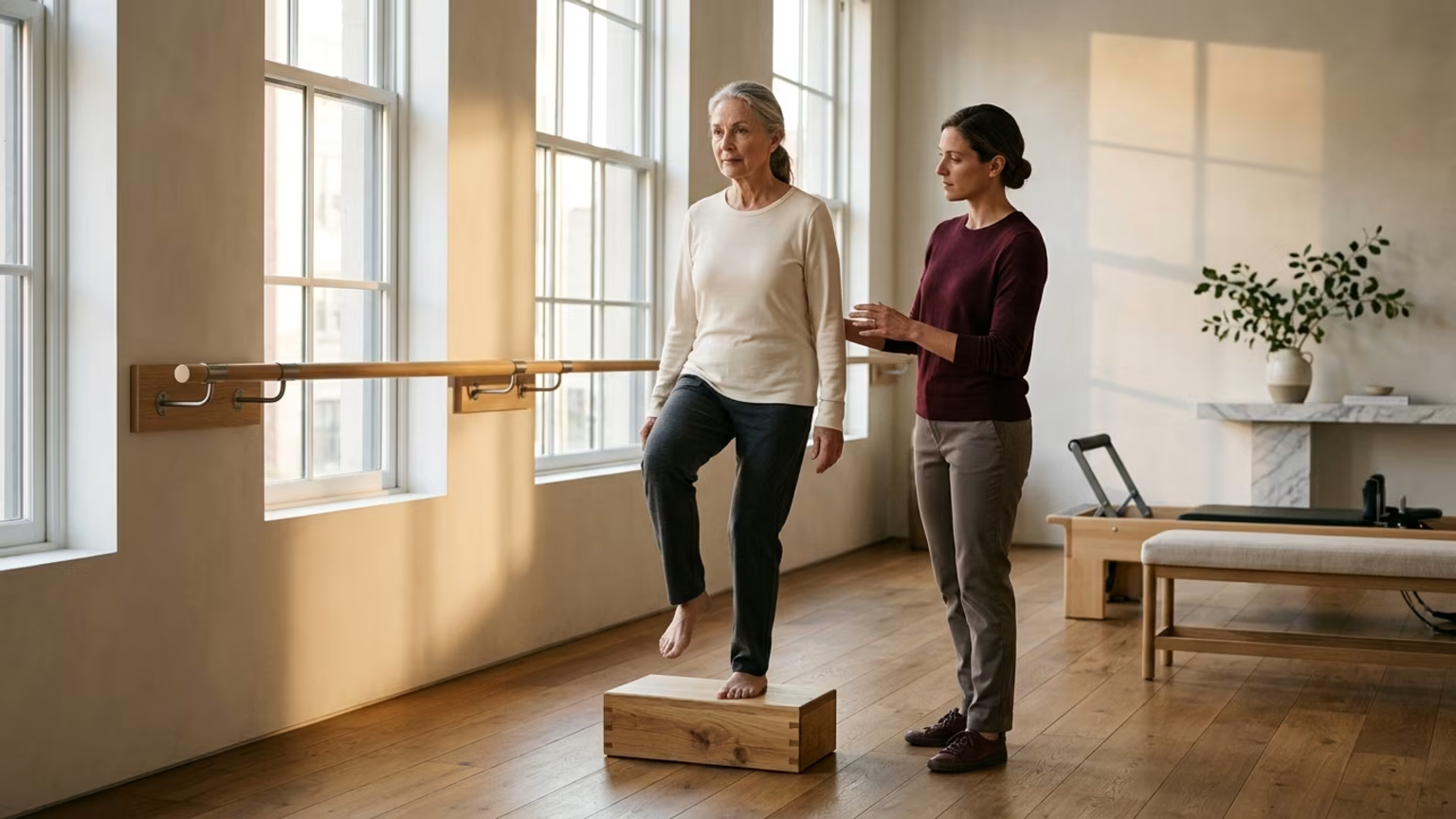
According to the trial report, the resistance group trained over 24 weeks. Participants began with traditional resistance exercises for 12 weeks. During the second half of the program, some exercises incorporated unstable surfaces such as foam pads and balance discs.
The researchers adjusted both resistance and instability according to performance. They also adapted exercises for participants with muscle or joint problems or mobility limitations. This was supervised and responsive training rather than a fixed sequence that everyone completed identically.
The comparison group took part in low-intensity functional exercise alongside balance work and stretching. Its sessions also included relaxation and recreational activities. Unlike the resistance program, these activities were non-progressive.
That active comparison is an important strength of the design. The question was whether the progressive training package produced different results from another structured exercise experience. It was not a comparison between attending an exercise program and remaining inactive.
At 24 weeks, the authors reported small adjusted advantages for the resistance-training group:
Both differences were statistically significant. The authors described the findings as domain-specific, meaning that the advantages appeared in particular cognitive tasks. The clearest result is therefore the difference between the groups on these named tests.
For readers accustomed to hearing that exercise supports the brain, this level of detail matters. “Brain health” is a broad category. Naming the actual tests makes it possible to judge the finding without giving it a larger meaning than the results support.
The WHO’s physical-activity fact sheet provides broader context. It identifies improved cognitive health among the outcomes associated with physical activity in adults and older adults. This trial addresses a more specific question: how cognitive-test results differed between two supervised exercise approaches.
The remaining cognitive outcomes showed no significant between-group differences at 24 weeks. These included memory measures and tests involving processing speed and other cognitive tasks. Some differences observed at 12 weeks were also absent at the final assessment, including findings involving delayed memory and Trail Making Test B.
The study authors said the clinical importance of the small score differences remains uncertain. They lacked established thresholds showing what would count as a meaningful change on these tests in this exercise setting. Statistical significance therefore does not establish that participants noticed a worthwhile change in daily life.
The Conversation’s analysis makes a related distinction: better performance on a cognitive test does not itself demonstrate greater confidence or independence. This trial did not establish improved everyday independence or reduced dementia risk. Its reported findings also do not establish faster travel recovery, easier altitude adjustment or more sustained energy during skiing and hiking.
The intervention must also be considered as a whole package. As The Conversation explains, the study did not compare the same resistance program performed on stable and unstable surfaces. It therefore cannot identify whether resistance work, balance demands or their combination explains the observed test differences.
Cognition was a secondary outcome; the trial was originally designed around falls incidence. Participants’ cognitive profiles were varied and the researchers could not establish their specific impairment subtype or severity. The findings should not automatically be extended to younger adults or people with more severe impairment or different health profiles.
Attendance also provides useful context. Mean attendance was 64.6% in the resistance group and 62.5% in the control group, including participants who withdrew. Those figures argue against treating the study as a precisely established cognitive-training formula.
Finally, the researchers recorded one mild loss-of-balance event during a rowing exercise using suspension straps. It caused no injury or need for medical attention and did not interrupt the program. Nevertheless, unstable-surface exercise should not be presented as inherently risk-free or automatically suitable for every reader.
For travel and sport, the defensible application is to treat strength and stability as complementary qualities when reviewing your training. The trial offers a concrete example of combining them through supervised progression. The practical action is a focused discussion about your existing routine with a qualified exercise professional.
Keep that discussion tied to what you want to do. A hiking itinerary or ski holiday gives the conversation a clear purpose. Rather than asking for a workout advertised as good for the brain, ask how strength and balance work can be scaled to your present abilities and planned activities.
This keeps attention on capability rather than novelty. An exercise does not become more relevant to your trip simply because it involves an unstable surface. The useful question is why a particular challenge belongs in your program and how its difficulty will be adjusted.
The trial’s sequence offers a helpful point of discussion. Participants worked on traditional resistance exercises before the researchers introduced additional instability. The transferable principle is thoughtful progression, with the challenge matched to performance rather than selected for its appearance.
That principle fits naturally with making strength work a lasting part of an active life. A review can begin with the routine you already have and consider how stability work belongs alongside it. There is no need to frame this news as a reason for a complete training overhaul.
Our discussion of balance practice in the context of independence provides another useful planning perspective. Strength and balance can sit within the same capability-focused conversation while remaining distinct training considerations. Keeping those purposes clear helps prevent a cognitive headline from becoming the sole reason for an exercise choice.
For someone with balance concerns or health limitations, qualified guidance is especially relevant. The researchers adapted exercises to participants’ needs and provided close supervision. Decisions involving personal medical concerns belong with a qualified clinician, alongside exercise guidance appropriate to the individual.
It is also worth being precise about the outcome you value most. Preparing for a trip may center on physical performance or the ability to manage planned activities. A useful professional review keeps those goals visible instead of substituting an interesting test result for the practical reason you train.
The aim is a coherent routine rather than a collection of exercises carrying separate promises. Strength work and appropriately scaled stability work can be discussed together around the activities that matter to you. That is a realistic way to use this research without allowing the headline to dictate the program.
The sensible adjustment is a professionally guided review of strength and balance within your existing routine, with your travel and sporting goals setting the priorities.
Stay connected for research and practical guidance on longevity, strength, recovery, energy and active living. New ideas to help you stay capable, curious and ready for more.


Explore practical guidance on strength, recovery, energy, travel and longevity for a life that stays active.
explore the Blog