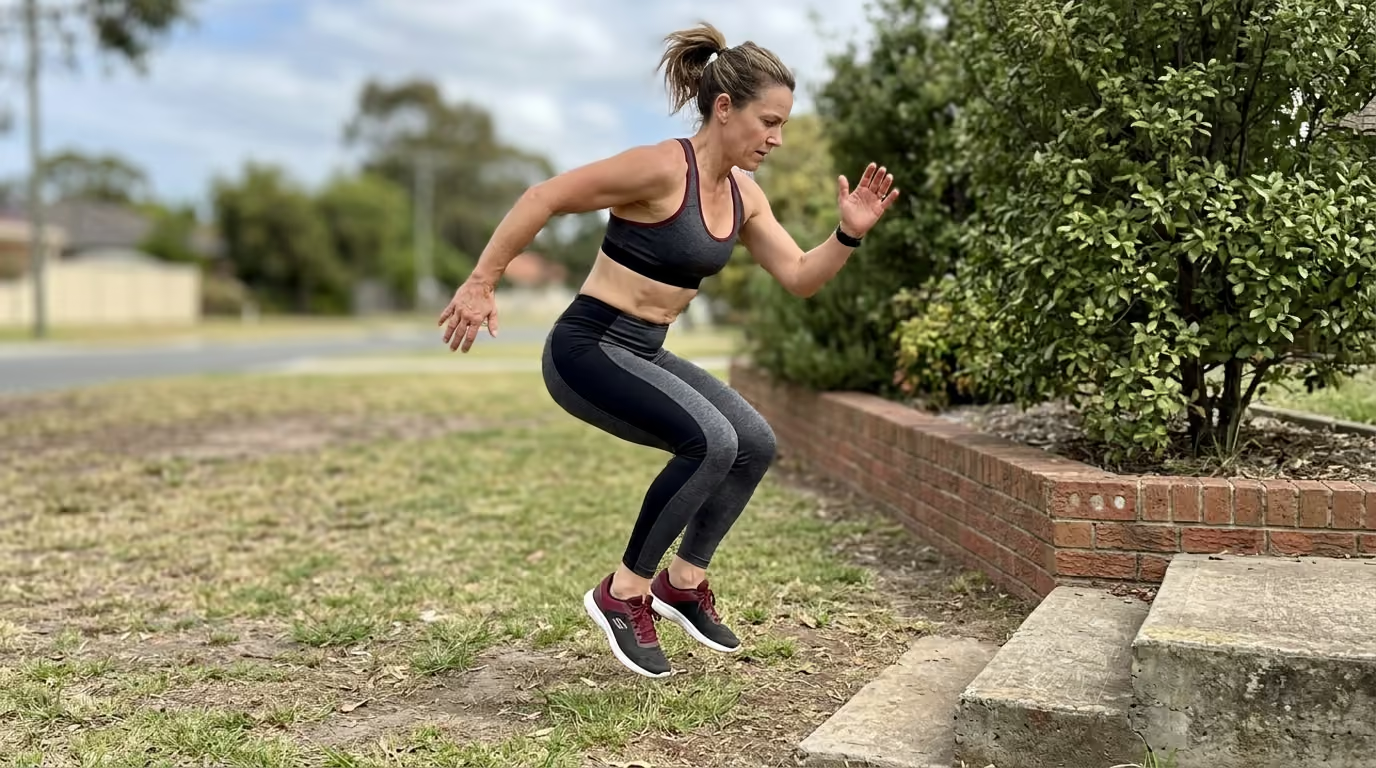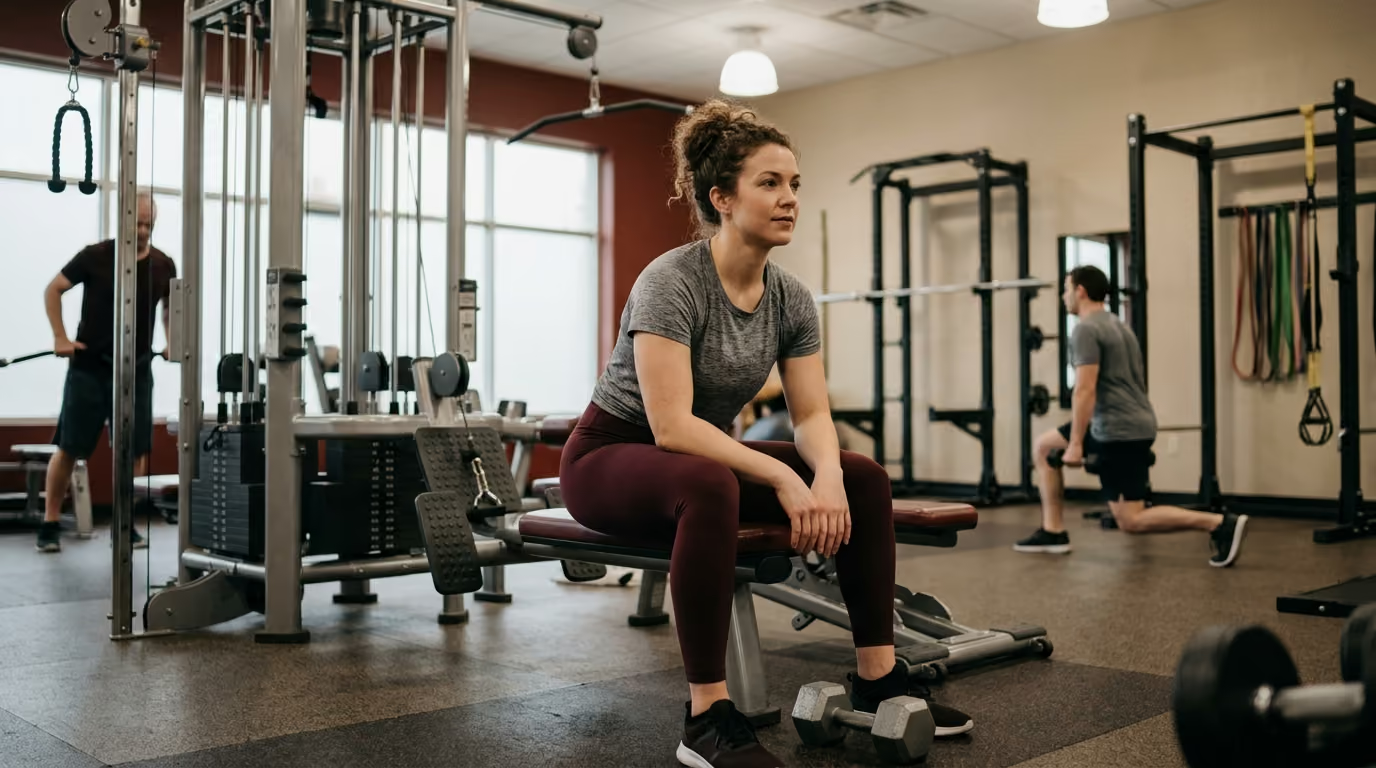

Human strength encompasses distinct neuromuscular qualities including maximal force, power, and rapid reactivity that support athletic performance and lifelong functional capability.





Most fitness programs treat strength as a single, uniform capacity. People ask how much you can bench press, squat, or deadlift, assuming that a single maximal number summarizes your total physical capability.
This narrow view creates significant blind spots for both athletic performance and lifelong physical autonomy. A person may possess remarkable force when moving a heavy barbell slowly, yet lack the rapid responsiveness required to catch their balance on an icy trail. Another individual might easily complete bodyweight pull-ups, but struggle to absorb the impact of descending a steep mountain path.
Strength is not a solitary attribute. It is a diverse family of neuromuscular capabilities that differ based on force magnitude, movement velocity, contraction type, time constraints, and fatigue resistance.
Understanding this taxonomy allows active adults over 40 to move beyond generic workouts. By diagnosing specific strength deficits, you can build a physical reserve that protects your joints, sharpens your movement, and preserves your capacity for demanding adventures worldwide.
To understand human movement, you must first separate maximal force from mechanical power and rapid force production. In physical mechanics, strength represents the total amount of tension a muscle or muscle group can generate against resistance. Power introduces the element of time, representing the product of force and velocity.
A central biological variable is the rate of force development. This metric reflects how quickly your central nervous system can recruit motor units and produce force within the opening milliseconds of a movement.
In many real-world scenarios, the time available to generate force is extremely brief. An athlete sprinting or an adult recovering from a sudden slip often has fewer than 250 milliseconds to react. Because maximal voluntary force production typically takes 400 to 600 milliseconds or longer, a high ceiling of raw strength does not automatically ensure safety or speed.
Research demonstrates that raw force and rapid force production adapt through distinct pathways. A systematic review published in Frontiers in Physiology examined resistance training adaptations in older adults, finding an 18.40 percent improvement in muscle strength alongside a 26.68 percent improvement in the rate of force development. The changes in maximal strength and rapid force production were not significantly correlated, showing that lifting heavy loads alone does not fully address fast neuromuscular recruitment.
Every physical movement can be analyzed through a practical organizing framework:
Task demand equals force magnitude multiplied by velocity, time constraints, repetition requirements, and contraction mode.
When you lift a heavy suitcase into an overhead bin, the demand focuses primarily on force magnitude and concentric action. When you react to an unexpected step off a curb, the demand shifts instantly toward velocity, rate of force development, and rapid eccentric absorption.
Viewing physical capability through this dynamic framework helps you direct your training toward specific movement requirements. If you want to refine your baseline capacity, examine our comprehensive resources on strength and physical performance to understand how these systems interact across a lifespan.
Human movement relies on seven distinct strength qualities. While these expressions overlap during complex athletics, each quality addresses specific physiological demands and requires targeted stimulation.
Maximal strength is the greatest voluntary force an individual can produce in a specific movement, joint angle, or contraction mode, regardless of time. It is traditionally evaluated through a one-repetition maximum test, heavy multi-repetition testing, or an isometric mid-thigh pull.
This quality depends on both structural and neural characteristics. Muscle cross-sectional area provides the physical machinery, while the central nervous system determines motor-unit recruitment, firing frequency, and synchronization. Tendon stiffness, joint leverage, and intermuscular coordination also dictate how effectively internal muscular tension transfers into external force.
In sporting contexts, maximal strength provides the baseline foundation for heavy lifting, grappling, and overcoming high external inertia. For long-term vitality, maximal strength ensures that daily physical requirements remain far below your absolute biological ceiling.
When your maximal force capacity declines, simple activities begin to consume a dangerously high percentage of your total energy. Standing from a low armchair or lifting a heavy cooler requires a minimum threshold of lower-body force. A high maximal strength reserve ensures these activities feel effortless, preserving energy and preventing early muscular exhaustion.
Relative strength is the amount of force an individual can generate in proportion to their total body mass. It is calculated by dividing absolute force production by body weight.
An individual weighing 70 kilograms who can complete a 140-kilogram squat demonstrates higher relative strength than a 100-kilogram individual performing the same lift. This distinction is critical whenever your primary physical objective involves moving, accelerating, or controlling your own body through space.
Relative strength governs performance in climbing, running, jumping, calisthenics, and gymnastics. It dictates how efficiently you navigate stairs, get up from the floor, or cross demanding terrain during outdoor travel.
As we age, relative strength often deteriorates through a dual mechanism. Age-related muscle loss reduces absolute force output, while shifts in body composition frequently increase passive body mass. This shift increases the relative effort required for basic movement. Prioritizing relative strength requires building neuromuscular capability while maintaining an efficient body composition.
Explosive strength is the capacity to express significant force within an extremely compressed time window. In exercise physiology, this quality is measured through the rate of force development, representing the steepness of the early force-time curve.
Explosive strength answers a specific question: how much force can you produce in the first 100 to 250 milliseconds of movement?
This expression is vital for sprinting, throwing, jumping, and changing direction quickly. It relies heavily on fast-twitch motor unit recruitment, neural firing rates, and rapid cross-bridge cycling within muscle fibers.
In everyday life, explosive strength is your primary defense against sudden mechanical perturbations. When you trip on an uneven sidewalk or lose traction on a wet surface, you do not have several seconds to organize a maximal contraction. You need an immediate, high-velocity burst of force to reposition your foot and brace your trunk. Maintaining explosive capacity is essential for maintaining high-speed movement and physical resilience.
Reactive strength is the ability to absorb, store, and rapidly reapply kinetic energy through the muscle-tendon system using the stretch-shortening cycle. This quality depends on the natural elasticity of your tendons, dynamic joint stiffness, and rapid neural reflexes.
A true reactive movement occurs with minimal ground contact time, typically under 250 milliseconds. When a runner's foot strikes the pavement, the Achilles tendon and calf complex stretch under load, store elastic energy, and recoil to propel the body forward.
This mechanism allows you to bounce, change direction seamlessly, and absorb repetitive impacts without wasting excess metabolic energy. Key assessments include drop jumps, continuous hurdle hops, and reactive strength index testing.
Reactive capacity tends to decline when high-velocity activities are completely removed from an exercise routine. Tendons lose natural compliance and stiffness, while the nervous system becomes slower at anticipating impact. Rebuilding this quality with controlled, low-amplitude bounding and quick footwork drills restores joint resilience and enhances running economy.
Strength endurance is the ability of a muscle or the whole body to sustain repeated contractions, or resist fatigue under submaximal loads over time. It can be divided into local muscular endurance, such as the quadriceps resisting fatigue during a long descent, and whole-body functional capacity, such as carrying gear across miles of rolling hills.
This quality operates at the intersection of muscular force and metabolic efficiency. It requires effective local blood perfusion, high mitochondrial density in active muscle beds, efficient clearance of metabolic byproducts, and the mental discipline to maintain form under accumulated fatigue.
Strength endurance differs from standard cardiovascular endurance. A person may possess an excellent cardiovascular base from cycling, yet lack the local muscular endurance needed to carry heavy luggage through a massive transit terminal.
In daily life, strength endurance supports repetitive physical tasks like yard work, continuous stair climbing, and multi-day mountain trekking. Developing this quality ensures that your structural integrity and movement mechanics remain stable even when fatigue sets in.
Isometric strength is the generation of muscular force without visible movement at the joint or changes in overall muscle length. Maximal isometric strength represents the peak force you can exert against an immovable resistance.
This quality is highly specific to the joint angle at which it is trained. It is essential for joint stabilization, postural integrity, and spinal bracing during heavy compound tasks.
Athletes rely on isometric strength to hold specialized body positions in climbing, gymnastics, skiing, and grappling. In functional movement, isometric strength keeps the trunk rigid while carrying asymmetrical loads, like a heavy duffel bag in one hand. It also provides a safe, joint-friendly method to apply muscular tension and rehabilitate connective tissues without the shear stress of dynamic motion.
Eccentric strength refers to the capacity of a muscle-tendon unit to produce force while lengthening under load. Muscles can generate substantially higher absolute forces during eccentric contractions than during concentric shortening, using less metabolic energy.
Eccentric strength serves as your body's primary braking and shock-absorption mechanism. It is used continuously when you lower a barbell, walk down steep terrain, descend a staircase, or land safely from a jump.
A systematic review published in the Journal of Science and Medicine in Sport highlighted that eccentric-focused resistance exercise yields equal or superior adaptations in functional measures and strength for older populations compared to traditional concentric lifting. Despite these clear benefits, eccentric training is often neglected in standard gym routines, which tend to focus almost entirely on lifting rather than lowering weight.
Lacking eccentric strength leaves your connective tissues vulnerable during high-load deceleration. Developing strong eccentric control protects your knees, stabilizes your hips, and allows you to move downhill with absolute confidence.
Because strength is multidimensional, imbalances between these seven qualities frequently emerge. Recognizing these patterns helps you adjust your training and resolve hidden performance bottlenecks.
This individual possesses substantial maximal strength and can handle heavy gym loads, but struggles with quick acceleration, rapid transitions, or reactive jumps. Their force ceiling is high, but their rate of force development is low.
This pattern is common among adults who rely solely on slow, heavy barbell lifting. To resolve this imbalance, you must incorporate exercises with high movement velocity. Adding medicine ball throws, kettlebell swings, and unloaded jump squats trains the nervous system to fire rapidly, transforming static force into dynamic athleticism.
This individual displays natural speed, agility, and jumping capability, but lacks eccentric braking capacity and robust isometric trunk stability. They can accelerate effortlessly, but struggle to decelerate smoothly or land with stability.
This discrepancy frequently leads to joint discomfort, especially around the patellar tendon, lower back, and hips. The solution requires focused eccentric strength training and isometric holds. Incorporating slow tempo squats, controlled step-downs, and suitcase carries builds the structural resilience required to safely handle rapid movement.
This individual has built substantial absolute strength on gym machines or stationary lifts, but their body mass has increased disproportionately. Consequently, their relative strength and strength endurance are compromised.
They may excel at a stationary leg press, yet struggle with bodyweight pull-ups or extended uphill climbs. Rebalancing this profile requires improving the strength-to-mass ratio. Emphasizing compound bodyweight movements, hill sprints, and nutritional strategies helps optimize functional power without carrying redundant mass.
This individual can produce remarkable force or speed on a single attempt, but their output drops precipitously on subsequent efforts. Their baseline capacity is sound, but their strength endurance and local metabolic recovery are underdeveloped.
They often feel exhausted halfway through a ski day or find their legs shaking after several flights of stairs. Correcting this deficit involves density training, loaded carries, and resistance circuits with structured rest periods. These methods improve local blood flow, accelerate cellular clearance, and build sustained physical stamina.
From a healthy aging perspective, muscular weakness is the primary diagnostic marker for physical decline. The European Working Group on Sarcopenia in Older People revised guidelines establish low muscle strength as the key indicator of sarcopenia, treating it as more reliable than muscle mass measurements alone.
Clinical assessments frequently use standardized metrics to identify functional deficits:
These screening tests highlight the functional link between maximal strength, relative strength, and everyday independence. Maintaining these baseline capacities protects against frailty and supports an active, adventurous lifestyle. For deeper insights into sustaining physical capability over time, read our practical framework on longevity and living well.
Travel, sport, and outdoor pursuits place unpredictable, multidirectional demands on the human body. Navigating an alpine route or managing transit days requires a seamless blend of strength qualities rather than isolated muscular output.
Last winter in Chamonix, I noticed something striking among our group. It was not the high altitude that forced my peers off the slopes and into the lodge by noon, it was a clear lack of rotational strength and poor recovery from long international flights.
We spend so much time debating the latest supplement stacks, yet we often neglect the basic foundational strength required to actually enjoy our travels. That trip changed how I approach fitness. I stopped training for aesthetics and started training exclusively for real-world capability.
Skiing provides a perfect example of these seven strength expressions operating together:
Extended international travel presents its own physical challenges. Hauling heavy luggage across train terminals demands relative strength, grip endurance, and isometric trunk control. Surviving long, fatiguing travel days requires strong postural stamina to prevent lower back and neck discomfort.
When your training builds all seven strength expressions, you create a durable physical buffer. You can step off a transatlantic flight and move straight into demanding activities, confident that your body can handle whatever environment you choose to explore. If your travel plans include challenging terrain, review our field guide to travel and adventure to optimize your physical preparation.
Misunderstandings regarding exercise selection, aging biology, and adaptation often lead active adults to follow incomplete training routines. Clarifying these myths helps you build a more effective, balanced strength program.
While muscle cross-sectional area sets the biological ceiling for force production, strength also relies heavily on neural recruitment, motor unit synchronization, and tendon stiffness. An individual can significantly increase their usable force through neural adaptations without adding unwanted body weight.
Heavy resistance training improves your maximal force ceiling, but it does not maximize your rate of force development. Explosive and reactive strength require moving light-to-moderate loads with maximum intent, or training with fast stretch-shortening cycles.
Balance is not merely an inner-ear or sensory function. Catching yourself after a stumble requires immediate, explosive force and strong eccentric braking in the hips and lower legs. Functional balance is largely a practical expression of neuromuscular strength.
Because eccentric actions generate high muscle tension, some assume they carry an excessive risk of injury. In reality, controlled eccentric training strengthens tendons, improves joint mobility, and enhances movement control. The key is to manage exercise volume and allow sufficient time for recovery.
A strong handgrip is a helpful clinical marker of general health, but it does not tell you if you can climb steep stairs or react quickly to a fall. Total physical capability requires assessing and developing multiple strength expressions across the whole body.
Light weights lifted for 25 to 30 repetitions build local endurance, but they do not create the motor unit recruitment needed to preserve your highest-threshold fast-twitch muscle fibers. You need heavier loads or explosive movements to stimulate these vital fibers.
Muscle and nerve tissues retain their ability to adapt throughout life. Landmark research confirms that adults in their eighties and nineties achieve substantial improvements in muscle strength, tendon function, and physical independence through progressive resistance training. To support these muscular adaptations through proper recovery, study our evidence-based strategies for recovery and sleep.
You do not need to spend hours in the gym every day to build all seven strength qualities. By pairing complementary movements and choosing versatile exercises, you can develop a balanced, resilient body using a structured, three-day weekly routine.
This session establishes your foundational force ceiling and challenges your strength-to-weight ratio. Perform each exercise with deliberate, high-quality form.
This workout trains rapid neural recruitment, tendon elasticity, and rate of force development. Focus on movement speed and crisp execution rather than muscular fatigue.
This session strengthens connective tissues, improves downhill control, and builds resilience against fatigue.
To further fine-tune your weekly programming, check our in-depth guides on performance and fitness for actionable training insights.
The broader medical and sports science communities increasingly recognize that comprehensive strength development is essential for lifelong functional health. Public health guidelines have shifted from recommending simple aerobic activity toward prioritizing multi-component strength and balance protocols.
The World Health Organization physical activity guidelines state that adults aged 65 and older should perform muscle-strengthening activities involving all major muscle groups on at least two days per week. The WHO also recommends diverse, multi-component physical activity emphasizing functional balance and strength training on three or more days per week to enhance functional capacity and prevent falls.
A comprehensive Cochrane systematic review evaluated physical activity interventions for preventing falls in older adults living in the community. Analyzing 64 randomized controlled trials, the authors concluded that structured exercise programs reduced the overall rate of falls by 23 percent.
When programs combined balance and functional training with progressive resistance exercise, the reduction in fall rates reached 28 percent. The evidence demonstrates that fall prevention requires a combination of maximal strength, balance, rapid explosive stepping, and eccentric deceleration.
Meta-analytic reviews consistently confirm that advanced age does not prevent muscular adaptations. A research review published in the British Journal of Sports Medicine analyzed progressive resistance training across 41 clinical trials involving 1,955 older participants. The researchers found an overall standardized mean difference of 0.68 for muscle strength improvements, confirming that older neuromuscular systems adapt reliably to progressive mechanical loading.
Additional clinical reviews demonstrate that higher-intensity resistance training produces superior adaptations in functional mobility and muscle capacity compared to low-intensity exercise. As long as movement quality and recovery are managed, challenging resistance training remains safe and highly effective across your entire lifespan.
True physical capability means building a wide, versatile reserve of strength that allows you to move with confidence, handle unexpected challenges, and pursue your favorite sports and adventures for decades to come.
Stay connected for research and practical guidance on longevity, strength, recovery, energy and active living. New ideas to help you stay capable, curious and ready for more.


Explore practical guidance on strength, recovery, energy, travel and longevity for a life that stays active.
explore the Blog