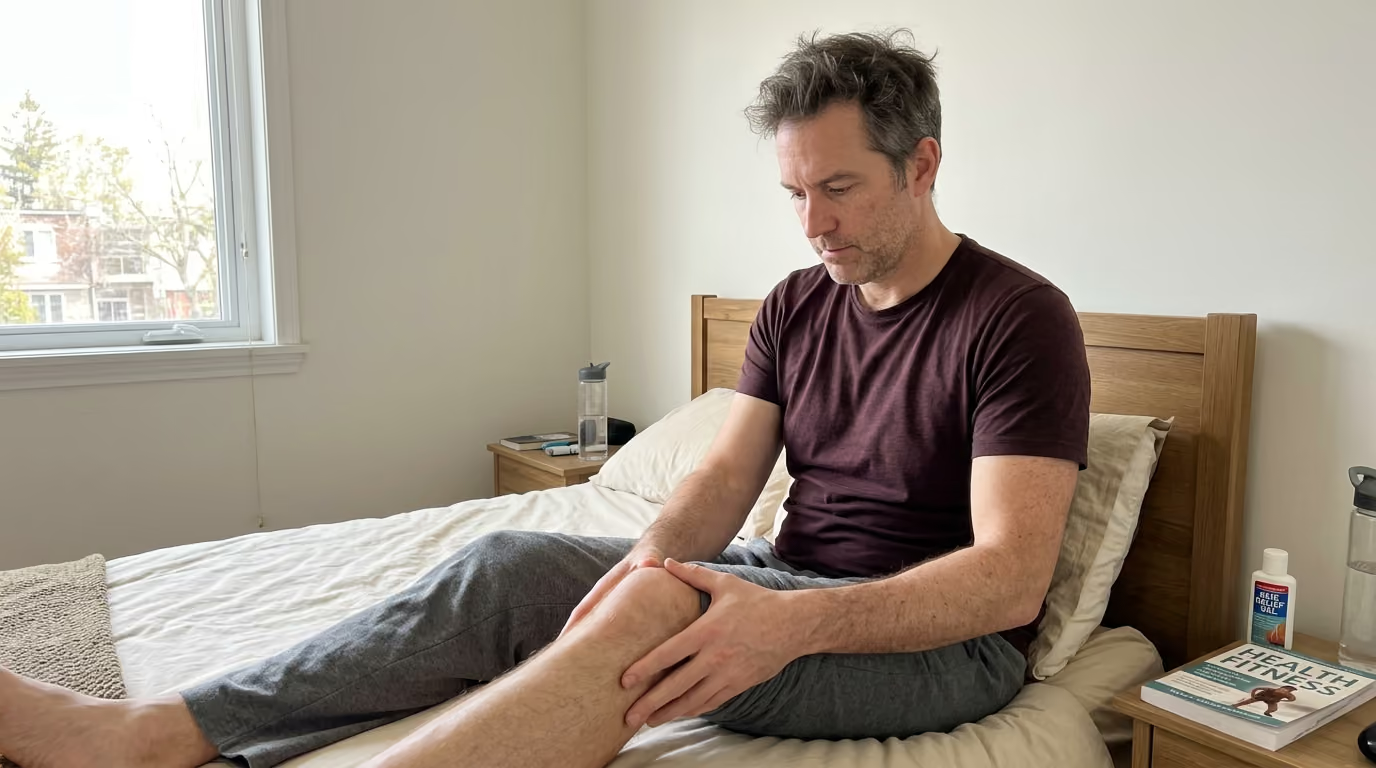

Four core readiness domains combine with objective biometrics and subjective wellness to guide athletes when modifying, proceeding.





You wake at dawn in a mountain lodge, preparing for a demanding day of high-altitude hiking. Your phone displays a bright red recovery score, warning that your autonomic nervous system is stressed. Yet your joints feel supple, your head is clear, and your motivation is high. On other mornings, your wearable presents a pristine green readiness rating, even though your legs feel like lead and work stress has kept your stomach in knots.
These conflicting signals create a familiar dilemma for dedicated athletes. Relying solely on a consumer device turns daily training into an automated guess. Ignoring your body to force a rigid workout schedule invites chronic fatigue, soft tissue injury, and wasted effort.
True readiness is not a single number delivered by an algorithm. It is a structured daily decision that weighs your current physiological capacity against the exact demands of your planned workout.
The purpose of a readiness framework is to eliminate guesswork before you lace up your shoes or unrack a barbell. A high-performance lifestyle requires knowing when to push your limits, when to adjust your plan, and when to step back entirely.
Research published in the British Journal of Sports Medicine demonstrates that athlete self-reported wellness often tracks training load changes more reliably than common objective biometrics. A single metric cannot capture your complete biological state. A reliable framework combines subjective perception, objective data, recent training history, and outside life stress into an actionable assessment.
The output of this evaluation is never complicated. Every morning, you arrive at one of three operational decisions:
This decision is always specific to the planned task. You might be unready for heavy eccentric squats or maximal interval sprints, yet perfectly prepared for an easy aerobic flush or a light mobility routine. Evaluating readiness in relation to the specific workout protects your physical longevity while keeping your athletic progress consistent.
Most commercial tracking devices treat recovery as a binary state. In their view, your body is either completely restored or entirely broken down. Human physiology does not operate on an all-or-nothing switch.
Recovery is the physiological and psychological process of restoring capacity after previous stress. It does not require every biometric marker to sit at a perfect baseline. It simply requires sufficient physical capacity to execute your intended session with excellent technique, acceptable injury risk, and a high likelihood of positive adaptation.
Your current capacity shifts constantly based on sleep, recent training volume, systemic inflammation, nutrition, and mental stress. Meanwhile, session demands vary dramatically across different training modalities. A 45-minute recovery ride places minimal mechanical strain on tendons and joints. In contrast, a session featuring maximal sprint acceleration or heavy eccentric loading imposes intense strain on the central nervous system and connective tissues.
Understanding this distinction requires separating external training load from internal training load. As outlined in the International Olympic Committee consensus statement on athlete load monitoring, external load represents the physical work performed. This includes your total mileage, barbell tonnage, running speed, or power output.
Internal load measures your biological response to that external work. It is reflected in your heart rate, blood lactate levels, oxygen consumption, and rating of perceived exertion.
A practical method to measure internal workload is the session rating of perceived exertion, commonly known as session RPE. To calculate this metric, multiply the total duration of your session in minutes by your subjective exertion on a 1 to 10 scale. A 60-minute session rated at a 7 produces an internal load score of 420 arbitrary units. Systematic reviews confirm that session RPE provides an exceptionally reliable assessment of internal training stress across endurance and strength sports.
Evaluating load also requires balancing acute workload with chronic workload. Acute load describes the stress accumulated over the previous seven days. Chronic load represents your rolling training average across the previous three to six weeks.
The acute-to-chronic workload ratio compares these two values to determine whether your current training represents an appropriate progression or a dangerous spike. Research across elite athletic populations indicates that an acute-to-chronic ratio between 0.8 and 1.3 generally maintains fitness while keeping injury likelihood low. When that ratio climbs above 1.5 due to sudden surges in volume or intensity, injury risk can more than double.
This ratio is an informative compass rather than an infallible injury calculator. Mathematical models vary, and individual tissue tolerances differ. Use acute and chronic load calculations as a helpful checkpoint to ensure you are not compounding severe fatigue on top of an unprepared muscular system.
Making an accurate training decision requires triangulating data from multiple angles. When you gather information across four distinct domains, you remove blind spots and build an accurate picture of your physical state.
Your internal perception is a highly sensitive instrument. A landmark systematic review by Anna Saw and colleagues analyzed dozens of athletic monitoring studies. The researchers found that subjective measures of well-being responded more sensitively and consistently to acute and chronic training load changes than objective blood markers, hormone ratios, or resting heart rate.
To assess this domain, take a 30-second inventory each morning across seven key markers, scoring each from 1 (very poor) to 5 (excellent):
Look for persistent patterns rather than an isolated low number. A single night of poor sleep or mild quadriceps stiffness is normal during an active training block. However, when three or four markers drop simultaneously across consecutive days, your body is signaling significant systemic strain.
Objective markers provide a helpful baseline to corroborate your subjective feelings. Heart-rate variability, or HRV, measures the variation in time between consecutive heartbeats. In sports science, the natural logarithm of the root mean square of successive differences, known as ln rMSSD, reflects parasympathetic nervous system activity.
When interpreting HRV, consistency is essential. Measure your HRV at the same time each morning, in the same seated or supine position, using a standardized device. Evaluate your daily numbers against your rolling seven-day average rather than universal population charts. An individual smallest worthwhile change window is roughly 0.5 to 1.0 standard deviations from your personal baseline.
Resting heart rate serves as a secondary objective check. A resting pulse elevated by five to ten beats per minute above your historical baseline often indicates dehydration, incomplete recovery, environmental heat stress, or an oncoming illness.
Objective monitoring should also include brief physical performance checks. Tracking your movement speed during a standard warm-up, bar velocity during an initial lift, or jump height provides direct feedback on neuromuscular readiness. If your nervous system cannot generate speed during low-load preparation, it is unlikely to handle maximal force safely.
Your training log holds vital context that a morning biometric scan cannot see. A workout that appears moderate on paper may overwhelm a body that has completed four demanding days in a row.
Inspect your training history for training monotony, which describes a lack of day-to-day workload variation. Sustaining high daily training loads without easy recovery days creates high training strain, sharply increasing the likelihood of overtraining.
Review your last seven days for specific movement stress. If your knees absorbed heavy downhill hiking or sprint intervals two days ago, your connective tissues may still be remodeling, even if your cardiovascular system feels refreshed. Consistent progress in progressive strength training relies on respecting tissue-specific recovery timelines rather than training on fixed calendar days.
Your physiology does not separate physical training stress from emotional, psychological, or environmental demands. The brain and body process all challenges through the same autonomic and neuroendocrine pathways.
Life stress functions as a direct training load multiplier. A demanding interval session that stimulates healthy adaptation during a calm work week can trigger total exhaustion during a week filled with corporate deadlines, poor nutrition, and family illness.
Assess your external environment honestly. Factor in recent time-zone shifts, ambient heat, nutritional deficits, alcohol intake, and cognitive fatigue. When life stress rises, your physiological capacity shrinks.
To turn these four domains into a clear morning decision, follow a systematic five-step sequence. This workflow prevents emotional bias from dictating your physical health.
Begin by ruling out issues that make intense physical training unsafe. If you display any of the following symptoms, immediately cancel demanding physical work:
No wearable score, training ambition, or competitive schedule justifies exercising through red flag symptoms. Rest and consult a healthcare professional when these signs appear.
When no red flags exist, compare your findings across the four primary domains.
A clear green light occurs when your subjective wellness is normal or high, your objective biometrics sit within baseline ranges, and your recent training load is stable. In this scenario, proceed directly to your standard warm-up.
An amber signal appears when your indicators deliver conflicting messages. For example, your subjective energy might be high while your HRV shows a sharp drop, or your resting biometrics may look perfect while your hamstrings remain excessively stiff.
A red signal occurs when several domains decline together. If your sleep duration was short, your muscle soreness is elevated, your resting pulse is high, and work stress is extreme, your system is compromised.
Morning metrics only provide an initial forecast. The standard warm-up serves as your ultimate diagnostic test.
Begin your movement preparation and pay close attention to coordination, breathing ease, joint lubrication, and mental focus. If you move smoothly, reach expected ranges of motion without pain, and produce light power effortlessly, proceed with your scheduled workout.
If the warm-up feels unusually heavy, painful, or disjointed despite favorable morning data, do not force the session. Adapt to what your neuromuscular system reveals in real time.
When facing mixed signals or a sluggish warm-up, modify the workout rather than abandoning it entirely. The goal is to preserve the primary training adaptation while reducing systemic stress.
These programmatic shifts protect your structural health while keeping your habit of daily movement intact.
When multiple domains show severe impairment, high-intensity exercise becomes counterproductive. Forcing a hard workout in an exhausted state compromises your immune system and delays future progress.
Replace the demanding session with active regeneration strategies:
When you postpone a workout, never attempt to make it up by stacking two difficult sessions together later in the week. Workload spikes raise injury risks substantially. Simply adjust your calendar forward and resume hard training when your capacity returns.
Athletes frequently encounter scenarios where objective metrics clash with personal feelings. Navigating these moments requires understanding the underlying physiology.
You wake up feeling vibrant, but your wearable indicates an HRV reading well below your normal range.
This discrepancy often happens due to harmless measurement noise. A late dinner, a warm bedroom, minor dehydration, or shifting positions during measurement can depress HRV without draining muscular capacity.
Review the weekly trend rather than reacting to a single data point. Complete your standard warm-up. If your movement quality and power outputs are crisp, proceed with the workout while keeping volume within sensible limits.
Your HRV displays a pristine reading, yet your body feels deeply fatigued, your mood is flat, and your muscles ache.
This pattern can indicate parasympathetic saturation. During states of severe accumulated training fatigue, the parasympathetic nervous system can become hyperactive, driving resting heart rate down and HRV up.
Subjective wellness is exceptionally sensitive to chronic strain. Trust your physical perception over the device. Drop the planned intensity, avoid maximal testing, and treat the session as an active recovery day.
Your sleep tracking app awards you an optimal recovery grade, yet you feel unfocused and sluggish throughout the morning.
Consumer sleep trackers rely on movement sensors and optical heart-rate monitors. While they estimate total sleep duration reasonably well, research shows they have significant limitations in accurately mapping sleep architecture and deep sleep stages.
A high device score does not guarantee cellular recovery. If your mental alertness is depleted, protect your nervous system by replacing high-speed, technically complex movements with stable, controlled exercises. This approach helps maintain sustained daily energy without draining your reserves.
Your resting biometrics are completely stable, but your calves or lower back are stiff and tender from a previous session.
Systemic biometrics like HRV and resting heart rate often fail to reflect localized myofibrillar damage. If you train through severe local muscle damage, you alter movement mechanics and place compensatory strain on surrounding joints.
Modify the session to train unaffected muscle groups, or switch to non-impact cross-training until the localized soreness resolves.
Navigating physical longevity requires separating sports science from marketing hype. Avoid these common recovery pitfalls.
Many athletes outsource their intuition to wearable technology. They push through severe joint pain because an algorithm displayed a green score, or they cancel a workout because a screen showed an arbitrary low number.
A wearable device provides helpful estimates of select physiological variables. It cannot assess your tendon integrity, technical movement precision, mental focus, or structural resilience. Treat wearable data as a secondary reference point, not an absolute command.
A low readiness state does not mean you must spend the day motionless. Complete physical inactivity can leave joints stiff and slow down metabolic clearance.
Active recovery promotes circulation, delivering oxygenated blood and nutrients to healing tissues without taxing the nervous system. Low-intensity walking, gentle swimming, and light mobility work are almost always superior to passive rest for restoring muscular function.
Delayed onset muscle soreness indicates novel mechanical stress or unaccustomed eccentric loading. It is not a direct requirement for building strength or aerobic capacity.
Chasing extreme soreness leads to chronic systemic inflammation and irregular training schedules. The most successful athletes prioritize consistent, repeatable session quality over muscular destruction.
The acute-to-chronic workload ratio is an exceptional tool for understanding training trends. However, some treat it as a mathematically certain injury predictor.
Injuries occur due to complex interactions between movement mechanics, tissue tolerance, sleep status, psychological stress, and contact trauma. Use workload ratios to structure steady progressions, but never treat them as an absolute guarantee of safety.
High-performance travel places unique physiological demands on the body. Long flights, rapid time-zone shifts, unfamiliar nutrition, and altitude exposure alter your baseline recovery state.
Crossing several time zones causes circadian desynchronization. Your peripheral biological clocks in skeletal muscle, the liver, and the gut fall out of rhythm with the central circadian pacemaker in your brain. Research demonstrates that this circadian disruption temporarily degrades coordination, peak power production, and reaction time.
When arriving at an international destination, do not schedule maximal strength sessions or intense interval work on your first day. Your cardiovascular system and nervous system require 24 to 48 hours to recalibrate.
Environmental altitude acts as an invisible multiplier of internal training load. At elevations above 5,000 feet, reduced atmospheric pressure lowers oxygen saturation in arterial blood. A pace or barbell load that normally feels moderate will elevate heart rate, ventilation, and session RPE.
When embarking on active mountain travel, adjust your training expectations:
Structuring your training around travel stress ensures you maintain peak physical capacity for mountain exploration, skiing, or hiking without triggering severe exhaustion.
You do not need a laboratory setup or hours of daily data entry to make intelligent training decisions. A reliable monitoring system should take less than two minutes each morning.
By focusing on these essential steps, you build a consistent stream of actionable data without creating mental fatigue. This minimalist approach integrates naturally into an active lifestyle, supporting long-term physical consistency.
The broader sports science community agrees that athletic readiness is multifactorial. The International Olympic Committee consensus statements on training load and illness prevention emphasize that no single biological marker can detect overtraining syndrome or predict injury in isolation.
Progressive adaptation requires an ongoing dialogue between physical stress and systemic regeneration. Expert consensus highlights several foundational truths:
Returning from illness or injury requires a progressive re-entry process. After an infection, resting biometrics may normalize before metabolic exercise tolerance fully recovers. Begin with low-intensity aerobic movement and confirm that your perceived exertion is normal before reintroducing maximal efforts.
When managing an orthopedic issue, whole-body readiness scores cannot override joint-specific pain. Modify movement patterns to protect healing tissues while maintaining cardiovascular conditioning through non-irritating modalities.
Applying comprehensive recovery and regeneration principles allows you to build physical resilience, maintain joint health, and perform at your highest level across every decade of life.
Revisit this framework whenever you prepare for a demanding travel itinerary, begin a new training phase, or notice persistent fatigue creeping into your daily workouts.
Mastering your daily readiness transforms training from an uncertain gamble into a sustainable, lifelong practice of capable physical performance.
Stay connected for research and practical guidance on longevity, strength, recovery, energy and active living. New ideas to help you stay capable, curious and ready for more.


Explore practical guidance on strength, recovery, energy, travel and longevity for a life that stays active.
explore the Blog