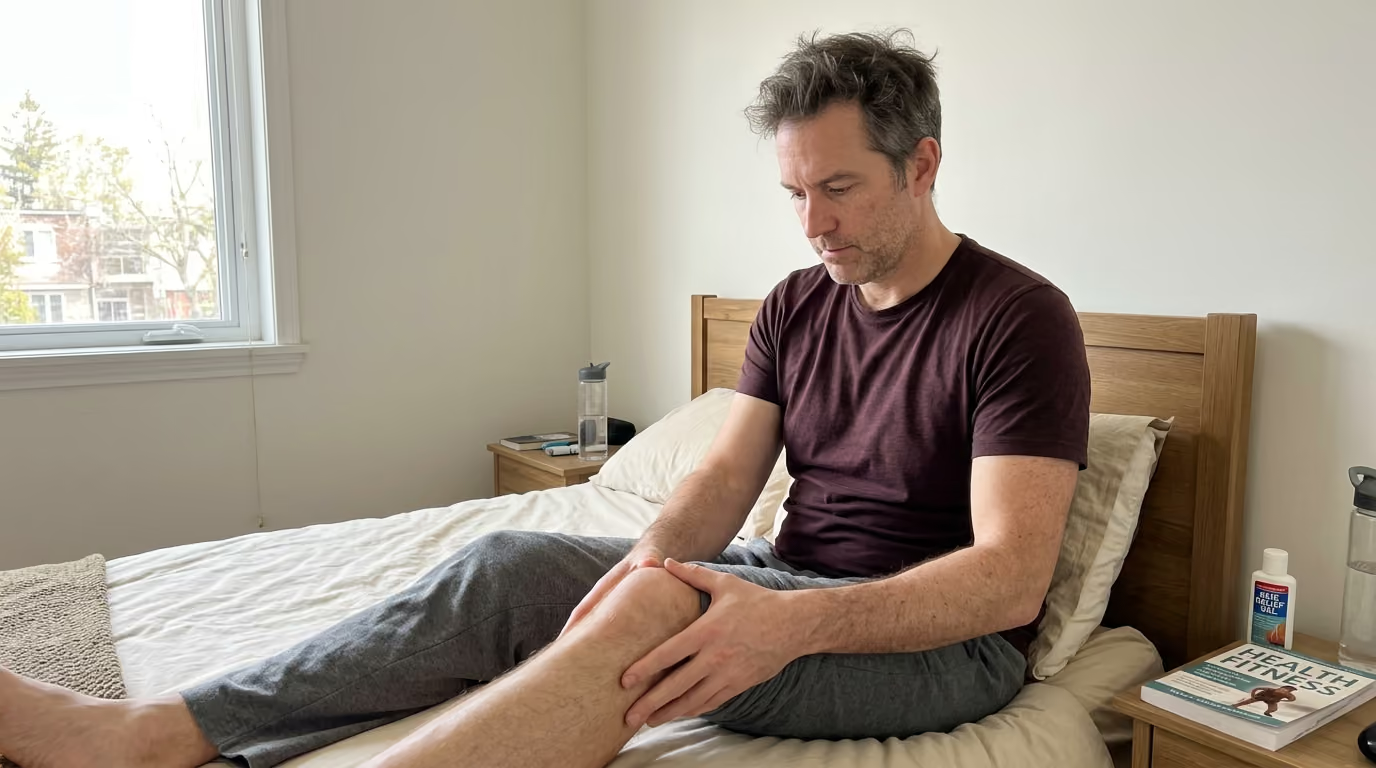

Heavy work deadlines combined with hard gym sessions often lead to severe burnout, making a recovery-first training framework essential for active adults over forty.





You step off an early morning flight, check into your hotel, and head straight down to the fitness center to complete the exact interval workout prescribed by your training app. By the third repetition, your legs feel like lead, your coordination feels slightly off, and your heart rate spikes far higher than normal. You push through because the calendar said today was a hard day, but two days later, persistent shoulder stiffness and overwhelming fatigue force you to cancel a scheduled alpine hike.
This scenario illustrates the central flaw in how most motivated adults structure their physical lives. We treat exercise as an isolated calendar event, assuming the body responds identically regardless of travel, broken sleep, corporate deadlines, or domestic demands.
A recovery-first framework inverts this relationship. Instead of squeezing recovery into whatever spare time remains after demanding workouts, recovery becomes the primary architectural constraint of your training plan. You do not lower your ambitions or settle for gentle movement. You simply match your physical stress to your actual physiological capacity to adapt.
Recovery-first training is not about doing less. It is a systematic method for getting the maximum adaptation out of every hour you invest in your physical health. When you design your routine around your capacity to recover, you build resilient joints, preserve lean muscle, maintain sharp energy, and stay ready for spontaneous adventures.
The core principle is simple. Your body does not distinguish between the physical strain of a barbell squat, the mental strain of a business acquisition, or the physiological strain of a red-eye flight across five time zones. All of these demands draw from the same biological reserve, known as your total stress load.
Active adults over 40 do not experience a sudden biological drop-off that forbids rigorous exercise. However, the margin for error narrows when career, travel, and family responsibilities compete with physical training. By treating recovery as an active design constraint, you ensure that every workout produces positive adaptation rather than accumulated exhaustion.
To put this framework into immediate practice, focus on five foundational rules:
For a deeper look into the biological foundations of restorative rest, explore our dedicated guide to restorative sleep and physical recovery.
To build an intelligent physical routine, we must first separate four basic concepts that are frequently blurred together in popular fitness media: training stress, fatigue, recovery, and adaptation.
Training stress is the deliberate physical disruption you apply to your muscular, cardiovascular, and nervous systems. Fatigue is the temporary reduction in performance and readiness that immediately follows this disruption. Recovery encompasses the biological processes that repair damaged tissue, replenish energy substrates, and restore systemic equilibrium. Adaptation is the structural improvement, such as increased mitochondrial density or greater tendon stiffness, that occurs only after recovery is complete.
Fatigue is not an enemy to be avoided at all costs. An effective program must create targeted fatigue to stimulate positive physical change. Problems arise only when fatigue accumulates across weeks faster than your biological systems can clear it.
Biological aging after 40 is characterized by subtle shifts in tissue turnover, tendon compliance, and metabolic flexibility. However, research demonstrates that trained masters athletes do not automatically suffer from severe anabolic resistance or dramatic declines in muscle protein synthesis. The primary differentiator between a 25-year-old and a 45-year-old athlete is rarely the capacity to train hard on any single afternoon. The real differentiator is systemic recovery capacity across consecutive weeks of complex life demands.
When you expose tissues to mechanical tension or metabolic stress, inflammatory cascades initiate the repair process. If you layer additional heavy stress onto an unrecovered system, these inflammatory signals remain chronically elevated. Over time, this unresolved state impairs collagen remodeling in tendons, disrupts sleep architecture, elevates resting sympathetic nervous system tone, and suppresses immune function.
Adaptation is an expensive biological process requiring ample energy, hormonal stability, and restorative sleep. If your lifestyle drains these resources before tissue repair is complete, your workouts simply produce chronic tissue breakdown without the corresponding fitness gains.
An effective recovery framework requires asking two distinct questions about every physical session. First, what did you physically do? Second, what did that specific session cost your body?
The physical work you perform is your external load. This includes easily quantifiable metrics such as barbell weight, repetitions, running distance, vertical elevation gain, and session duration. External load is the metric most people track obsessively in their training logs.
The biological toll of that work is your internal load. Internal load reflects how your cardiovascular, hormonal, and central nervous systems respond to the external work. It is influenced by your hydration, nutritional status, previous night of sleep, ambient temperature, and baseline psychological stress.
For example, running five miles at an eight-minute pace on a cool Saturday morning after eight hours of sleep represents a manageable internal load for a conditioned runner. Running that exact same five miles at the same pace after a five-hour flight, a missed lunch, and three days of poor sleep represents a massive internal load. The external work is identical, but the recovery cost is magnified.
The International Olympic Committee consensus on athlete load monitoring emphasizes that tracking both external and internal metrics is essential for preventing injury and avoiding systemic overreaching. For active adults balancing demanding careers, monitoring internal cost is even more critical than tracking external mileage or tonnage.
You can monitor internal load without complicated laboratory equipment. Pay close attention to these everyday signals:
When your internal cost spikes disproportionately to your external workload, your body is signaling that your current recovery capacity is temporarily reduced. Recognizing this discrepancy allows you to adjust your session before you induce unnecessary systemic fatigue.
To understand how targeted movement builds long-term biological resilience, review our library of applied strength and physical performance resources.
The wellness marketplace is crowded with expensive tools promising instant recovery, from cold plunge tubs and compression boots to complex peptide protocols. However, scientific literature consistently demonstrates that recovery follows a strict biological hierarchy. If the foundational layers are absent, supplemental tools provide negligible benefit.
The most powerful recovery tool is the intelligent design of your physical workouts. No amount of passive therapy can compensate for an exercise program that systematically exceeds your capacity to repair tissue. Structuring progressive volume, separating high-impact days, and inserting planned deload periods form the absolute bedrock of physical longevity.
Sleep is the ultimate biological restorative state. During deep slow-wave sleep, growth hormone release supports tissue repair and protein synthesis. During rapid eye movement sleep, neurological restoration and motor skill consolidation occur.
Adults generally require between seven and nine hours of sleep per night, and adults engaged in demanding physical training often sit at the upper end of that range. A recovery-first plan protects the sleep opportunity window before adding new training sessions to the calendar. Waking up at 4:30 a.m. to complete a hard lifting session after only five hours of sleep creates a net recovery deficit that undermines your physical progress.
Recovery is a calorically expensive process. Active adults often make the mistake of aggressively cutting calories while simultaneously increasing their training volume, creating a condition known as low energy availability. When total energy intake drops too low, the body downregulates reproductive hormones, decreases bone mineral density, elevates cortisol, and slows muscle protein synthesis.
Protein intake provides the essential amino acids required to repair muscular and connective tissues. While some older guidelines suggested massive protein increases for older individuals, sports nutrition research on masters athletes shows that standard optimal athletic targets remain effective. Aim for approximately 1.6 to 2.2 grams of protein per kilogram of body weight daily, distributed across three to four balanced meals containing 0.3 to 0.4 grams per kilogram per feeding.
Carbohydrates are equally critical for recovery and endocrine stability. Carbohydrates replenish muscle glycogen stores, reduce post-exercise stress hormone elevations, and support thyroid function. Consuming adequate carbohydrates around your most demanding training sessions ensures that your nervous system recovers rapidly for the next physical stimulus.
Fluid loss impairs cellular volume, slows nutrient transport, and increases cardiovascular strain during subsequent exercise. Hydration planning should account for daily sweat rate, environmental humidity, and travel conditions. Rather than forcing arbitrary gallon targets, drink enough water to maintain pale urine and include balanced electrolytes during prolonged sessions or hot conditions.
Psychological decompression, boundary management around professional work, and regular social engagement directly influence your autonomic nervous system. Shifting from a sympathetic dominant state to a parasympathetic dominant state is required for optimal digestion, tissue repair, and immune regulation.
Massage, sauna bathing, dynamic compression, and cold-water immersion sit at the top of the hierarchy. These tools can offer modest improvements in perceived muscle soreness, subjective relaxation, and local circulation. However, they are strictly secondary optimizations that cannot rescue a plan lacking proper sleep, adequate food, and intelligent workload design.
Translating recovery-first principles into a practical routine requires structuring your week around high-cost and low-cost days. A common error among adults over 40 is making every workout moderately hard, creating a perpetual state of intermediate fatigue where they are never fresh enough to train with true intensity nor rested enough to fully recover.
Last winter in Chamonix, I noticed something striking among a group of experienced mountain athletes. It was not the altitude that forced my peers into the lodge by noon, it was a lack of rotational strength and poor recovery from the flight. We spend so much time debating the perfect supplement stack, yet we neglect the basic foundational strength and pacing required to actually enjoy our travels. That trip changed how our team approaches fitness programming. We stopped training for aesthetic exhaustion and started training exclusively for capability.
A robust weekly structure clearly separates your days into three functional categories:
These sessions create substantial mechanical or metabolic disruption. Examples include heavy multi-joint strength training, maximum velocity sprinting, high-intensity interval training, plyometrics, or long endurance outings over challenging terrain. High-load days demand complete nutritional support, optimal hydration, and dedicated recovery windows over the following 48 hours. Most active adults thrive on two to three high-load days per week.
These sessions maintain movement quality, support local blood flow, and stimulate the cardiovascular system without adding significant systemic fatigue. Examples include easy Zone 2 aerobic cycling, steady-state swimming, light mobility work, or technique-focused skill practice. You should finish a low-load session feeling distinctly more energized than when you began.
These days involve no structured exercise demands. Physical activity is limited to casual walking, gentle stretching, and normal daily life movement. The explicit focus of a rest day is psychological relaxation, restorative nutrition, and extended sleep opportunity.
Consider this practical weekly blueprint for an active adult balancing a demanding career with strength and outdoor conditioning:
To maintain physical readiness across decades of demanding activities, read our insights on healthy aging, physical performance, and mobility.
Your physiological capacity for exercise fluctuates directly with non-training life stress. The International Olympic Committee consensus on athletic health highlights that psychological stressors, including professional deadlines, financial concerns, and interpersonal conflict, significantly increase the risk of physical illness and sports-related injury.
A helpful mental model is the daily stress equation:
Your appropriate training dose equals your planned training dose minus your current life-load penalty.
When professional or personal stress surges, blindly executing a demanding workout creates an excessive total stress load that impairs adaptation. Instead, use a daily readiness framework to make real-time adjustments before starting your session.
Your sleep duration was normal and continuous. Your morning energy is high, resting heart rate is within baseline parameters, and you feel mentally eager to train. Your warm-up feels crisp and coordinated with no persistent joint stiffness.
Action: Execute the planned workout as written, including any scheduled progressions in load, speed, or volume.
You experienced one or two minor disruptions. Perhaps you slept poorly due to a late dinner, work deadlines are unusually tight, or your legs feel moderately heavy during the warm-up.
Action: Modify the session by reducing total working sets by 30 to 50 percent, removing forced repetitions to muscular failure, or replacing high-intensity intervals with steady Zone 2 aerobic work. Maintain movement patterns and moderate intensity, but significantly lower the total volume.
Multiple warning signals converge. You slept fewer than five hours, your resting heart rate is noticeably elevated, your mood and motivation are depressed, or you feel early symptoms of a viral illness.
Action: Do not attempt a high-load workout. Replace the session with a 30-minute easy walk outside, gentle mobility drills, or a dedicated nap. Taking an unscheduled rest day when in a red state prevents weeks of accumulated non-functional overreaching.
For executives who travel frequently, medical professionals, or shift workers, rigid weekly templates quickly fall apart. If your schedule is unpredictable, anchor your training to your sleep windows rather than the calendar day.
Never perform high-intensity interval training or heavy maximal lifts immediately following a night of severe sleep restriction. Instead, schedule your high-load sessions exclusively on days following your longest, most restorative sleep blocks. Keep portable, nutrient-dense protein sources accessible so that irregular work hours do not lead to accidental under-fueling.
Travel introduces a complex cocktail of physical stressors: circadian misalignment, prolonged immobility in pressurized cabins, dry air, irregular meal timing, and disrupted sleep. If you arrive at an adventure destination and immediately begin high-intensity activities, your risk of soft tissue strain and systemic fatigue spikes dramatically.
Scientific literature on athlete travel underscores the importance of managing travel fatigue and jet lag through structured behavioral adjustments before, during, and after your journey.
Upon landing, your primary biological goal is circadian synchronization and gentle neuromuscular re-activation. Seek direct morning sunlight to anchor your central biological clock, which suppresses melatonin production and elevates daytime alertness.
Keep your first physical session after a long-haul flight strictly low-load. A brisk 30-minute outdoor walk, light bodyweight mobility work, or an easy swim resets your movement patterns without stressing an already compromised central nervous system. Delay heavy strength training, high-velocity running, or technical alpine ascents until you have secured at least one full night of unbroken sleep in the new time zone.
To discover practical methods for maintaining vitality across demanding travel itineraries, consult our guide to managing energy, focus, and travel performance.
The longevity and fitness industries are saturated with aggressive marketing that misleads active adults about how biological repair actually operates. Correcting these myths is essential for building a streamlined, effective recovery routine.
Many people assume that recovery days require sitting entirely still on the couch. In reality, passive recovery is often inferior to active recovery for non-injured adults. Low-intensity movement promotes local blood circulation, facilitates lymphatic drainage, reduces perceived muscle soreness, and supports joint lubrication without taxing the nervous system. Walking, easy cycling, and casual swimming are active recovery tools that accelerate readiness far better than complete sedentary behavior.
A dangerous myth suggests that reaching middle age means you should abandon heavy strength training, explosive power work, and challenging conditioning. Research clearly shows that maintaining muscle mass, bone mineral density, and high-velocity motor unit recruitment requires substantial mechanical loading across your entire lifespan. The solution after 40 is not to eliminate intensity, but to manage its frequency and respect the necessary recovery intervals between hard efforts.
Purchasing a continuous glucose monitor, sleeping on an expensive temperature-controlled mattress, and using percussive massage guns will not offset the systemic damage of sleeping five hours a night and eating insufficient protein. High-performing adults often fall into the trap of buying technological solutions to bypass basic lifestyle discipline. Master sleep regularity, caloric adequacy, protein distribution, and intelligent workload design before spending money on supplemental recovery technologies.
Heart rate variability is a valuable metric for tracking autonomic nervous system trends over time. However, an isolated low reading on a commercial fitness tracker is not a clinical diagnosis of overtraining syndrome. Heart rate variability can fluctuate based on hydration status, digestion, ambient room temperature, and minor psychological shifts. Use wearable metrics as secondary contextual clues alongside subjective mood, muscle soreness, and actual physical performance rather than letting an algorithm dictate your daily confidence.
The traditional guideline suggesting you should never increase weekly training volume by more than ten percent is a helpful conservative guardrail, but it is not an absolute biological law. For some experienced adults, a fifteen percent jump in low-intensity aerobic volume is completely tolerable, while for an untrained individual returning from injury, a five percent jump in heavy eccentric loading may provoke tendon distress. Progress one variable at a time, such as volume, intensity, or frequency, and observe how your tissues respond over a 72-hour window.
When work demands or family obligations force you to skip a scheduled session, the natural instinct is to combine two workouts into a single grueling day later in the week. This impulse almost always backfires. Compressing high-cost sessions into a shortened recovery window sharply increases soft tissue injury risk and produces excessive systemic fatigue. Simply write off the missed workout, accept the extra recovery, and continue with your planned schedule.
Life rarely moves in a predictable, linear path. Demanding work quarters, international travel schedules, and family emergencies will inevitably disrupt your standard physical training routine. During these periods, the goal shifts from progressive physical adaptation to strategic physical preservation.
You do not lose substantial cardiovascular fitness or muscular strength over two to three weeks of reduced training, provided the training you do perform maintains high movement quality and sufficient intensity. The minimal effective dose allows you to maintain your physical hard-earned baseline with a fraction of your normal time commitment.
When professional or travel demands peak, compress your physical routine into this highly efficient, low-cost structure:
This minimal effective dose protects your physical capability while dramatically reducing your external workload, leaving ample biological resources available to manage the life stressors at hand. Once your schedule normalizes, you can progressively rebuild your training volume from a stable, uninjured foundation.
For comprehensive strategies on matching your physical training to long-term health objectives, explore our full library of evidence-backed longevity and lifestyle guides.
When evaluating sports science, clinical exercise physiology, and athletic consensus literature, several foundational points emerge with broad scientific agreement regarding training and recovery after 40:
The body responds to the sum of all internal and external stressors. Exercise cannot be evaluated in isolation from psychological stress, environmental conditions, sleep debt, and nutritional status. The International Olympic Committee, the American College of Sports Medicine, and the European College of Sport Science all emphasize that managing total load is the most critical factor in preventing non-functional overreaching and injury.
While biological changes occur with aging, there is no arbitrary chronological age where physical capacity drops off a cliff. Trained adults over 40 who manage training volume, maintain adequate protein intake, and prioritize sleep can sustain high levels of athletic output, muscular power, and cardiovascular endurance for decades. Individualized programming based on training history and tissue resilience is far more relevant than age-bracket prescriptions.
Consensus statements across sports medicine consistently identify adequate sleep as the single most potent biological recovery mechanism available. Sleep restriction impairs muscle glycogen resynthesis, blunts cognitive processing, increases systemic inflammation, and elevates musculoskeletal injury rates across all athletic populations.
There is no single blood test, hormonal ratio, or wearable metric capable of diagnosing overtraining syndrome or predicting soft tissue injury with absolute certainty. The scientific consensus recommends combining subjective well-being questionnaires, perceived exertion tracking, performance metrics, and physiological resting trends to gain an accurate assessment of systemic readiness.
Return to this framework whenever your physical routine feels unsustainable, your daily energy drops consistently, or your upcoming calendar involves significant disruptions. Re-evaluating your recovery hierarchy is particularly valuable before beginning a new athletic training block, when planning demanding multi-day adventures, or when recovering from an unexpected plateau.
By respecting your biological recovery constraints and aligning your physical ambition with intelligent lifestyle design, you ensure that your training preserves lifelong strength, mobility, and independent capability.
Stay connected for research and practical guidance on longevity, strength, recovery, energy and active living. New ideas to help you stay capable, curious and ready for more.


Explore practical guidance on strength, recovery, energy, travel and longevity for a life that stays active.
explore the Blog