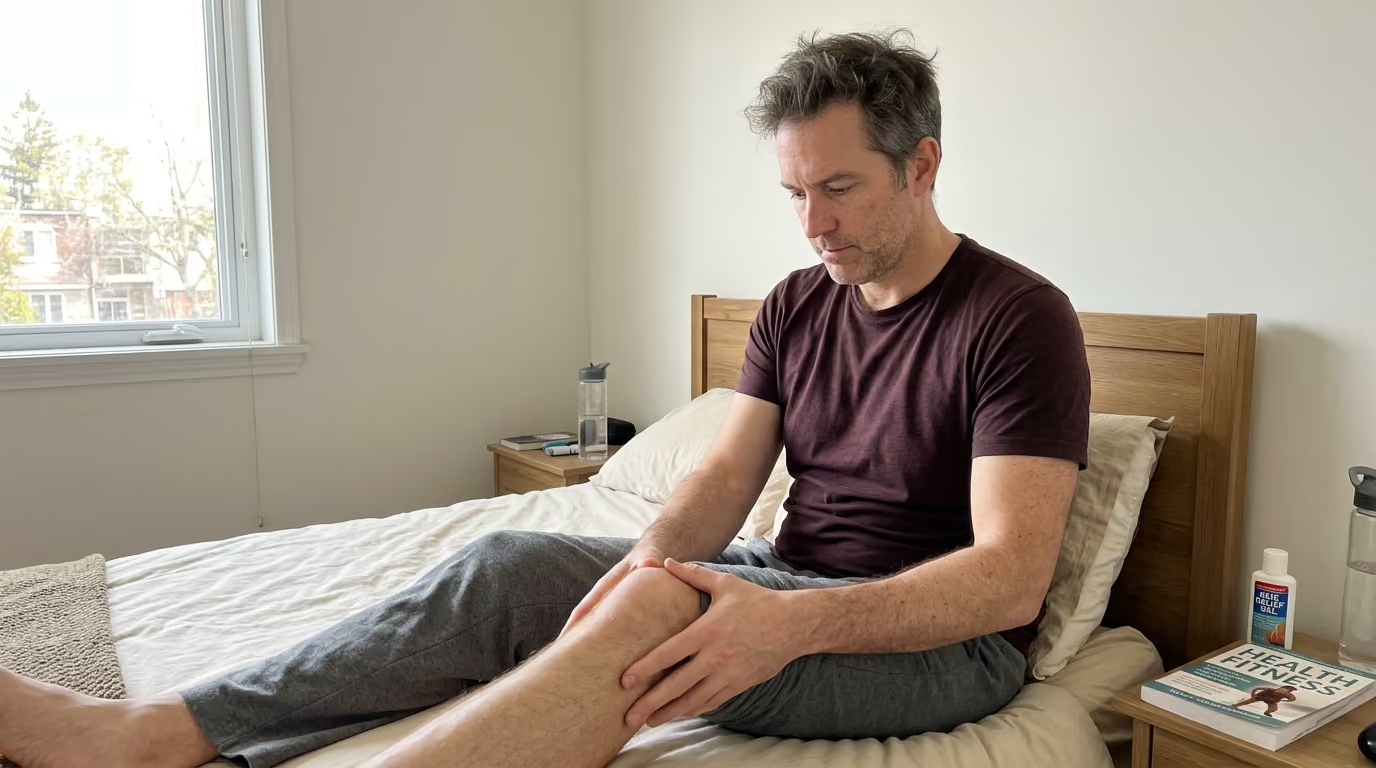

Persistent fatigue, sluggish workouts, and disrupted sleep indicate accumulated stress that requires tracking key physiological markers and tier-based.





Why do workouts that felt effortless last week suddenly feel like wading through wet concrete? Many active adults search for answers to that exact question after noticing their energy dip, their joints ache, and their motivation evaporate.
Fatigue is a natural part of physical training, but when fatigue accumulates faster than your body can adapt, performance drops and injury risk climbs. This resource delivers a definitive decision system to help you distinguish between normal training tiredness and the early stages of systemic breakdown.
Active performance after 40 requires a deliberate approach to physical stress. When you balance demanding work, family commitments, travel, and regular exercise, your nervous system processes all of it as a single combined load. Recovery is not a passive luxury or an afterthought. It is the active physiological process that restores your physical capacity, replenishes cellular energy, and rebuilds muscular strength.
This manual provides a practical, field-tested method for tracking five distinct recovery domains. By watching for multi-day trends across your performance, physical sensations, sleep, mood, and resting biometrics, you can make intelligent daily adjustments. You will know exactly when to push forward, when to scale back, and when to stop entirely.
Your body does not separate stress into neat, independent categories. Physical strain from a heavy squat session, mental stress from a professional deadline, and physiological disruption from a red-eye flight all draw from the same reserve. When you apply stress through exercise, your body breaks down tissue, consumes glycogen, and activates the sympathetic nervous system. Recovery is the biological window where protein synthesis repairs muscle fibers, hormones rebalance, and the parasympathetic system restores calm.
To manage your physical longevity, you must understand the spectrum of fatigue. In exercise science, fatigue begins as acute tiredness immediately following a workout. If you provide adequate nutrition and sleep, your body undergoes supercompensation. This process allows your muscles and cardiovascular system to rebuild slightly stronger than before.
When you increase your training load over several days or weeks, you enter what researchers term functional overreaching. In this state, your performance drops temporarily for a few days to two weeks. With planned rest, your performance rebounds higher than your baseline. This is the productive mechanism behind athletic progression.
The danger arises when stress continues without adequate restoration, leading to nonfunctional overreaching. In this phase, physical capacity drops for three to four weeks or longer. You experience persistent heaviness, sleep disruptions, and psychological irritability without gaining any physical improvement. If nonfunctional overreaching is ignored, it can spiral into overtraining syndrome.
Overtraining syndrome is a severe clinical state characterized by long-term neuroendocrine, hormonal, and autonomic dysfunction. According to the joint consensus from the European College of Sport Science and the American College of Sports Medicine, overtraining syndrome involves a performance decline lasting longer than two months. It is accompanied by profound mood disturbances, systemic fatigue, and immune suppression. Crucially, overtraining syndrome is a diagnosis of exclusion that requires ruling out underlying medical conditions, chronic infections, and severe nutritional deficiencies.
Understanding training load helps prevent this systemic decline. Training load consists of two components: external load and internal load. External load measures the objective work you perform, such as miles run, kilograms lifted, or meters climbed. Internal load reflects the physiological and psychological cost of that work on your body.
A hill sprint session on eight hours of deep sleep creates a moderate internal load. The exact same hill sprint session performed after four hours of sleep and a contentious business meeting creates a severe internal load. Tracking both loads ensures you do not mistake a rising internal stress response for a lack of willpower.
To build a reliable recovery system, you must avoid relying on any single measurement. A poor night of sleep does not automatically ruin your physical readiness. A high readiness score on a wearable device does not mean your tendons are ready for heavy loads. A dependable decision framework relies on the convergence of five distinct domains.
Performance is your primary functional indicator. You do not need to test your maximum limits daily to assess readiness. Instead, observe your body's response to familiar, submaximal baseline tasks.
Watch for these warning signs during standard training sessions:
If your warm-up sets feel heavy and slow for three consecutive sessions, your nervous system is signaling incomplete recovery.
Your subjective perception of effort is a sensitive indicator of physiological readiness. Research on athlete monitoring demonstrates that subjective wellness ratings often reflect acute training load changes more rapidly than objective lab markers.
Pay close attention to how everyday movements feel. If walking up a flight of stairs produces heavy, burning quadriceps, your muscular system is still carrying residual fatigue. If an easy recovery run feels like a tempo effort, your internal load is elevated. Disproportionate breathlessness during low-intensity movement indicates that your cardiovascular and nervous systems have not fully regenerated.
Sleep is the ultimate foundation of physical and cognitive restoration. The American Academy of Sleep Medicine and the Sleep Research Society recommend that adults obtain at least seven hours of sleep per night to maintain metabolic, immune, and neuromuscular health.
When monitoring sleep for recovery, track several specific markers:
A single disrupted night causes minimal harm, but three consecutive nights of fragmented sleep impair glucose metabolism, reduce muscle protein synthesis, and alter motor control.
You must distinguish between benign delayed-onset muscle soreness and mechanical pain. Delayed-onset muscle soreness typically peaks between 24 and 72 hours after unaccustomed eccentric exercise. It produces a diffuse, symmetrical dull ache across the muscle belly that improves as you warm up.
In contrast, structural pain demands immediate caution. Watch for these mechanical warning signs:
Training through mechanical joint pain causes compensatory movement patterns that accelerate tissue damage.
Your psychological state provides direct insight into your autonomic nervous system balance. When systemic fatigue accumulates, your brain exhibits measurable behavioral changes before gross muscular failure occurs.
Key psychological indicators of incomplete recovery include:
When your mood and motivation decline alongside physical performance, your central nervous system requires restoration. For broader strategies on maintaining peak physical capacity, review our comprehensive healthy aging and performance resources designed for active adults.
Modern wearables provide valuable biometric data, but they must be interpreted through a clear analytical lens. Many active adults become overly focused on daily algorithm scores. A proprietary recovery score is simply an estimation based on a mathematical model, not an absolute physiological truth.
Resting heart rate serves as an accessible baseline metric. For accurate tracking, check your resting pulse immediately upon waking, before consuming caffeine, and before getting out of bed. An isolated morning elevation of two to three beats per minute is normal noise. However, an elevation of five to eight beats per minute across three consecutive mornings indicates systemic strain, dehydration, or an impending immune challenge.
Heart rate variability measures the microsecond variations between consecutive heartbeats. This variability is governed by the dynamic interaction between your sympathetic fight-or-flight system and your parasympathetic rest-and-digest system. Higher heart rate variability generally indicates a responsive autonomic nervous system and strong recovery capacity. Lower heart rate variability often reflects accumulated physiological or emotional stress.
To use heart rate variability effectively, follow these established guidelines:
A reader recently asked our team if they needed to adopt a complicated, three-hour morning routine they discovered online. We advised them against it. When we examined the underlying research, the measurable benefits were marginal compared to getting eight hours of quality sleep and lifting weights twice each week.
In our experience, it is remarkably easy to get distracted by extreme optimization protocols. Active adults achieve far superior long-term results by focusing on foundational recovery principles. To dive deeper into these foundational habits, explore our guides on recovery and sleep strategies that directly support cellular repair.
A field manual must provide clear, actionable rules. You need a systematic method to translate daily subjective and objective data into smart training adjustments. Use this four-tier traffic-light system to determine your daily training readiness.
You are operating with complete physical and systemic capacity. Your subjective wellness and objective biometrics align to support demanding physical training.
Your body is processing moderate stress from training, work, or lifestyle factors. One or two domains show mild disruption, but there is no evidence of systemic failure.
Multiple physiological and psychological systems are showing signs of strain. Continuing with high-intensity training in this state will accelerate nonfunctional overreaching.
This state indicates acute tissue injury, systemic illness, or severe neuroendocrine exhaustion. Training through these symptoms creates serious health risks.
Applying recovery science becomes essential when you take your physical fitness into real-world environments. Demanding mountain sports, remote expeditions, and international travel present combined environmental stressors that accelerate fatigue.
Consider an active individual preparing for a week of backcountry skiing or high-altitude trekking. The external load includes thousands of vertical feet of climbing, heavy pack weight, and sustained muscular contraction. Simultaneously, cold air, lower oxygen pressure, and caloric expenditure increase the internal physiological load.
In an alpine environment, do not wait for complete muscular exhaustion before adjusting your daily pace. If your morning resting pulse is elevated by ten beats per minute at altitude, your cardiovascular system is working overtime to acclimatize. Pushing through severe fatigue in remote terrain impairs motor control, increases the risk of falls, and compromises decision-making.
Schedule an active recovery day every third or fourth day during high-output adventures. Keep your heart rate in a light aerobic zone, consume calorie-dense carbohydrates, and hydrate with electrolytes.
International travel presents another complex recovery challenge for active adults. Crossing multiple time zones disrupts your suprachiasmatic nucleus, the master circadian clock in your brain. This desynchronization impairs nighttime melatonin production and alters natural cortisol rhythms.
When arriving in a new time zone after long-haul transit:
Applying these adjustments ensures you maintain high physical capability throughout international trips. For expanded strategies on staying resilient across diverse environments, review our practical articles on travel and adventure performance.
Misunderstandings regarding human recovery often lead active adults to make poor training decisions. Clearing away these common myths will protect your physical longevity and improve your training consistency.
Many individuals believe that a workout is only effective if they experience crippling soreness the following morning. Delayed-onset muscle soreness is primarily a reaction to novel movement patterns and eccentric muscle lengthening. It indicates unfamiliar micro-trauma, not systemic adaptation or cardiovascular progress. Highly conditioned athletes often experience minimal soreness while making consistent strength and endurance gains.
Experiencing one bad training session is entirely normal. A single poor workout can result from dehydration, a heavy meal, ambient heat, or temporary mental distraction. As established in clinical exercise science, overtraining syndrome requires weeks of persistent performance decrements accompanied by psychological and physiological symptoms. Do not overhaul your training program because of one frustrating afternoon.
Complete physical stillness is rarely the most effective way to recover from normal training fatigue. Sitting on a couch all day slows circulation, reduces lymphatic drainage, and can leave your joints feeling stiff. Active recovery involves light aerobic movement, such as brisk walking, easy cycling, or mobility flows. These low-intensity activities enhance blood flow, deliver nutrients to recovering tissues, and accelerate metabolic clearance without adding systemic fatigue.
A wearable device tracks a limited set of physiological proxies, such as skin temperature, pulse rate, and heart rate variability. It cannot feel your tendon inflammation, assess your mental clarity, or detect an emerging respiratory infection. If your wearable reports a 95 percent readiness score, but your knee hurts and you feel dizzy, trust your subjective symptoms every time.
Ignoring structural pain is the fastest way to turn a minor soft-tissue irritation into a chronic tendon pathology. Ordinary training discomfort feels diffuse, symmetrical, and fades as your muscles warm up. Pain that is sharp, asymmetrical, or localized to a joint indicates mechanical stress that requires load modification. Adjusting an exercise early protects your long-term consistency. To maintain long-term muscular strength without joint irritation, consult our guide on performance and fitness training.
You do not need complicated laboratory equipment, frequent blood draws, or complex spreadsheets to monitor your recovery. Sustainable habits require simplicity and minimal daily friction. A two-minute morning routine provides all the data necessary to make informed training decisions.
Execute this simple daily readiness audit every morning upon waking:
If your scores remain within your normal baseline range, proceed with your scheduled physical training. If two or more markers drop significantly below your average for two consecutive days, shift your plan into the Yellow or Orange tier.
This streamlined process provides clear physiological insight without consuming your morning. Focusing on the vital few indicators keeps your training structured, effective, and enjoyable. To understand how consistent recovery habits support everyday vitality, review our foundational resources on healthy aging and living well.
Leading sports scientists, physical therapists, and exercise physiologists agree that sustainable physical capability after 40 depends on balancing training strain with systemic recovery. The human body does not grow stronger during the workout itself. The workout provides the stimulus, but functional adaptation occurs entirely during the recovery window.
The broader scientific community shares several fundamental conclusions regarding recovery management:
Applying these evidence-based principles allows active adults to maintain strength, athletic capability, and adventure readiness across their entire lifespan.
Use this checklist to implement this recovery monitoring manual over the next seven days:
Stay connected for research and practical guidance on longevity, strength, recovery, energy and active living. New ideas to help you stay capable, curious and ready for more.


Explore practical guidance on strength, recovery, energy, travel and longevity for a life that stays active.
explore the Blog