
Passive stretching cannot undo travel stiffness, but targeted mobility, submaximal isometrics, and nervous system down-regulation restore athletic function.





You drop your bags on the luggage rack after seven hours in transit. Your lower back feels compressed from the airplane seat, your hip flexors are locked into flexion, and your ankles feel puffy. You have an early trail run, an alpine ski day, or a demanding morning meeting tomorrow. The standard temptation is either to collapse directly onto the mattress or to force yourself through an aggressive gym session to undo the travel fatigue.
Neither extreme serves your body well. True physical restoration requires a precise, minimum effective dose of movement that restores joint mechanics without creating extra physiological debt.
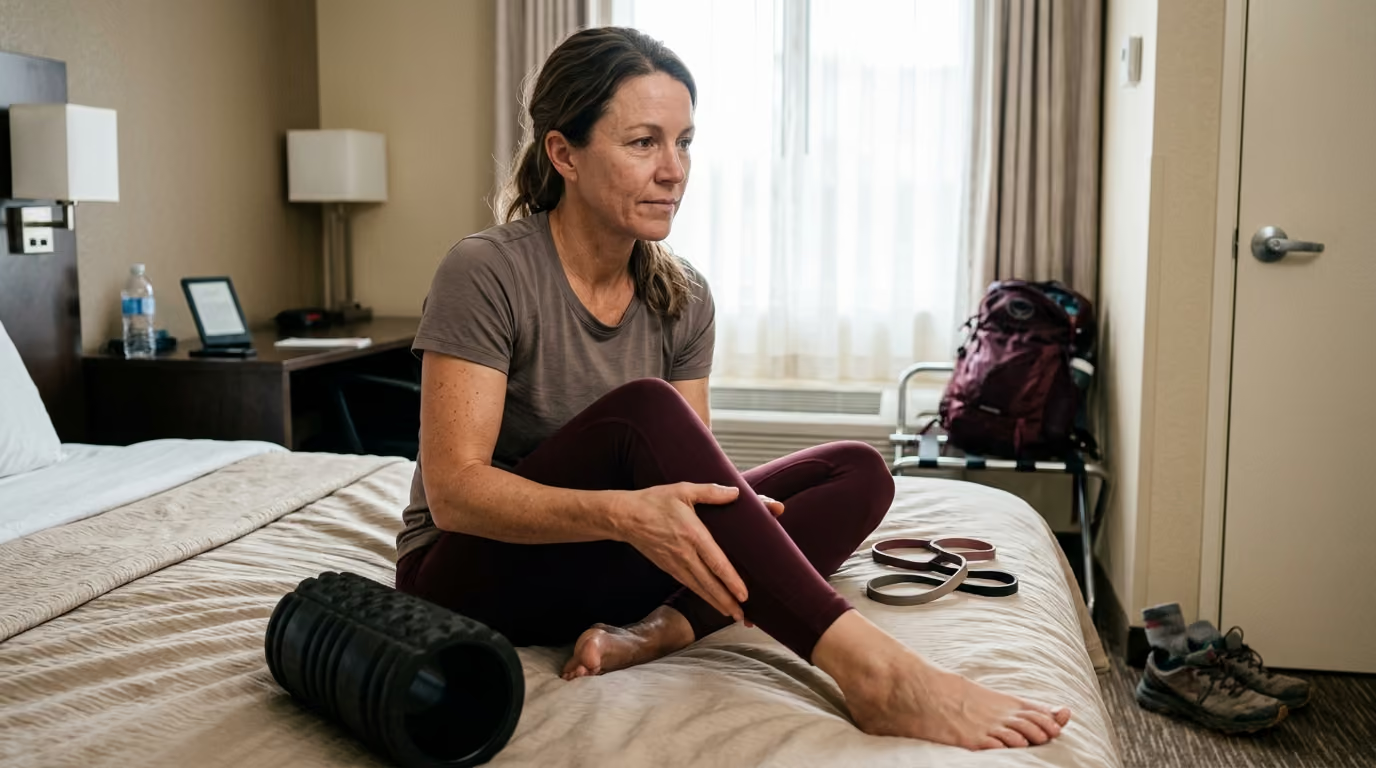
The goal of a hotel-room recovery routine is simple and practical. It restores movement quality, down-regulates a stressed nervous system, preserves baseline strength, and prepares your tissues for the next day of adventure or work. When structured correctly, a compact space, a sturdy chair, and fifteen minutes of targeted movement can reset your physical capacity. This guide provides a comprehensive, research-backed blueprint designed specifically for active adults managing the dual demands of physical performance and frequent travel.
Physical recovery changes after age 40 due to subtle shifts in tissue hydration, tendon stiffness, baseline metabolic rate, and autonomic nervous system regulation. When you combine these biological realities with the physical constraints of travel, the body responds with distinct protective mechanisms. Understanding these changes allows you to address stiffness intelligently rather than aggressively forcing tight muscles into extreme ranges of motion.
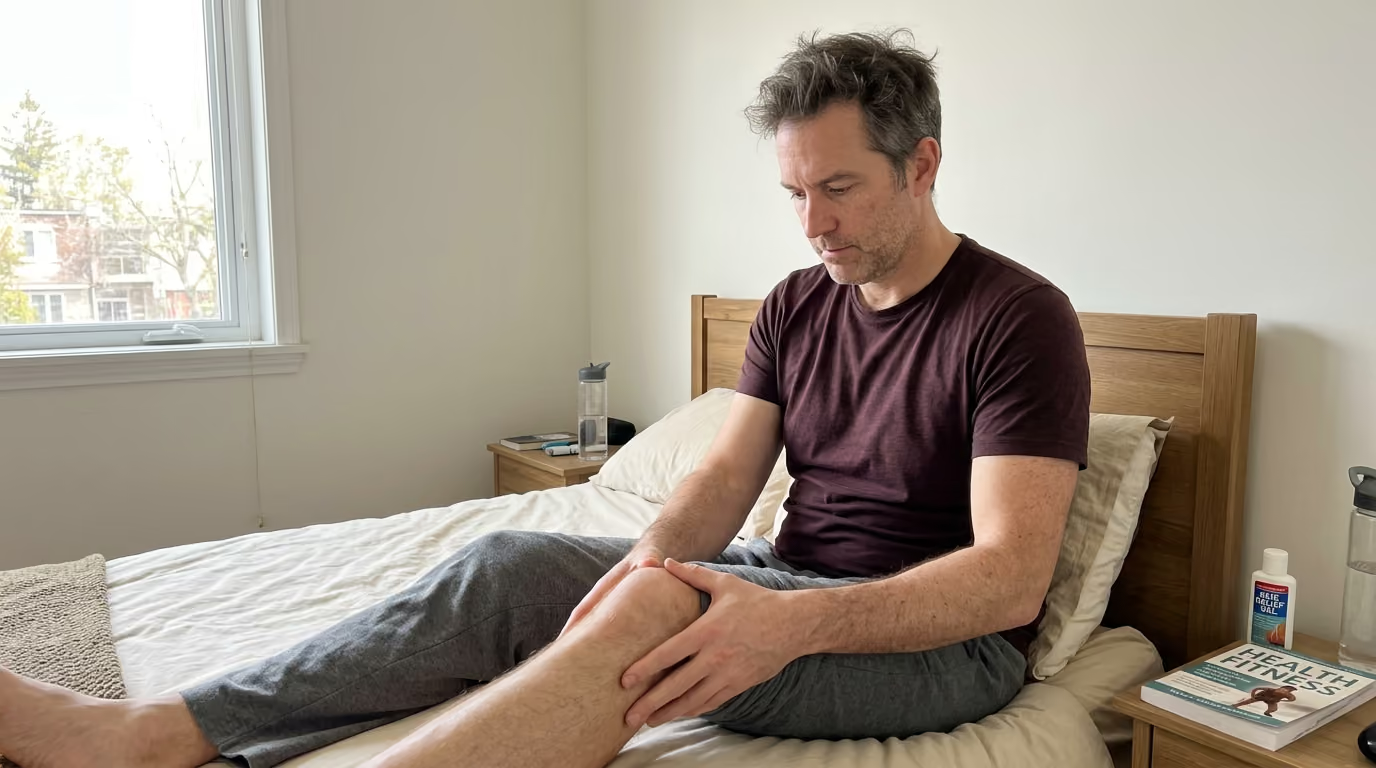
Prolonged sitting in planes, trains, or rental cars places the hips, spine, and knees into fixed, passive positions for hours. This prolonged lack of movement reduces venous return from the lower extremities, which leads to fluid accumulation in the feet and calves. At the same time, the neuromuscular system down-regulates muscle activation around the glutes and deep hip rotators, while tonic muscles like the hip flexors and lumbar erectors become stiff from maintaining static posture.
Research shows that physical capacity and joint function depend heavily on regular movement exposure. When active movement drops, joint capsule lubrication decreases, temporarily reducing usable range of motion. For active adults over 40, this stiffness is often protective guarding rather than permanent tissue shortening. Aggressive stretching can irritate guarded tissues, whereas active, low-load movement signals the nervous system that it is safe to release tension.
Travel also creates systemic physiological stress that goes beyond simple muscle tightness. Pressurized cabin air, altered meal timings, dehydration, and disrupted circadian rhythms stimulate sympathetic nervous system arousal. This heightened state of physical alertness raises resting heart rate, elevates baseline cortisol, and alters normal sleep architecture. A recovery routine must therefore address both local joint mechanics and the central nervous system to establish true physical readiness.
An effective hotel-room routine does not attempt to reproduce a full athletic facility workout. Instead, it relies on five foundational pillars that target tissue quality, motor control, and neurological state.
Flexibility refers to the passive length of a muscle when pulled by an external force. Mobility represents the active, usable range of motion you can demonstrate with motor control and strength. Sitting in a passive stretch for several minutes may temporarily change tissue sensation, but it does not teach the central nervous system how to stabilize the joint.
Hotel recovery should prioritize dynamic, controlled movement patterns. Movements like slow hip hinges, supported split squats, thoracic spine rotations, and ankle mobilization drills restore active joint ranges. These drills send sensory feedback to the spinal cord, improving local circulation and resetting resting muscle tone far more effectively than static stretching alone.
An isometric contraction occurs when muscle fibers produce tension without changing the joint angle. In a hotel room, isometrics offer significant advantages. They require zero specialized equipment, generate no floor impact or noise, and allow you to regulate mechanical tension precisely.
Isometrics serve two primary purposes on the road. First, moderate-intensity holds of twenty to forty seconds improve tendon stiffness and joint stability without creating muscle soreness. Second, isometric contractions provide safe, high-threshold motor unit recruitment when dynamic movement feels irritated after long travel days. Movements like wall sits, single-leg glute bridge holds, and side planks reinforce core and lower-body stability without adding mechanical wear.
Breathing mechanics directly influence autonomic nervous system tone. When travel stress keeps the body in a prolonged sympathetic state, deliberate slow breathing shifts the system toward parasympathetic dominance. This transition lowers heart rate, promotes vasodilation, and improves readiness for restorative sleep.
Research published in peer-reviewed physiological reviews shows that voluntary slow breathing significantly increases vagally mediated heart-rate variability both during the practice and immediately afterward. A systematic review covering over two hundred studies confirmed that slow, controlled respiration enhances respiratory sinus arrhythmia and supports autonomic balance. A practical hotel protocol emphasizes unforced nasal inhalation for four seconds followed by an extended, smooth exhalation for six seconds.
Physical recovery is incomplete without quality sleep. The Centers for Disease Control and Prevention recommends seven or more hours of sleep per night for adults aged 18 to 60, and seven to nine hours for adults aged 61 to 64. When travel cuts into your available sleep window, an intense late-night workout is often counterproductive.
Creating an optimal sleep environment in a hotel room requires active management. Hotel rooms are frequently overheated, excessively dry, and compromised by ambient light from electronic devices and streetlights. Prioritizing a cool room temperature, using blackout curtains or an eye mask, eliminating screen use thirty minutes before bed, and utilizing quiet breathwork will generate far greater recovery returns than an exhaustive late-night fitness session.
Autoregulation means adapting the duration and intensity of your physical routine to match your current physiological state. Rather than following a rigid, unchanging plan, you assess your readiness using a simple three-tier traffic-light model:
The following routines use the "Restore, Reinforce, Rehearse" framework. Perform each exercise with deliberate, controlled pacing. Focus on smooth breathing and high-quality movement execution rather than speed or fatigue.
Use this sequence immediately after checking into your room, particularly after flights or multi-hour drives. It breaks the posture of prolonged sitting and restores blood flow.
Spend sixty seconds walking naturally around the room or down the hallway. Focus on an upright posture, letting your arms swing freely to re-establish normal gait mechanics.
Stand in front of the hotel bed or a sturdy chair with feet shoulder-width apart. Hinge at your hips, lower yourself slowly until your glutes touch the edge, pause for one second without relaxing, and stand up by driving through your heels. Complete five controlled repetitions.
Place one hand on the desk or wall for balance. Step backward with your right leg, lowering your back knee toward the floor until both knees reach a ninety-degree angle. Press through your front foot to return to standing. Complete four slow repetitions per leg.
Stand with feet hip-width apart and hands resting on a wall. Rise up onto the balls of your feet over two seconds, hold the top position for two seconds, and lower slowly over three seconds. Perform ten repetitions to stimulate venous return.
Place your left hand against the wall at shoulder height. Reach your right arm forward, then sweep it in an open arc across your body and behind you, following your hand with your eyes. Rotate your upper back while keeping your hips facing forward. Perform six slow repetitions per side.
Stand tall with relaxed shoulders. Inhale quietly through your nose for four seconds, expanding your ribcage in all directions. Exhale slowly through your nose for six seconds. Complete five breath cycles.
This sequence targets the most common trouble areas resulting from long-distance transit: stiff ankles, restricted hip flexors, deactivated glutes, and a rigid thoracic spine.
Kneel on the carpet with your right foot forward, knee bent at ninety degrees. Keep your right heel firmly planted on the floor. Slowly glide your right knee forward directly over your middle toes until you feel a gentle stretch in your Achilles tendon and calf. Hold for two seconds, return to the start, and repeat for eight repetitions per side.
Stand with feet hip-width apart and soft knees. Place your hands on the creases of your hips. Push your hips straight back toward the wall behind you while maintaining a flat spine and proud chest. Stop when your torso reaches roughly forty-five degrees, squeeze your glutes, and return to standing. Complete eight smooth repetitions.
Lie on your left side on the carpet with knees bent at ninety degrees and arms extended straight out in front of your chest. Keep your knees glued together on the floor. Slowly lift your right arm up and rotate it across your body toward the floor behind you, turning your head with it. Hold the open position for two deep breaths, then return. Perform six repetitions per side.
Kneel on your left knee with your right foot flat on the floor in front of you. Tuck your pelvis underneath your torso by squeezing your left glute, creating a posterior pelvic tilt. Without arching your lower back, shift your entire pelvis forward two inches until you feel tension across the front of your left hip. Hold for thirty seconds while breathing deeply, then switch sides.
Lie flat on your back with knees bent and feet flat on the floor, hip-width apart. Drive through your heels to raise your hips until your thighs and torso form a straight line. Squeeze your glutes firmly at the top for three full seconds without hyperextending your lower back. Lower down under control for eight to ten repetitions.
Lie on your side with your elbow under your shoulder and knees bent at ninety degrees. Lift your hips off the floor, creating a straight line from your head through your knees. Hold this position for twenty seconds per side, focusing on keeping your abdominal wall braced and breathing steadily.
Lie on your back on the carpet with your calves resting on the edge of the bed or a chair. Place one hand on your lower belly and one hand on your upper chest. Inhale through your nose for four seconds, allowing your belly to rise. Exhale slowly through slightly parted lips for six seconds. Continue for sixty seconds.
When you have dedicated time before dinner or after a demanding day of outdoor activity, this routine balances nervous system down-regulation, multi-planar mobility, and low-fatigue strength reinforcement.
Lie comfortably on the floor with your eyes closed. Inhale through your nose for four seconds, pause for one second, and exhale through your nose for six seconds. Repeat for twelve complete breath cycles to lower resting sympathetic tone.
Walk slowly around the room for sixty seconds to allow blood flow to normalize. Drink eight to twelve ounces of water to replenish travel fluid loss.
This routine is not a recovery session in the strict sense. It is a strength-maintenance workout for days when travel prevents access to a gym, but your readiness is high and you need to keep neuromuscular pathways primed. To explore our broader library of training protocols, consult our healthy aging and performance resources.
Complete two to three rounds of the following sequence at a moderate effort, resting forty-five seconds between movements:
Recovery demands vary based on the specific physical stressors of your itinerary. A day on the ski slopes requires a different post-activity routine than a six-hour business flight or a mountain trail run. Learn more about balancing physical readiness with active itineraries in our travel and adventure articles.
Downhill skiing and mountain hiking subject the lower body to substantial eccentric loading. This mechanical stress causes microscopic muscle damage in the quadriceps, calves, and glutes.
After a day on the slopes or trails, avoid high-repetition bodyweight leg workouts or aggressive static hamstring stretching. Instead, focus on joint decompression and passive venous return. Perform five minutes of half-kneeling ankle mobilizations to restore ankle dorsiflexion lost in stiff boots.
Follow this with the legs-elevated supine position, resting your calves on the edge of the bed for five minutes while practicing diaphragmatic breathing. Conclude with gentle glute bridges and hip-flexor resets to restore pelvic alignment without adding muscular fatigue.
Running in a new city is an exceptional way to explore, but combining a morning run with an afternoon flight can leave the Achilles tendons and lumbar spine irritated. When managing tight timelines, review our guidance in recovery and regeneration to keep joint tissues healthy.
Prioritize single-leg stability and calf tendon health. Perform two sets of fifteen controlled calf raises with a distinct top pause to load the Achilles tendon smoothly. Follow this with single-leg balance drills and side-lying thoracic open books.
Protect your sleep window before a morning race or long training run. If you arrive late at your destination, choose a ten-minute mobility sequence over a forty-minute run to prevent training while compromised.
Business travel combines prolonged sitting with psychological demands, irregular meals, and limited movement opportunities. The primary physical consequences are hip extension restriction, forward head carriage, and spinal compression.
Upon arrival, your primary tool is the five-minute reset sequence combined with a brisk ten-minute walk outside or through hotel hallways. Before sleeping, execute the ten-minute stiffness sequence, placing extra emphasis on thoracic spine rotation and prone back extensions. Avoid working on your laptop in bed, which encourages poor cervical spine posture right before sleep.
Rotational sports require adequate mobility through the thoracic spine and hips to protect the lumbar spine from excessive torque. Long drives or flights restrict rotational capacity.
Focus on side-lying open books, half-kneeling hip flexor resets, and bird dogs with a rotational tap. Reinforce this mobility with short twenty-second side planks to prime the oblique abdominal muscles that decelerate rotational forces during the golf swing.
True physical restoration is impossible when your internal biological clock is out of alignment with your environment. Jet lag disorder occurs when crossing time zones disrupts the synchronization between the central circadian pacemaker in the brain and local environmental cues like sunlight and food.
The Centers for Disease Control and Prevention Yellow Book outlines clear behavioral strategies for managing circadian disruption during travel. Rather than relying on passive rest, active travelers can use light exposure, movement timing, and meal scheduling to shift their circadian rhythm rapidly.
Traveling eastward requires advancing your circadian clock to an earlier local schedule. This direction is generally more challenging for active recovery because it compresses your normal sleep window.
Traveling westward requires delaying your circadian clock to a later local schedule.
Hotel rooms rarely come optimized for restorative sleep. Taking three minutes to prepare your room creates significant recovery benefits:
For deeper insights into creating optimal sleep conditions on the road, explore our guide to restorative sleep strategies.
Many common recovery practices rest on outdated training myths or oversimplified advice. Eliminating these mistakes protects your time and energy on the road.
A common assumption is that holding aggressive static stretches for tight hamstrings or hip flexors repairs tissue damage from travel. Static stretching temporarily alters pain tolerance, but it does not accelerate muscle protein synthesis or clear metabolic waste products. In fact, aggressively pulling on a muscle that is already sore or strained can provoke protective muscular spasm. Active mobility and low-load contractions are far more effective for restoring functional movement.
Because isometric exercises do not involve joint movement, travelers often underestimate their physiological cost. A sixty-second maximal wall sit or extended plank creates significant neuromuscular tension and fatigue. When your goal is recovery rather than capacity building, keep isometric holds to a moderate effort level of five to six on a ten-point scale.
Many people judge the effectiveness of an exercise session by how much they sweat. Sweating is simply a thermoregulatory response to dissipate heat, not an indicator of cellular repair or joint restoration. A successful hotel-room recovery session should leave you feeling refreshed, agile, and grounded, not drenched and exhausted.
Heart-rate variability is a valuable physiological marker, but an acute increase in HRV following a slow breathing drill simply reflects immediate vagal nerve stimulation. It does not prove that muscle glycogen stores are replenished, that connective tissue inflammation has cleared, or that you are ready for a maximal training load. Use breathing drills as an arousal management tool, not as an excuse to ignore physical fatigue.
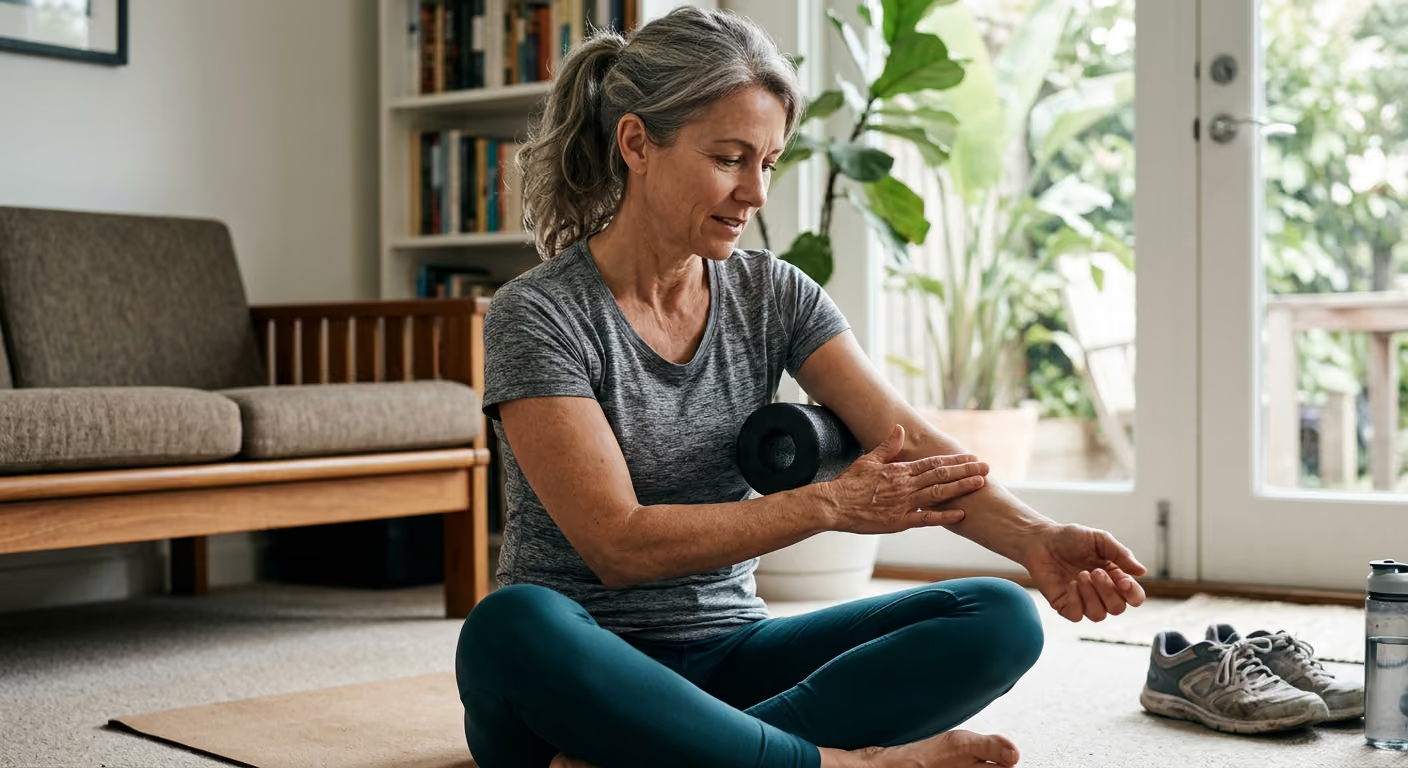
Systematic reviews demonstrate that foam rolling can increase short-term joint range of motion without impairing muscular power output, with an effect size around 0.76 for range of motion improvements. Research suggests that rolling durations of ninety to one hundred twenty seconds per muscle group can help reduce the sensation of delayed-onset muscle soreness.
However, rolling aggressively over bony prominences, the lumbar spine, or acutely inflamed tendons can cause bruising and trigger protective muscle guarding. If you use a travel massage ball or foam roller, apply moderate pressure over large muscle bellies like the glutes, calves, and upper back, avoiding painful or acutely swollen areas.
When traveling, time and energy are finite resources. Knowing how to dose your physical movement ensures you maintain athletic capacity without compromising work, family, or adventure schedules. Discover more about balancing training volume in our strength and physical performance section.
The World Health Organization physical activity guidelines recommend that all adults achieve 150 to 300 minutes of moderate-intensity aerobic activity or 75 to 150 minutes of vigorous aerobic activity each week. In addition, the WHO explicitly recommends muscle-strengthening activities involving all major muscle groups on two or more days per week. For adults over 40 maintaining long-term physical independence, the WHO emphasizes varied multicomponent balance and strength training on three or more days per week to enhance functional capacity and prevent falls.
Importantly, the WHO emphasizes that any amount of physical activity is better than none. When long flights, meetings, or busy schedules eliminate your standard two-hour gym window, dividing movement into five- to fifteen-minute blocks throughout the day helps preserve physical capacity.
To maintain movement quality and joint health while traveling, aim for the following weekly baseline:
The broader scientific consensus across exercise physiology, physical therapy, and sleep medicine supports several definitive principles for travelers:
Systematic reviews and meta-analyses examining resistance training and mobility exercise confirm that regular, multi-joint resistance loading improves lower-extremity strength, walking speed, and functional balance. Research shows that maintaining muscle strength through compound bodyweight patterns and isometrics preserves joint integrity and functional mobility during travel periods.
Controlled breathing research confirms that voluntary slow breathing at five to six breaths per minute significantly increases vagally mediated heart-rate variability and respiratory sinus arrhythmia. While breathwork cannot instantly repair structural tissue damage, it is a proven, non-pharmacological tool for down-regulating sympathetic arousal and facilitating transition into sleep.
Large-scale public health data from the CDC and sleep research organizations confirm that sleeping less than seven hours per night correlates with impaired cognitive function, elevated injury rates, reduced immune function, and slower neuromuscular recovery. Exercise routines should support sleep timing rather than replace it.
When dealing with non-acute travel stiffness or mild training soreness, low-intensity active movement is superior to passive bed rest. Active muscle contractions stimulate blood flow, encourage lymphatic drainage, maintain joint capsule health, and reassure the central nervous system that movement is safe.
Bookmark this resource and review its protocols whenever you prepare for cross-country or international travel, when planning a multi-day outdoor adventure trip, or when recovering from long sedentary transit days. Revisit the specific movement routines before your next trip to ensure your travel toolkit remains sharp, practical, and effective.
Maintaining physical capacity and joint freedom throughout a lifetime of travel does not require an entire gym floor. It simply requires a clear understanding of your physiology, a few square feet of open carpet, and the discipline to apply the minimum effective dose of restorative movement.
Stay connected for research and practical guidance on longevity, strength, recovery, energy and active living. New ideas to help you stay capable, curious and ready for more.


Explore practical guidance on strength, recovery, energy, travel and longevity for a life that stays active.
explore the Blog