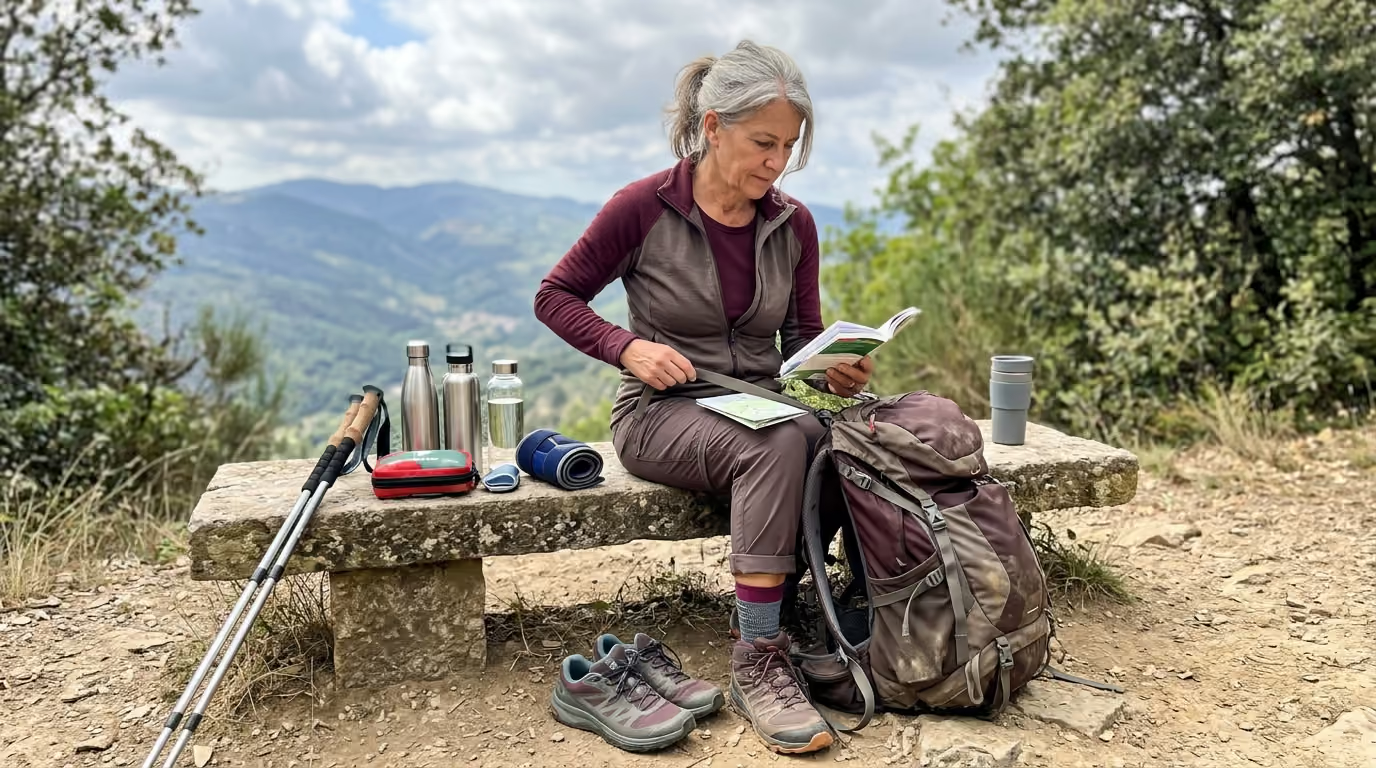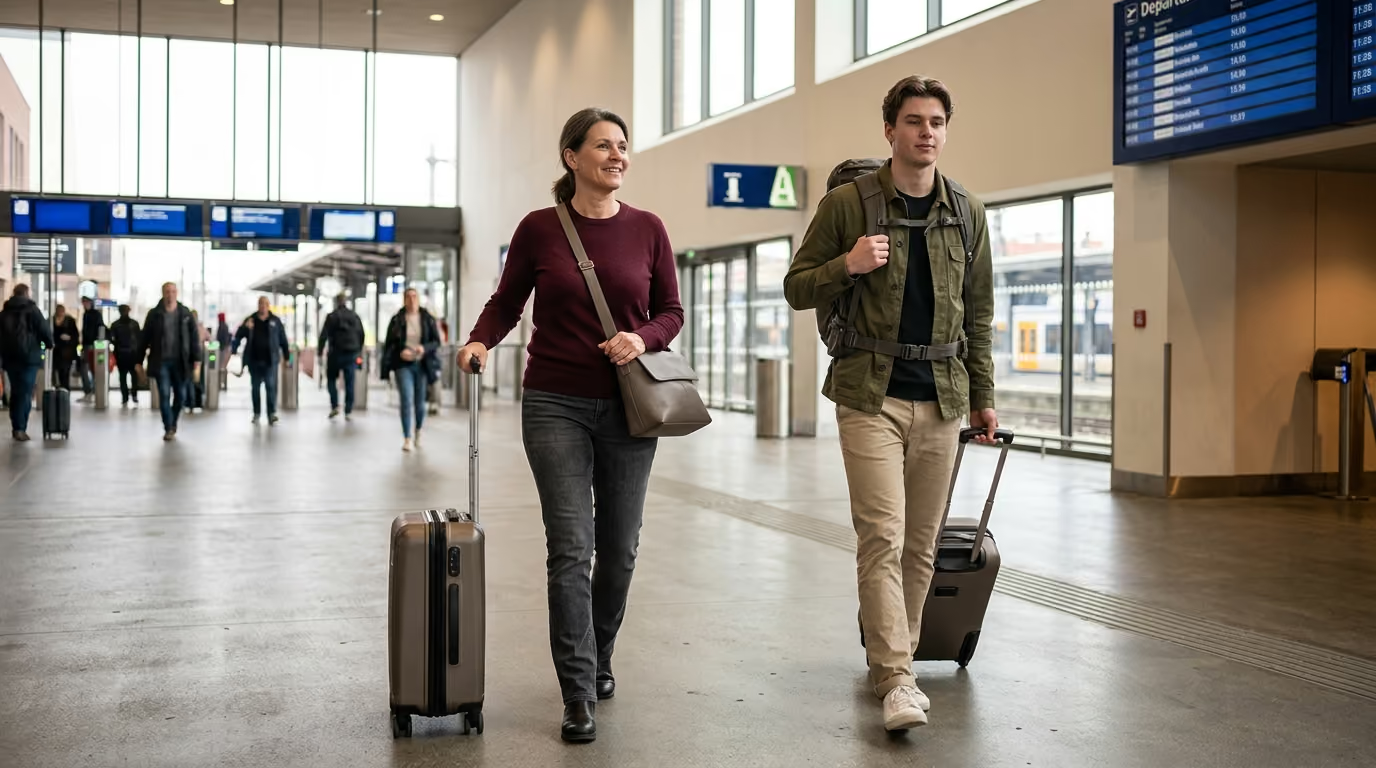

Five essential biomechanical variables determine how different luggage styles, carrying positions, and fatigue alter spinal curvature and physical strain.





You have just stepped off a ten-hour flight into a crowded terminal. Your neck is stiff from sleeping upright, and you need to lift a dense twenty-kilogram suitcase from the baggage carousel. You haul it onto the floor with one arm, hoist your camera bag over your right shoulder, and begin the half-mile walk toward the train station. Within ten minutes, your opposite lower back begins to ache, your shoulder tightens, and your walking pace slows.
This scenario is familiar to nearly every frequent traveler. Physical strain during travel is rarely caused by a single dramatic injury. Instead, it results from the cumulative demands of carrying uneven, shifting, or excessive mass across unfamiliar environments.
Managing travel loads requires an understanding of how external weight interacts with human biomechanics. Travel luggage is not merely a weight problem. The same mass creates completely different physical stresses depending on whether it is carried symmetrically on your back, pulled behind on wheels, held in one hand, or lifted overhead.
By applying proven ergonomic principles to how you pack, lift, and carry your gear, you can protect your spine, preserve your energy, and arrive at your destination ready for adventure.
Every piece of luggage you transport changes your body mechanics. When you pick up a bag, your musculoskeletal system instantly integrates that external mass into your own center of mass. To remain upright and mobile, your muscles, joints, and connective tissues must generate counteracting forces.
Ergonomic research evaluates travel loads across five primary variables.
Load magnitude refers to the absolute weight of your luggage. However, absolute weight tells only part of the story. Biomechanists evaluate relative load, which is the mass of the luggage expressed as a percentage of your body mass.
A ten-kilogram bag imposes a very different cardiovascular and mechanical demand on an individual weighing sixty kilograms compared to someone weighing ninety kilograms. Research on backpack carriage demonstrates that relative loads exceeding twenty percent of body mass produce significant alterations in walking mechanics and increase physical strain. For mature adults, a 2025 systematic review noted that symmetrical loads below five percent of body mass produce no measurable disruption to normal walking patterns. While five percent serves as a conservative benchmark, keeping your total carried gear within ten to fifteen percent of your body weight represents a sensible target for active travelers.
Where a load sits relative to your spine determines the internal force required to hold it. This relationship is defined by the moment arm, which is the horizontal distance between the center of mass of the luggage and the pivot point in your joints.
If you hold a nine-kilogram suitcase close to your thighs, the moment arm is short. Your back muscles perform minimal extra work to keep you upright. If you extend that same suitcase thirty centimeters away from your body, the mechanical leverage multiplies the compressive forces on your lumbar spine. This is why packing heavy items far away from your body inside a backpack or holding luggage away from your torso causes rapid muscular fatigue.
Symmetrical carriage distributes external mass evenly across both sides of the body. A properly fitted backpack with two shoulder straps is the classic example of symmetrical loading.
Asymmetrical carriage concentrates the entire load on one side, such as a rolling duffel pulled with the right arm, a shoulder bag, or a heavy briefcase carried by the handle. When you walk with an asymmetrical load, your spine tilts laterally. Your contralateral paraspinal muscles must contract continuously to prevent you from falling toward the weighted side. This creates uneven spinal compression, shortens your step length, and increases lateral hip torque.
A stable load maintains a fixed center of mass as you move. An unstable load features loose contents that shift whenever you turn, accelerate, or step off a curb.
Unstable loads force your nervous system to make sudden, micro-corrective muscular contractions to preserve balance. In biomechanical testing of older adults, carrying unstable loads significantly reduced mediolateral dynamic stability and caused wider, less predictable step patterns. Securing the items inside your bags is just as important as reducing their overall weight.
Carrying a bag across a flat airport concourse requires far less effort than hauling that same bag up three flights of stairs at a boutique hotel.
Your physical capacity fluctuates based on sleep quality, hydration, previous physical exertion, and environmental friction. When travel tasks combine multiple risk factors, such as lifting an asymmetrical, heavy bag in a cramped aircraft aisle after hours of sitting, the potential for acute strain increases dramatically. Maintaining your functional capacity through strength and physical performance allows you to handle these inevitable travel demands with confidence.
Active travelers use a wide variety of luggage systems. Each style presents unique biomechanical advantages and physiological costs. Understanding these trade-offs allows you to select the right luggage for your specific itinerary.
A well-engineered backpack remains one of the most mechanically efficient tools for moving gear over distance. By securing the mass directly over your base of support, a backpack frees your hands and balances external forces across both shoulders.
However, backpacks are not universally ergonomic. As the weight inside a backpack increases, your body naturally leans forward to reposition the combined center of mass over your feet. This forward trunk inclination places sustained tension on the muscles of your neck, upper back, and lumbar spine.
To optimize a backpack, you must fit it systematically:
First, tighten the internal compression straps to pull all contents against the back panel.
Second, adjust the shoulder straps so the bottom of the pack rests near the top of your hip bones rather than sagging down over your glutes.
Third, engage the hip belt. A rigid, padded hip belt transfers up to seventy percent of the total load directly to the pelvis, bypassing the spinal column entirely.
Fourth, buckle the sternum strap across your chest. This pulls the shoulder straps inward, freeing your arms to swing naturally and relieving localized pressure on the brachial plexus nerves. Research published in 2024 confirmed that utilizing chest and hip belts improves pressure symmetry across the shoulder and trapezius regions during sustained walking.
Many travelers rely on single-strap shoulder bags or cross-body messengers for cameras, electronics, or business documents. Unfortunately, biomechanical modeling indicates that shoulder bags produce the highest lumbar disc compression and paraspinal muscle activation of any common bag style.
When you hang a dense bag over one shoulder, your body instinctively elevates that shoulder and leans the torso toward the opposite side to keep the strap from slipping. This posture creates persistent asymmetric shear forces across the intervertebral discs.
A cross-body strap offers superior stability compared to an open shoulder strap by preventing the bag from swinging forward when you walk. However, a cross-body strap does not eliminate load asymmetry. It merely anchors an unbalanced weight against your torso. If you must use a shoulder bag, keep the total weight under five kilograms and switch carrying sides every fifteen minutes.
Carrying a traditional suitcase by its top handle creates a unilateral carrying task similar to the farmer's walk exercise used in strength training. While this movement builds grip and core strength in controlled gym environments, it is poorly suited for long-distance transit.
Carrying a heavy bag in one hand forces the quadratus lumborum and obliques on the opposite side of your torso to work at high intensity. This asymmetrical effort alters your normal gait cycle. You will take shorter steps, decrease your walking cadence, and widen your stance to maintain lateral balance.
If you must carry luggage by hand, divide the contents into two equal bags. Carrying two ten-kilogram bags symmetrically, one in each hand, generates significantly less spinal shear stress than carrying a single twenty-kilogram bag on one side.
Wheeled suitcases have transformed modern transit by transferring the static weight of the luggage directly onto the ground. On smooth, polished airport floors, a rolling suitcase demands minimal muscular effort.
Yet rolling luggage is not entirely free of physical strain. Pulling a two-wheeled suitcase behind your body forces your arm into extension and internal rotation, accompanied by continuous trunk rotation toward the pulling side. Over long distances, this repetitive twisting can irritate the rotator cuff and strain the lower back.
Four-wheeled spinner bags reduce this twisting motion by allowing you to push the suitcase alongside your body with an upright, neutral spine. However, wheels lose their mechanical advantage the moment you encounter carpet, cobblestones, curbs, or stairs. Dragging a wheeled bag over high-friction surfaces or hoisting it over architectural barriers turns a rolling task into an awkward, high-torque lifting event.
Active travel often involves carrying bulky sports equipment, such as golf bags, ski tubes, bicycle travel cases, or surfboards. These items present unique ergonomic challenges because their physical dimensions extend far beyond your body's footprint.
The primary risk with sports gear is the extended lever arm. A two-meter ski bag held at its midpoint still concentrates significant rotational torque on your wrists and shoulders whenever you pivot or navigate crowded doorways. Furthermore, rigid cases prevent you from holding the center of mass close to your torso.
Whenever you travel with sports gear, use wheeled travel cases with rigid internal frames. When lifting long bags into vehicles or luggage racks, position your hands wide apart on the handles to establish control over rotational forces, and pivot by moving your feet rather than twisting your spine.
Fatigue during travel is not merely a subjective feeling of low energy. It is a physiological state that progressively compromises your movement mechanics and increases your risk of musculoskeletal strain.
When you are well-rested, your nervous system coordinates muscle activation patterns with high precision. As you walk with a load, your primary postural muscles contract smoothly to absorb ground reaction forces and keep your spine aligned.
Research on load carriage demonstrates that physical fatigue fundamentally alters spinal geometry. In laboratory studies of individuals carrying loads, researchers discovered that thoracic-to-lumbar spinal curvature changes significantly as fatigue sets in.
Crucially, external visual indicators, such as head angle and resting trunk inclination, often appear unchanged even after internal spinal curvature has shifted. You may look like you are standing upright, but your deep stabilizing muscles have begun to disengage. This forces passive structures, such as spinal ligaments and intervertebral discs, to absorb the mechanical stress of the load.
Carrying luggage over extended transit days creates localized fatigue in the muscles of the lower extremities. Electromyographic studies show that carrying heavy baggage significantly increases the activation of the tibialis anterior and soleus muscles in the lower leg compared to the larger muscles of the thighs.
These calf and shin muscles are responsible for fine ankle stabilization, foot clearance, and balance control. As these smaller muscles fatigue, your ability to clear low obstacles decreases. You begin to scuff your shoes against the floor, your step-to-step variability increases, and your capacity to recover from a minor stumble drops.
To prevent acute strain, you must learn to recognize the subtle biomechanical warning signs that indicate your musculoskeletal system is becoming overloaded:
When these signs appear, continuing to push forward with heavy gear invites injury. Taking a five-minute seated rest, checking your luggage at a station locker, or utilizing a luggage cart will restore your movement margins and protect your body for the rest of your trip.
For active adults over forty, traveling with heavy or awkward luggage introduces critical balance and stability considerations. Aging involves gradual, natural changes in sensory integration, proprioception, joint mobility, and muscular power. When you add a heavy, dynamic load to these baseline physiological changes, the margin for error narrows.
Your limit of stability is the maximum distance you can shift your center of mass in any direction over your base of support without taking a step or losing your balance.
Biomechanical research confirms that wearing a loaded backpack significantly reduces the limits of stability in older adults. Because the external pack occupies a large portion of your stability reserve, your body has less room to compensate for unexpected balance perturbations. If you are bumped in a busy terminal or step unexpectedly on an uneven curb, your nervous system must react much faster to prevent a fall.
Dynamic stability refers to your ability to maintain balance while your body is in motion. Walking is essentially a controlled series of falls from one leg to the other.
When you carry an unstable load, such as an uncompressed duffel bag where heavy items slide around inside, the shifting center of mass disrupts your dynamic stability. Studies show that older adults walking with unstable loads exhibit greater step-width variability and slower balance recovery times.
A 2024 investigation on balance recovery revealed that carrying backpack loads impairs backward balance recovery. When pulled backward, loaded individuals were less capable of executing effective reactive stepping responses. If your travel itinerary involves high-risk surfaces, maintaining your balance requires structured attention to healthy aging and living well.
Transit environments are filled with architectural features that elevate balance risks. You can mitigate these hazards by applying specific movement strategies:
Ergonomics begins long before you arrive at the airport. How you organize the interior of your luggage dictates how that mass will interact with your body throughout your journey. By packing according to mechanical principles, you can eliminate unnecessary strain before you take your first step.
Most travelers pack by item category: shirts in one section, shoes in another, electronics in an outer pocket. Ergonomic packing requires you to pack by material density.
Dense items, such as laptops, camera bodies, dense toiletry kits, and heavy footwear, concentrate significant mass into small volumes. Light items, such as down jackets, technical clothing, and base layers, occupy high volume with minimal mass.
In a backpack, the densest items must be placed directly against the back panel, positioned between the shoulder blades and the mid-back. Light items should fill the bottom of the pack and the outer perimeter.
This configuration keeps the combined center of mass high and tight against your spine. It minimizes the horizontal moment arm, preventing the backpack from pulling you backward and eliminating the need for excessive forward trunk lean.
In a wheeled suitcase, dense items should be packed at the bottom near the wheelbase. This low center of mass stabilizes the suitcase, preventing it from tipping over when you roll it around corners or pull it over uneven surfaces.
Loose contents act like fluid in a tank, shifting whenever you accelerate, brake, or turn. This internal movement creates dynamic instability that forces your stabilizing muscles to work overtime.
Use compression packing cubes to consolidate your clothing into rigid, modular bricks. Fill empty spaces inside your bag with soft items to prevent dense objects from sliding. Once your bag is packed, cinch down all exterior compression straps. If you can shake your bag without feeling the internal contents slide, your load is mechanically stable.
No ergonomic technique can fully compensate for an overloaded bag. Every unnecessary kilogram you pack represents hundreds of kilograms of cumulative force exerted across your joints over a full day of walking.
Audit your travel gear with strict discipline:
Applying these packing strategies ensures your transit days support your broader travel and human performance goals rather than draining your physical reserves.
Lifting luggage is fundamentally different from performing a controlled deadlift in a fitness facility. Travel lifts occur in confined spaces, under time pressure, and often when your body is stiff after hours of immobility.
The Revised National Institute for Occupational Safety and Health (NIOSH) Lifting Equation provides the scientific foundation for safe lifting. The equation defines an ideal lifting constant of 23 kilograms (51 pounds). However, this maximum weight applies only under perfect conditions: two hands, smooth motion, close to the torso, between knuckle and waist height, with no twisting.
In travel environments, non-ideal factors significantly reduce this safe threshold. Extended reach, lifting from the floor, hoisting overhead, and twisting reduce safe load limits by fifty percent or more.
Whenever you lift a suitcase or heavy duffel, execute this eight-step movement sequence:
Certain travel situations require tailored lifting adaptations.
Lifting a ten-to-fifteen-kilogram carry-on bag into an airplane overhead bin represents one of the highest-strain activities in travel. The lift requires moving a dense mass above shoulder height with an extended horizontal reach.
Never attempt to hoist a suitcase from the aisle floor directly into the overhead bin in one continuous movement. Use a two-stage lift instead.
Stage One: Lift the suitcase from the floor onto the armrest or aisle seat using a solid two-handed hip hinge.
Stage Two: Regrip the bag with one hand on the top handle and one hand on the bottom base. Step into the aisle, brace your core, and press the bag upward and forward into the bin using the power of your legs and shoulders. If the bin is high or the bag is heavy, ask a fellow passenger or flight attendant for assistance.
Loading luggage into a car trunk forces you to bend forward and reach outward, creating a long horizontal moment arm that strains the lower back.
To load a vehicle trunk safely, slide the bag as close to the trunk opening as possible before lifting. Rest the base of the suitcase on the trunk sill, and then slide the bag horizontally into the trunk space rather than carrying its full weight at arm's length.
Luggage carousels introduce dynamic movement to lifting tasks. As the carousel rotates, passengers often lunge forward to grab their moving bag, resulting in an awkward, twisting pull.
Stand close to the edge of the carousel and identify your bag well before it reaches you. As the bag approaches, position your body parallel to its movement. Grab the handle with both hands, allow the carousel's forward momentum to assist your initial pull, and guide the bag smoothly off the belt onto the floor.
A variety of popular myths surround travel ergonomics. Correcting these misconceptions helps you make informed decisions when selecting gear and navigating transit days.
Many travelers assume that because they can successfully hoist a heavy bag into a vehicle, they possess the physical capacity to carry it through a journey. Single-event lifting capacity reflects momentary peak strength, whereas carrying luggage is an endurance challenge.
Repetitive loading, long walking distances, and unexpected obstacles rapidly deplete muscular reserves. A bag that feels manageable during a five-second test at home can become a serious injury risk after twenty minutes of walking through a sprawling train terminal.
While backpacks distribute weight symmetrically across both shoulders, they are not inherently ergonomic. An overloaded backpack, a pack with loose shoulder straps, or a bag that hangs low over the buttocks forces severe forward head and trunk posturing.
Furthermore, wearing a heavy backpack increases spinal axial compression. For individuals with existing disc issues, a high-quality four-wheeled spinner suitcase pushed on smooth surfaces is often far less stressful on the spine than carrying a heavy backpack.
Rolling suitcases reduce the need to support static mass, but they do not eliminate mechanical stress. Pulling a two-wheeled bag behind you produces continuous asymmetrical torque across your shoulders and rotational shear through your lumbar spine.
Additionally, wheeled bags must still be lifted into car trunks, carried up stairways, and hauled over curbs. If a rolling suitcase is excessively heavy, its wheels create a false sense of security until you encounter an obstacle that requires manual lifting.
Travelers often believe that good ergonomics requires holding the spine completely straight and rigid. In reality, a healthy spine is designed to adapt, flex, and distribute forces dynamically.
Attempting to hold a completely rigid posture while carrying a load creates unnecessary muscular tension and accelerates fatigue. Ergonomic carrying focuses on maintaining a balanced, functional alignment with loads positioned close to your center of mass, allowing your body to move naturally without extreme joint angles.
Before packing for your next departure, use this systematic decision framework to select and manage your luggage. Answering these practical questions will help you optimize your gear for comfort, performance, and durability.
Before you adjust a single strap or purchase new luggage, scrutinize every item in your packing list. Removing two kilograms of unnecessary clothing is far more effective at reducing physical strain than any lifting technique. Aim to keep your carried luggage below ten to fifteen percent of your body mass.
If your total gear weight exceeds your comfortable carrying capacity, divide the mass. Transporting two smaller, balanced bags is significantly easier on your musculoskeletal system than struggling with a single massive suitcase.
Evaluate the physical environment of your journey:
Ensure your gear is distributed evenly. If using a backpack, pack dense objects high and close to your spine, and engage all compression straps to lock the internal contents in place. If using a shoulder bag, commit to switching sides every fifteen minutes.
Adjust your handling strategy based on your current physical state. If you are well-rested, uninjured, and conditioned, managing a moderate load is completely safe.
If you have just completed a long international flight, are recovering from illness, or suffer from joint discomfort, utilize transit infrastructure. Rent an airport luggage cart, take advantage of station porters, or check your bags directly to your final destination. Supporting your body's restorative needs through structured recovery and sleep ensures you maintain the capacity to travel comfortably.
Understanding travel ergonomics transforms the way you navigate the world. By treating your luggage as an integrated biomechanical system, you eliminate unnecessary physical fatigue, protect your joints, and ensure that every journey leaves you feeling strong, capable, and ready for your next adventure. For more strategies on optimizing your health and physical capacity on the road, explore our comprehensive collection of healthy aging articles.
Revisit these guidelines before planning international itineraries, whenever you invest in new luggage systems, or if you experience neck, shoulder, or lower back discomfort following transit days.
Approaching travel with ergonomic awareness preserves your physical freedom, allowing you to explore demanding destinations with complete confidence and ease.
Stay connected for research and practical guidance on longevity, strength, recovery, energy and active living. New ideas to help you stay capable, curious and ready for more.


Explore practical guidance on strength, recovery, energy, travel and longevity for a life that stays active.
explore the Blog