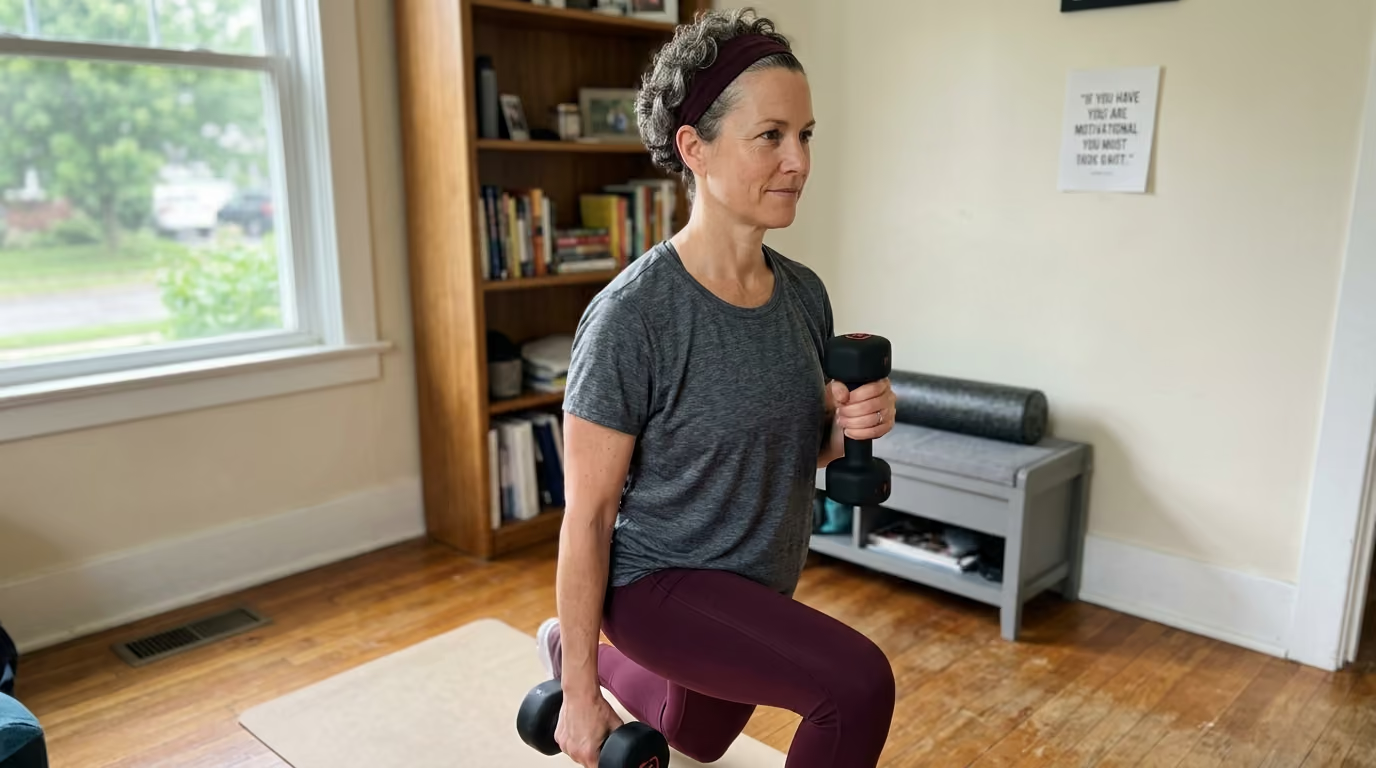

Aging legs often fatigue before cardiovascular endurance fades, making heavy resistance exercises and progressive plyometrics essential for sustaining speed.





You step out for a morning run on a crisp autumn Saturday. Your lungs feel open, your cardiovascular engine is ready, but by mile six your hips feel unstable and your calves tighten. Later that afternoon, going down the stairs reminds you that your legs absorbed thousands of harsh impacts without sufficient mechanical support.
For runners over 40, endurance is rarely the first quality to fade. Instead, the loss of muscular force, tendon elasticity, and joint stability silently degrades your running economy. Resistance training is not an optional hobby to tack onto a high-mileage schedule. It is the fundamental support system that keeps your stride powerful, resilient, and durable over decades of movement.
A well-designed strength routine is not about building bulky muscle or exhausting yourself with complicated fitness trends. For masters athletes, resistance training serves as a precise performance tool. It improves your ability to produce force against the ground, stabilizes your pelvis during single-leg stance, and preserves rapid muscle recruitment as natural hormonal profiles shift.
As we move past age 40, natural declines in fast-twitch muscle fiber volume and tendon stiffness can gradually slow our cadence. When you maintain maximal strength and power in the gym, you reduce the relative effort required for every running stride. A steep hill that previously spiked your heart rate becomes manageable because your legs possess higher peak force reserves.
Strength work also provides systemic durability. Distance running exposes your lower limbs to repetitive impact forces equal to two to three times your body weight. Lifting heavy weights stimulates connective tissue remodeling, increases bone mineral density, and reinforces the joints against repetitive microtrauma. Building raw capacity in the gym ensures that your body absorbs training loads without breaking down.
To build long-term athletic capability, explore our strength and physical performance guides for evidence-based programming.
Running economy describes the amount of oxygen and energy your body requires to run at a specific, submaximal pace. If two runners have the exact same aerobic capacity, the runner with superior running economy will always run faster with less physiological strain. Resistance training directly improves this metric through several neuromuscular mechanisms.
First, heavy strength training enhances motor unit recruitment. When your central nervous system learns to activate a larger percentage of available muscle fibers simultaneously, each individual stride requires less relative effort. Systematic research, including a landmark meta-analysis on competitive distance runners, demonstrated that lower-body strength training creates a significant improvement in running economy.
Second, resistance training alters tendon properties and leg stiffness. Your Achilles tendon and plantar fascia act like mechanical springs that store elastic energy when your foot hits the ground and return it during toe-off. Lifting heavy loads and performing controlled hops increases collagen cross-linking in tendons, allowing you to recycle free energy with every foot strike.
A 2024 systematic review published in sports science literature confirmed that combining heavy resistance with plyometric exercises improves running economy across a wide range of speeds. The underlying biomechanics might not drastically change on video, but the internal efficiency of your muscular system improves substantially. You travel further while burning less fuel.
A comprehensive strength routine for masters runners does not require dozens of exotic movements. It requires consistent execution of fundamental movement patterns that target force production, single-leg stability, and postural endurance.
Maximal strength is the foundation of power. When you increase your baseline force capacity, every submaximal contraction during a run requires a smaller percentage of your total capacity.
Bilateral exercises allow you to load your hips, quadriceps, and hamstrings safely with meaningful weight:
Running is a strictly single-leg sport. You never land on two feet at the same time. Single-leg strength exercises expose side-to-side asymmetries and build dynamic control across the hip, knee, and ankle joints.
Incorporate these unilateral patterns into your routine:
Distance runners frequently suffer from underloaded calves and inactive hamstrings. Neglecting direct lower-leg training leaves the Achilles tendon vulnerable to excessive strain during speedwork and hill climbs.
Prioritize these targeted exercises:
Core training for runners is not about performing hundreds of standard crunches. It is about resisting unwanted motion and transferring force efficiently between your upper and lower body.
Use anti-rotational exercises to lock in your running posture:
To learn more about optimizing your physical output, review our complete collection of performance and fitness strategies.
Plyometrics are explosive exercises that train your stretch-shortening cycle. They teach your nervous system to produce force rapidly and condition your tendons to act as efficient biological springs. For runners over 40, plyometric training must be introduced with methodical patience to protect unconditioned tendons.
A review of athletic conditioning methods showed that while heavy lifting builds raw muscular force, plyometrics teach that force to express itself in milliseconds. Running ground-contact times range from 180 to 250 milliseconds. You need both maximal strength and rapid rate of force development to maximize stride power.
Follow this four-phase plyometric progression:
Begin with low-impact drills to build baseline tissue tolerance. Perform double-leg ankle pogos, where you bounce lightly on the balls of your feet with minimal knee bend. Add low-intensity jump rope intervals and forward skipping drills into your warm-ups twice a week.
Once your ankles tolerate light bouncing, introduce bilateral jumps. Perform broad jumps for distance, focusing on soft and quiet landings. Add low box jumps, stepping down gently between repetitions to eliminate landing shock while training triple extension of the hips, knees, and ankles.
Single-leg plyometrics closely replicate the demands of fast running. Begin with forward line hops, jumping back and forth over a line on the ground on one foot. Progress to alternating bounding drills, emphasizing horizontal displacement and powerful knee drive.
Advanced masters runners with robust strength foundations can introduce depth drops. Step off a 12-inch box, land softly on both feet, and immediately rebound vertically into the air. Keep the volume low, limiting sessions to 20 to 30 total ground contacts to avoid overloading your Achilles tendons.
Always stop plyometric sets well before technical fatigue sets in. The goal is crisp, springy reactivity rather than metabolic exhaustion.
The primary fear many masters runners express is that heavy gym sessions will ruin their key running workouts. When you program your training week poorly, lifting fatigue interferes with interval sessions and long runs. When scheduled correctly, strength training complements your running volume seamlessly.
The golden rule of concurrent training is to keep your hard days hard and your easy days truly easy. Avoid placing a heavy lower-body lifting session on your scheduled rest or recovery days. Doing so creates a state of continuous low-grade muscular fatigue, preventing full physiological recovery.
Here is an optimal weekly structure for a runner training four to five days per week:
This structure consolidates intense neuromuscular stress on Tuesday and Friday. By performing your hard run first, you protect running quality when your nervous system is fresh. Lifting four to six hours later ensures that Wednesday remains a true recovery day.
If you must lift and run in the same hour, complete your primary running workout first. If your priority for a specific block is building maximal lower-body force, you can occasionally perform your strength workout first, keeping the subsequent run very short and easy.
For detailed strategies on balancing systemic recovery and rest periods, browse our dedicated recovery and sleep resources.
Many runners over 40 spend years performing ineffective gym routines because they rely on outdated fitness myths. Correcting these common missteps will immediately improve your training return on investment.
Many endurance athletes believe they should mimic their sport in the gym by performing sets of 25 to 30 repetitions with tiny dumbbells. Running already provides thousands of low-load contractions. Performing light-weight circuits in the gym simply adds low-quality aerobic fatigue without stimulating new muscle fiber recruitment or tendon stiffness. Lift heavy loads for 4 to 8 repetitions to trigger true neuromuscular adaptations.
Endurance athletes are famous for their high pain tolerance, but taking heavy compound lifts to absolute failure creates severe central nervous system fatigue. It leads to days of deep muscular soreness and degrades running mechanics. Always leave 1 to 3 repetitions in reserve on your working sets. You will gain all the performance benefits without compromising your weekend long run.
Balancing on wobble boards or foam pads while squatting reduces the amount of weight you can safely handle. While balance training has a place in early ankle rehabilitation, it does not produce maximal force adaptations. Perform your heavy strength movements on solid, stable ground where you can load your muscles and bones effectively.
Strength training is a powerful tool to increase tissue capacity, but it is not a magical shield. Running injuries are multifactorial, resulting from sudden spikes in mileage, poor sleep, inadequate fueling, and biomechanical factors. Use resistance training as an essential risk-management tool, but always manage your overall running volume intelligently.
You do not need to live in the gym to become a faster, more resilient runner. Research consistently demonstrates that masters runners achieve profound performance gains from just two focused strength sessions per week, lasting 30 to 45 minutes each.
Use these practical templates to structure your strength routine:
To maintain consistent progress without burnout, change your focus throughout the year. During your off-season or early base-building phase, emphasize heavier loads to build peak strength. As you enter your race-specific phase, reduce gym volume by 30 to 50 percent, focusing entirely on movement quality and explosive speed.
During race week, perform one short maintenance session five days out from your event. Complete 2 sets of 4 repetitions with moderate weight, followed by a few crisp strides. This keeps your nervous system primed without creating any lingering muscular fatigue.
To discover practical methods for sustaining lifelong vitality, read our guide on healthy aging and living well.
For many runners over 40, the ultimate joy of running lies in travel and outdoor exploration. Whether preparing for a destination marathon in Europe or a rugged trail race in the American West, specific strength qualities determine your success.
Last winter in Chamonix, I noticed something striking. It was not the altitude that forced my peers into the lodge by noon, it was a lack of rotational strength and poor recovery from the flight. We spend so much time debating the perfect supplement stack, yet we neglect the basic foundational strength required to actually enjoy our travels. That trip changed how I approach fitness. I stopped training for aesthetics and started training exclusively for capability.
Trail running and mountain adventures place massive eccentric demands on your quadriceps during extended downhills. When running downhill, your muscles act as brakes, absorbing kinetic energy while lengthening under tension. Without targeted eccentric strength training, your muscle fibers experience severe microscopic damage, leaving you with debilitating soreness for days.
In our experience, incorporating heavy reverse lunges, slow-tempo goblet squats, and loaded step-downs prepares the quadriceps for harsh descents. Additionally, long travel days across time zones stiffen the spine and hips. Combining unilateral strength work with rotational core exercises ensures your body remains adaptable and ready to handle demanding terrain straight off the airplane.
For comprehensive strategies on staying physically capable during remote expeditions, explore our travel and adventure guides.
The broader sports science community firmly agrees on several core principles regarding aging, performance, and resistance training. Understanding these scientific realities helps you make informed choices about your routine.
While absolute peak athletic performance eventually declines with age, sports science reviews demonstrate that much of this loss stems from voluntary reductions in training intensity and volume. Masters runners who maintain high-intensity resistance training preserve muscle mass, bone density, and athletic speed far longer than sedentary individuals.
To repair muscle damage from concurrent running and lifting, masters athletes require more dietary protein than younger runners. Research published on masters athletic nutrition suggests a daily intake of approximately 1.6 to 1.9 grams of protein per kilogram of body weight. Distribute this across four meals daily, consuming roughly 0.4 grams per kilogram per meal to maximize muscle protein synthesis.
Support your physical training by reading our evidence-based nutrition and metabolism insights.
Scientific evaluations indicate that older muscle tissue recovers effectively when training stress is properly managed. However, systemic recovery can be compromised by external factors such as poor sleep quality, career stress, and inadequate caloric intake. Masters runners must use autoregulation, adjusting gym loads downward when life stress or running fatigue spikes.
Muscles have a rich blood supply and adapt relatively quickly to new training loads. Tendons, however, have lower metabolic turnover and adapt slowly over months. When starting a heavy lifting or plyometric routine, progress your weights and jump volumes gradually. Patience over your first eight weeks prevents Achilles or patellar tendon flare-ups.
Leading international sports medicine organizations agree that heavy resistance training is safe for healthy adults over 40 when performed with proper technical form. Avoiding heavy resistance out of fear accelerates age-related muscle loss. Focus on mastering movement patterns, keep repetitions in reserve, and enjoy the profound performance advantages of a stronger body.
Revisit this field manual whenever you transition between training seasons, when planning an upcoming destination race, or if you notice your running times stagnating despite consistent aerobic mileage.
Building durable, lifelong running capability requires the patience to lift heavy, move explosively, and treat your physical structure with the respect it deserves.
Stay connected for research and practical guidance on longevity, strength, recovery, energy and active living. New ideas to help you stay capable, curious and ready for more.


Explore practical guidance on strength, recovery, energy, travel and longevity for a life that stays active.
explore the Blog