
Power training for adults over 40 preserves fast-twitch muscle fibers, improves neuromuscular reaction speed, and enhances athletic longevity.





Most strength routines for adults over 40 focus almost entirely on lifting heavier weights at controlled tempos. Conventional wisdom says that as you age, the safest path forward is slow, methodical resistance. Yet when you slip on an icy trail, react to a sharp tennis serve, or absorb a bump on a ski slope, absolute strength alone will not save you. Real-world physical capability relies on how fast you can apply force, not just how much force you can produce under a barbell.
Focusing exclusively on slow strength training ignores the specific neuromuscular qualities that decline earliest in midlife. Power, the combination of speed and force, deteriorates nearly twice as fast as raw muscular strength as the decades advance. Rebuilding explosive capability does not require reckless Olympic lifts or punishing plyometrics that jeopardize aging joints. By understanding how to train high-velocity intent, you can protect your joints, sharpen your reflexes, and maintain high physical function across decades of travel, sport, and outdoor pursuits.
Many active adults notice subtle physical changes in their late forties and early fifties. You might feel capable during a steady uphill hike or a set of heavy squats, yet feel sluggish when stepping quickly over rough terrain or reacting to a sudden change of direction on the court. This shift happens because fast-twitch motor units, the muscle fibers responsible for rapid bursts of energy, experience selective atrophy when they are not deliberately stimulated.
Traditional strength training builds a high ceiling of force production. However, daily life and demanding outdoor activities rarely give you two or three full seconds to produce that force. Recovering your balance after tripping over a root on a trail requires generating force in less than one-tenth of a second. If your nervous system is not trained to fire rapidly, having high absolute strength will not prevent a fall.
Power training bridges the gap between the controlled environment of a weight room and the unpredictable physical demands of the world. It teaches your nervous system to recruit motor units quickly and coordinate complex movement patterns under time pressure. The goal is not to chase extreme personal records or risk injury. The goal is to build a responsive, durable body that moves with confidence, whether you are stepping off a curb or navigating a technical ski descent.
Adding high-velocity work to your weekly routine provides profound functional benefits without requiring hours of additional gym time. In fact, research shows that power training offers unique functional advantages over traditional resistance work while matching its gains in muscle mass and bone density. By dedicating a fraction of your regular training volume to explosive intent, you develop a physical reserve that supports athletic longevity. To explore more about maintaining vitality across midlife, see our collection on healthy aging and living well.
To program power effectively, you must understand the basic mechanical relationship behind it. In physics, mechanical power is defined as force multiplied by velocity. This means you can increase power output by generating more absolute force, by moving a given resistance at a higher speed, or by improving both simultaneously. Traditional lifting develops the force half of this equation, while power training targets the velocity component and the neuromuscular efficiency connecting them.
Muscular actions occur across a spectrum. At one end lies maximum strength, where you move very heavy loads at slow speeds. In the middle lies strength-speed, where you move moderate loads with explosive intent, such as during kettlebell swings or push presses. At the far end lies speed-strength, where you propel light implements or your own body weight as fast as possible, such as in medicine ball throws or unloaded hops. A well-rounded program for adults over 40 touches each of these zones rather than lingering in just one.
Another critical concept is the rate of force development, often abbreviated as RFD. This metric describes how rapidly your muscles can develop tension from a relaxed state. In early contraction windows, specifically the first 50 to 75 milliseconds, rapid neural drive determines how much force reaches your limbs. This brief window is precisely when dynamic stabilization occurs during a slip, a pivot, or an unexpected step. Heavy lifting improves the later stages of force development, but ballistic and explosive actions directly train those vital opening milliseconds.
Equally important is your body's ability to absorb force, known as the rate of force absorption. Athletic movements involve dynamic cycles where muscles rapidly lengthen before contracting, utilizing the stretch-shortening cycle. Decelerating your body while walking down a steep mountain path or absorbing an edge catch on a snowboard requires strong eccentric braking. If you only practice moving weights upward, your structural tissues will remain unprepared for the shock of landing and deceleration.
Power training also enhances tendon stiffness and collagen architecture. Tendons act as biological springs, storing elastic energy during the loading phase of a movement and releasing it during propulsion. As we age, tendons naturally lose some of their elasticity and hydration, which can make movement feel stiff and disjointed. Gradual, well-managed explosive training stimulates tendon remodeling, creating a spring-like quality in your lower limbs that makes walking, running, and jumping feel lighter and more fluid. For detailed guidance on building structural durability, review our resources on strength and physical performance.
Before adding explosive exercises to your routine, you need a clear baseline of your current movement quality, balance, and force production. Testing should never create unnecessary injury risk. You do not need expensive laboratory equipment, force plates, or maximum jump tests to understand your physical readiness. Simple, repeatable field assessments provide all the data necessary to guide your exercise selection.
A practical assessment protocol must answer four fundamental questions:
The rapid chair stand is a reliable screen for lower-body power, balance, and coordination. Place a standard, armless chair against a wall to prevent it from sliding. Sit upright with your feet flat on the floor, hip-width apart, and cross your arms over your chest.
On a timer, stand up to full hip extension and sit back down five times as quickly as possible. Ensure your hips touch the chair seat on every repetition without slamming down. Record the total time required to complete all five cycles. A smooth, rapid performance indicates good baseline concentric speed, while hesitation or reliance on momentum suggests a need for foundational leg power work.
This test evaluates horizontal propulsion along with your ability to brake and stabilize force. Stand behind a line with your feet shoulder-width apart. Swing your arms back, hinge at your hips, and jump forward a comfortable, submaximal distance.
The critical part of this test is the landing. You must land on both feet simultaneously and hold your position completely still for two seconds. Look for quiet foot contact, level hips, and knees that track in line with your toes. If you stumble forward, land loudly, or experience knee collapse, prioritize deceleration mechanics and landing control before progressing to reactive jump variations.
The seated chest pass isolates upper-body explosive power by removing lower-body assistance. Sit on the floor or on a sturdy bench with your back pressed flat against a solid wall and your legs extended. Hold a light medicine ball, typically two to four kilograms, against your chest with both hands.
Push the ball aggressively away from your chest with maximal intent, throwing it horizontally across an open space. Measure the distance the ball travels before its first bounce. This screen reveals your ability to generate rapid pressing force through your chest, shoulders, and triceps without compensating through your lower back.
Multi-directional stability is essential for tennis, skiing, and trail running. Stand on your right leg with your knee slightly bent and your torso upright. Step or hop lightly to your left side, landing solely on your left foot, and immediately freeze the position for three full seconds.
Repeat this movement in both directions for four repetitions per side. Observe whether your foot wobbles, whether your knee caves inward, or whether your torso leans excessively to maintain balance. Asymmetrical control between sides highlights specific stability deficits that must be addressed during warm-ups and foundational training blocks.
Progressing your power training requires a systematic, phased framework. Jumping directly into complex plyometrics or heavy ballistic lifts without preparation creates joint irritation and stalled progress. By following a staged progression, you allow your muscles, tendons, and central nervous system to adapt harmoniously.
The initial phase focuses on establishing pain-free joint ranges of motion and building tissue tolerance. You cannot move fast safely if you cannot move well slowly. During this stage, master fundamental patterns such as the goblet squat, hip hinge, split squat, and controlled push-up.
Emphasis belongs on eccentric control and positional stability. Spend three to four weeks mastering controlled descents and brief pauses at the bottom of each movement. Incorporate low-impact dynamic actions, such as rapid sit-to-stands and low-load medicine ball throws against a wall. This prepares your connective tissues for faster loading rates without provoking joint inflammation.
Once foundational movement patterns are solid, focus on lifting moderate to heavy loads to raise your overall force ceiling. The National Strength and Conditioning Association emphasizes that multi-joint resistance training provides the mechanical foundation required for high-velocity power development.
Train compound movements like Romanian deadlifts, trap-bar deadlifts, dumbbell overhead presses, and chest presses. Perform sets of four to six repetitions using roughly 70 to 80 percent of your capacity. Always lower the weight with strict control, but initiate the lifting phase with crisp, forceful intent. Even when a heavy weight moves slowly, the mental intention to drive fast recruits high-threshold motor units.
In the ballistic phase, you transition to exercises that allow complete acceleration through the entire range of motion. In traditional lifting, your body naturally decelerates the barbell near the top of the movement to protect your joints. Ballistic exercises eliminate this braking phase by allowing you to throw, swing, or jump freely.
Incorporate implements such as kettlebells, medicine balls, and light barbells. Focus on kettlebell swings, medicine ball scoop tosses, push presses, and light trap-bar jumps using 30 to 50 percent of your maximum load. The primary goal is maximum concentric speed on every single repetition. Keep set volumes low so that fatigue never compromises your movement velocity.
Plyometric training develops the stretch-shortening cycle and enhances tendon stiffness. This phase introduces short-duration, high-velocity impacts that teach your musculoskeletal system to absorb and redirect ground forces. Systematic reviews confirm that lower-limb plyometric training is safe and highly effective for mature adults when properly structured and progressed.
Begin with low-amplitude movements such as double-leg pogo hops, low box drop-and-stick landings, and lateral skater bounds with stick landings. Focus entirely on quiet, soft landings before introducing continuous or reactive bounces. Height and distance are secondary; landing quality, foot stiffness, and joint alignment are the true markers of success.
The final phase shapes your accumulated power into patterns that directly transfer to your chosen activities. General gym power does not automatically transfer to the court, the mountain, or the water unless you practice the specific movement vectors and timing required by those sports.
For hikers and mountaineers, this means weighted step-up drives and rapid uphill bounding. For skiers, it involves lateral bounds, rotational deceleration catches, and isometric-to-explosive transition drills. For tennis and pickleball players, prioritize rotational medicine ball throws, split-step agility reactions, and multi-directional crossover pushes. To learn how focused physical training integrates with broad lifestyle longevity, read our guide on performance and fitness.
Selecting the right exercises allows you to build tremendous explosive power while respecting your orthopedic history. You do not need to perform high-risk movements to gain the neurological benefits of speed training. A thoughtfully curated selection of jumps, throws, kettlebell drills, and low-impact tools provides all the stimulus you need.
Jumping develops lower-body triple extension through your hips, knees, and ankles. It also teaches your lower limbs how to dissipate ground reaction forces during landing. Always prioritize landing mechanics over jumping height.
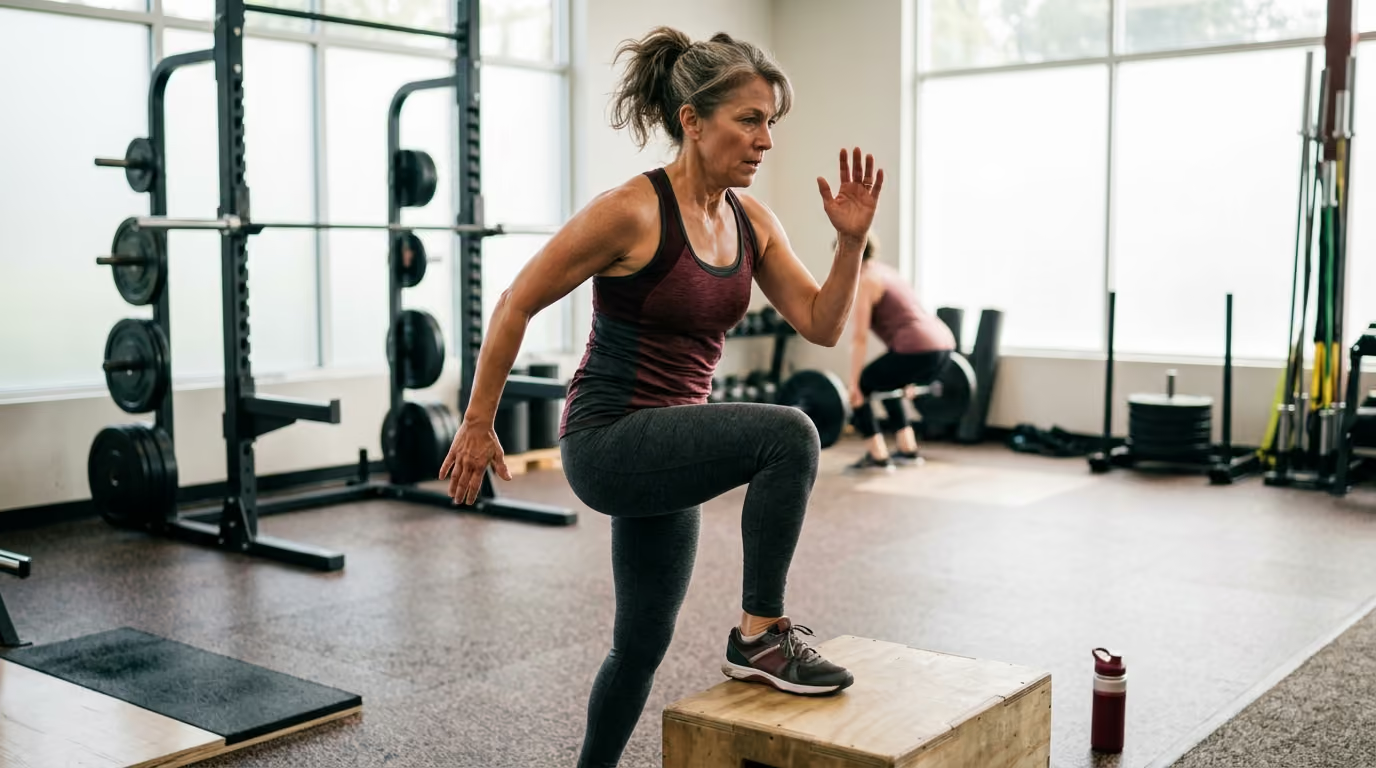
Begin with the box jump. Jumping onto an elevated platform reduces the downward landing impact on your joints compared to landing on flat ground. Step down carefully onto a small riser rather than jumping backward off the box. Progress from box jumps to standing broad jumps with stick landings, and eventually to low-amplitude pogo hops that condition the Achilles tendon.
Medicine balls are among the safest and most effective power tools for adults over 40. They allow you to produce maximal acceleration without placing heavy eccentric loads on your joints or spine. If a throw feels slightly off, you simply release the ball without fighting a falling iron weight.
The overhead slam develops explosive hip flexion, lat power, and anterior core stiffness. Stand tall with a non-bouncing medicine ball overhead, hinge aggressively at your hips, and throw the ball downward into the floor with full effort. The rotational scoop toss builds rotational hip and trunk power, which transfers directly to golf, tennis, and paddling. Stand sideways to a solid masonry wall, load your rear hip, and throw the ball into the wall using your lower body to drive the rotation.
The kettlebell swing is a premier tool for building posterior-chain explosiveness. It trains the hips, hamstrings, and glutes to snap into extension rapidly while maintaining a neutral spine. The movement must remain a crisp horizontal hip hinge rather than a vertical squat.
Dumbbell high pulls and single-arm snatches from the hang position offer accessible alternatives to traditional barbell Olympic lifts. They provide similar explosive hip drive and upper-body coordination without requiring extreme wrist, elbow, or shoulder mobility. Focus on initiating the pull entirely from your hips and legs, allowing the arm to act merely as a guide for the weight.
If joint pain, arthritis, or previous surgeries make jumping ill-advised, low-impact power training delivers exceptional neuromuscular benefits without joint trauma. Power is about speed of contraction, not the magnitude of impact.
The light sled push is an outstanding low-impact power tool. Load a sled with moderate weight and sprint forward with aggressive, driving leg strides for ten to fifteen meters. Fast concentric repetitions on a selectorized leg press or chest press machine also work well. Lower the weight plate slowly under control, pause for one second, and drive the weight outward as fast as possible. Cable woodchops, rapid step-ups, and explosive heel raises provide additional low-impact avenues for speed development.
Developing physical power transforms how you move through demanding environments. Whether you are trekking across high alpine passes, carving down snow-covered slopes, or managing long transit days across international hubs, rapid force production keeps you capable and resilient.
Consider alpine hiking. While steady cardiovascular endurance carries you up the mountain, power determines your ability to step dynamically over large granite boulders, surge up steep switchbacks, and instantly stabilize your ankles when loose shale shifts beneath your boots. When descending, your quads and calves must produce rapid eccentric braking forces thousands of times. Training deceleration and reactive balance in the gym prevents muscle fatigue and knee discomfort during long mountain descents.
Skiing and snowboarding place intense demands on multi-planar power and rapid force absorption. Every turn requires dynamic pressure shifts and instant adjustments to terrain changes, icy patches, and heavy snow. Practicing rotational medicine ball throws and lateral bounds conditions your hips and core to absorb sudden perturbations. This physical readiness keeps you skiing cleanly from the first lift of the morning to the final run of the afternoon.
International travel and remote adventure also demand robust physical capability. Hoisting heavy luggage into overhead compartments, navigating crowded transit terminals, and adjusting to demanding terrain require quick physical adjustments. After a grueling thirty hour transit to Tokyo, I realized my old strategy of just powering through was no longer working. I felt foggy for three days, and my physical responsiveness was completely blunted.
I started digging into circadian biology and realized that timing my light exposure and fasting during the flight could completely shift my recovery. Now, I never board a long haul flight without a precise schedule for when to eat and when to put on an eye mask. It is the difference between losing a week of your trip and hitting the ground running. When your energy, circadian rhythm, and physical power are aligned, you arrive at your destination ready for immediate adventure rather than spending days recovering in a hotel room. For more strategies on staying resilient on the road, explore our guide on travel and adventure.
The most common mistake when integrating power training is treating it like endurance or bodybuilding work. Power training is strictly dependent on neural freshness and high movement quality, not metabolic fatigue or muscular burn. If you perform explosive exercises while exhausted, movement speed drops, mechanics break down, and the risk of injury rises sharply.
You do not need an entirely new workout split to build power. The simplest and most efficient approach is to place two or three power exercises at the very beginning of your existing strength workouts, immediately after a thorough dynamic warm-up. At this point in your session, your central nervous system is completely fresh, allowing for maximal velocity and focus.
A minimal effective dose requires only three to five sets of three to five repetitions per exercise, performed two times per week. Rest intervals between sets must remain generous, typically between sixty and ninety seconds for medicine ball work and up to two minutes for heavier ballistic lifts. When you perform a set of power exercises, you should feel fully recovered and ready for maximal effort before starting the next set. Stop each set the moment you feel movement speed or crispness decline.
Many adults over 40 balance their gym time with cycling, running, swimming, or court sports. When combining endurance and power training, keep in mind that prolonged aerobic exercise induces residual fatigue that blunts explosive power output. Whenever possible, perform your power sessions on dedicated strength days or before moderate endurance work, never immediately following a grueling long-distance run or ride.
Listen closely to tendon feedback. Unlike muscles, which receive rich blood flow and adapt relatively quickly, tendons and ligaments adapt more slowly to high-velocity loading. If you experience persistent tightness in your Achilles tendons, patellar tendons, or shoulders, reduce jump volume and increase rest intervals. Prioritize sleep, adequate protein intake, and structured downtime between hard training days to ensure full tissue regeneration. To optimize your downtime and tissue repair, visit our hub on recovery and sleep.
Training for power requires a mindset distinct from traditional fitness approaches. Avoiding common programming errors ensures you gain all the functional rewards of explosive training without unnecessary setbacks.
A frequent pitfall is turning power exercises into high-repetition conditioning circuits. Performing thirty consecutive kettlebell swings or continuous box jumps until exhaustion trains cardiovascular endurance, but it destroys the velocity component necessary for true power adaptations. When fatigue sets in, your nervous system slows down, your mechanics degrade, and you train your body to move slowly rather than quickly. Keep power sets short, explosive, and separated by adequate rest.
Generating high force is only half the battle; absorbing that force safely is what protects your joints over the long term. Many people focus entirely on how high they can jump or how hard they can push, while neglecting how they land or brake. Loud, slapping foot strikes and inward knee collapse indicate poor force dissipation. Always master the stick landing and controlled eccentric lowering phases before adding higher speeds or reactive rebounds.
While barbell snatches and clean-and-jerks are impressive displays of power, they demand extensive technical coaching, exceptional mobility, and months of practice. For most adults over 40, the orthopedic risk and time investment outweigh the benefits. Dumbbell high pulls, kettlebell swings, trap-bar jumps, and medicine ball throws deliver comparable neuromuscular adaptations with vastly simpler technique and minimal joint strain.
High-velocity training places unique demands on connective tissues. Disregarding minor tendon stiffness or joint aching can turn mild irritation into chronic tendinopathy. If an exercise causes localized joint discomfort, modify the movement immediately. Switch from a jump to a sled sprint, reduce the load, or adjust your stance. Long-term athletic capability comes from consistent, intelligent training, not pushing through pain.
The scientific community broadly agrees that maintaining physical capability across the lifespan requires deliberate attention to rapid force production. Major sports science organizations, including the American College of Sports Medicine and the National Strength and Conditioning Association, now explicitly recommend including high-velocity, moderate-load power training for mature adults alongside traditional strength work.
Authoritative systematic reviews consistently confirm that power training yields small-to-moderate advantages over traditional slow-speed lifting for improving functional daily tasks, balance recovery, and stair-climbing speed. Importantly, research demonstrates that power training achieves these functional gains while producing comparable improvements in muscle hypertrophy, bone mineral density, and absolute strength. You do not sacrifice raw strength when you train for speed; you make that strength usable across a wider range of real-world situations.
The evidence also clarifies that power training does not require extreme protocols or dangerous movements. When performed with moderate loads, typically between 30 and 70 percent of maximum capacity, and stopped well short of failure, high-velocity training is safe, joint-friendly, and highly adaptable. Whether using medicine balls, sleds, kettlebells, or simple bodyweight jumps, the primary requirement is moving with maximum intent.
Developing power is an investment in your physical autonomy and athletic freedom. It sharpens your nervous system, protects your joints through improved reactive stability, and ensures you remain capable of pursuing challenging outdoor adventures for decades to come. By adding a small, focused dose of explosive training to your weekly routine, you preserve the speed, spring, and confidence that define true physical capability.
Building explosive capability allows you to navigate rugged mountains, demanding sports, and everyday movements with lasting confidence and ease.
Stay connected for research and practical guidance on longevity, strength, recovery, energy and active living. New ideas to help you stay capable, curious and ready for more.


Explore practical guidance on strength, recovery, energy, travel and longevity for a life that stays active.
explore the Blog