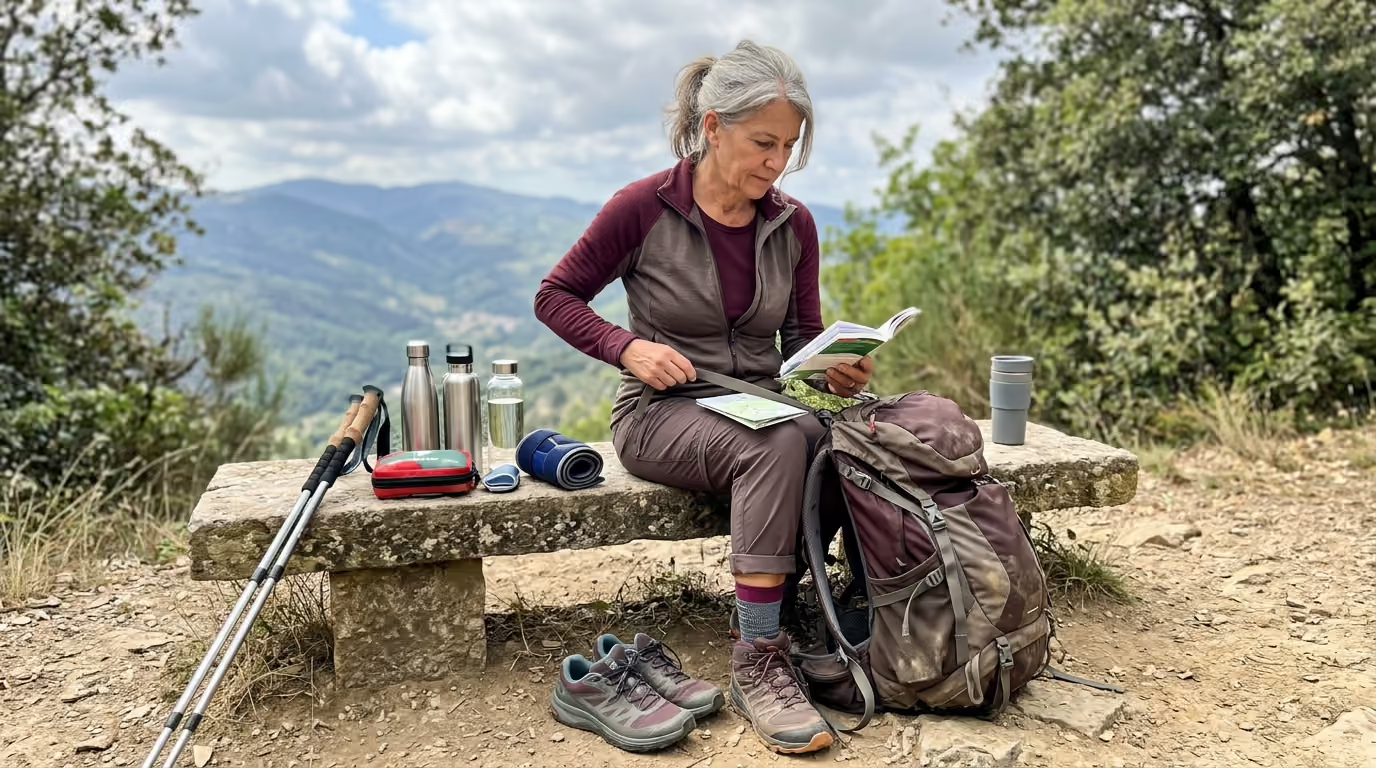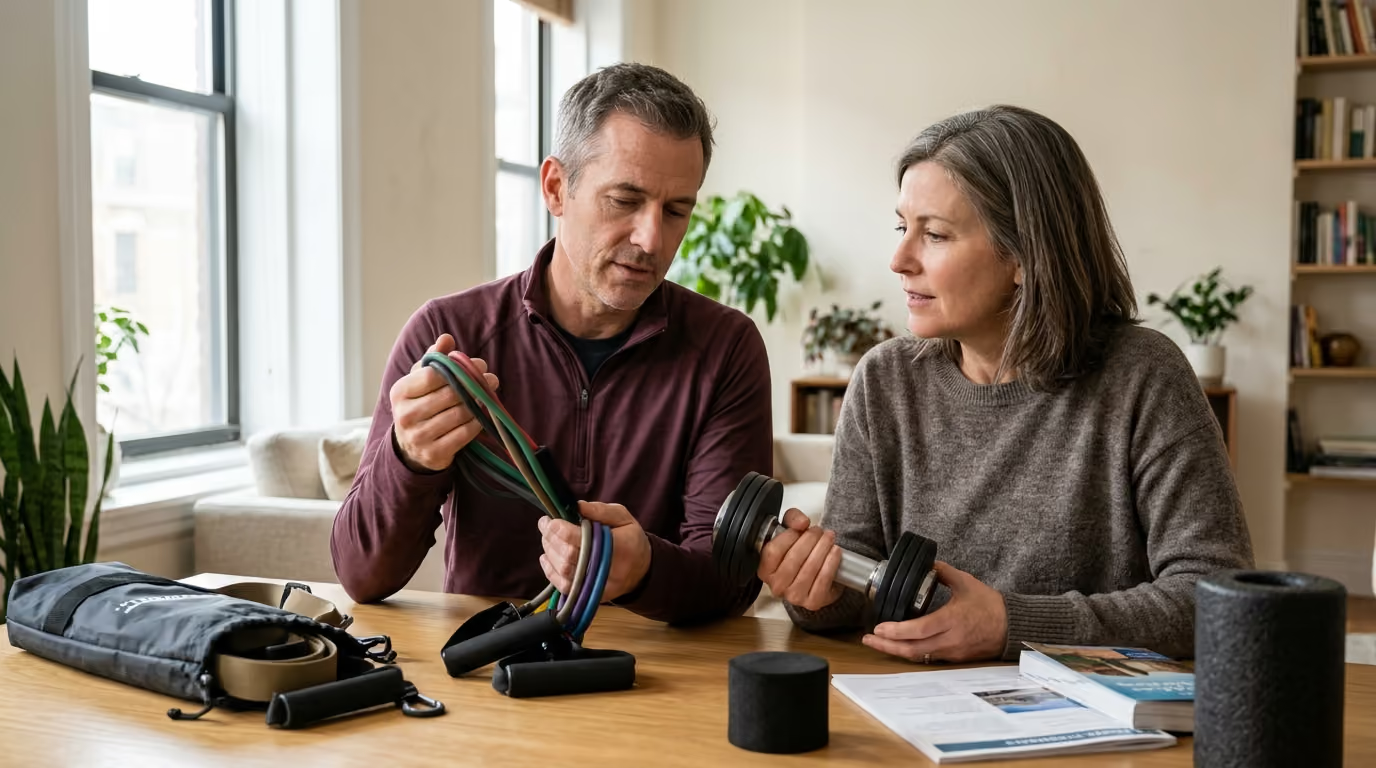

Five portable strength modalities offer distinct biomechanical loading profiles and travel friction trade-offs for maintaining full-body muscular capacity.





Most fitness advice insists that maintaining strength on the road requires finding a commercial gym. Many travelers believe that without heavy barbells and selectorized machines, workouts become an exercise in futility.
The physiological evidence tells a very different story. Your neuromuscular system does not recognize whether tension originates from an Olympic plate, a suspension strap, or an elastic loop. It only registers mechanical tension, motor unit recruitment, and progressive challenge over time.
For active adults over 40, maintaining physical capacity during travel is essential. Consistent training preserves joint integrity, metabolic health, and muscle mass across demanding itineraries. The challenge is identifying which portable tools deliver a genuine training stimulus without overloading your luggage.
This comprehensive guide evaluates five major portable training modalities. We examine their mechanics, practical trade-offs, and evidence-based applications so you can stay capable anywhere in the world.
Training while traveling requires an understanding of how external resistance interacts with human biomechanics. In a standard gym, progressive overload usually means adding iron plates to a bar. When you travel, progression relies on manipulating mechanical leverage, tempo, range of motion, and elastic tension.
Resistance training is fundamentally any activity where muscles work against an external or internally generated force. This force can come from gravity acting on your body, tension from stretched elastomers, or mass held in your hands. The American College of Sports Medicine emphasizes that regular participation in resistance training is the primary driver of physical performance. The specific implement matters far less than applying adequate effort through a complete range of motion.
Absolute resistance refers to the exact weight of an implement, such as a 20-kilogram dumbbell. Relative resistance describes the physiological difficulty of an exercise relative to your individual capacity.
A standard push-up represents an absolute load of roughly 64 percent of your body mass. For one person, that load might be trivial. For another, it provides an intense stimulus for upper-body hypertrophy.
Portable equipment excels at manipulating relative resistance. By altering your body angle or adjusting the anchor point of a band, you can dramatically increase mechanical tension. You do not need to pack heavy iron to challenge your muscular system.
Every strength tool creates a distinct loading curve throughout an exercise. Free weights deliver constant gravitational pull, but the torque on your joints changes as your limb angles shift. An exercise often feels hardest at a specific sticking point where leverage is least advantageous.
Elastic bands demonstrate an ascending resistance profile. As the band stretches, tension increases linearly. This means the movement becomes progressively harder toward the end of the range of motion.
Suspension trainers rely on pendulum mechanics and body angle. The closer your body moves toward horizontal, the higher the percentage of your body weight you must overcome. Understanding these profiles allows you to select the right tool for your specific joint profile and performance goals.
Progressive overload without heavy weights depends heavily on mechanical disadvantage. You can make an exercise substantially more demanding by lengthening the resistance arm or reducing your base of support.
Moving from a bilateral squat to a rear-foot-elevated split squat immediately doubles the relative load on the working leg. Transitioning from a two-arm suspension row to a single-arm variation increases core rotational demand and latissimus recruitment.
These leverage adjustments stimulate high-threshold motor units effectively. You can build significant strength without placing massive compressive loads on your spine. Explore our detailed guides on strength and physical performance to master these movement patterns.
Choosing travel equipment involves balancing portability, exercise versatility, progression clarity, and joint comfort. Below is an exhaustive breakdown of the five primary categories available to travelers.
Elastic bands range from thin rehabilitation loops to heavy, continuous closed-loop latex bands capable of generating over 100 pounds of tension. They represent the gold standard of space-to-resistance efficiency.
Bands are exceptionally light and take up virtually no space in a carry-on bag. A complete set of four resistance levels weighs under two pounds. They require no specialized mounting hardware if you perform exercises using your own feet as the anchor point.
Bands allow you to train virtually every major movement pattern. They are particularly outstanding for upper-body pulling exercises, such as seated rows, face pulls, and lat pulldowns. These pulling patterns are notoriously difficult to perform with bodyweight alone in a standard hotel room.
Bands also facilitate effective pressing, lateral raises, triceps extensions, and rotational woodchoppers. However, loading the lower body for heavy squats or deadlifts can be awkward. Heavy band loops can compress the hands or place uncomfortable pressure on the feet.
Progression with bands is less linear than with iron. You increase tension by switching to a thicker band, doubling up bands, or pre-stretching the band to remove slack. Because resistance changes throughout the movement, measuring exact absolute load is difficult.
Bands are remarkably joint-friendly for adults over 40. Because tension is lowest at the start of the movement where joints are often in compromised, lengthened positions, connective tissue stress is minimized.
Users must inspect bands regularly for micro-tears or pinholes. A snapping band can cause serious injury. Always ensure that door anchors are positioned on doors that close toward you or are securely locked.
Suspension systems utilize durable nylon webbing straps, adjustment buckles, and ergonomic handles anchored to a door, overhead beam, or outdoor structure. They harness your body weight against gravity.
Suspension trainers pack down into a compact pouch roughly the size of a water bottle and weigh between one and two pounds. Setup requires a secure anchor point. In a hotel, this is typically a solid door with the included door anchor.
You must ensure the door closes securely and latches completely. In outdoor or adventure travel settings, suspension straps can be secured to trees, structural pillars, or pull-up bars.
Suspension systems provide unparalleled upper-body pulling versatility. You can perform horizontal rows, high rows, and single-arm pulls with micro-adjustable resistance simply by shifting your foot position.
They excel at core integration, allowing for suspended planks, pikes, and mountain climbers. For the lower body, they provide exceptional assistance for deep single-leg pistol squats, lunges, and hamstring curls.
Progression is achieved by adjusting your body angle relative to the anchor point. Moving your feet closer to the wall during a row increases the percentage of body weight lifted.
Progression can also involve elevating the feet, narrowing your stance, or transitioning to unilateral movements. While tracking exact poundage is difficult, noting your foot placement relative to floor markers provides a reliable metric.
Suspension trainers allow your joints to rotate freely through natural planes of motion. The handles rotate dynamically, reducing torque on the wrists, elbows, and shoulders during pressing and pulling.
However, the instability of suspension straps requires strong rotator cuff and core stabilization. Deconditioned travelers must avoid excessive instability until baseline strength is established.
Adjustable travel weights include loadable dumbbell handles, fillable water or sand kettlebells, and modular travel plates. These tools bring traditional resistance methods into portable formats.
Solid adjustable weights are the heaviest and bulkiest option. Fillable canvas or bladder-style kettlebells offer a lighter alternative, packing flat when empty and filling with water or sand at your destination.
Water-filled implements are limited in total mass, usually topping out at 15 to 25 pounds. Sand-filled bags can achieve higher loads but require access to clean, dry sand, which is rarely practical in standard business hotels.
Free weights provide the most direct loading for hinge patterns, loaded carries, goblet squats, and overhead presses. They replicate the exact movement mechanics of home or commercial gym workouts.
However, carrying enough mass for heavy lower-body training is impractical during air travel. A single 20-pound implement may challenge your shoulder press while proving far too light for effective split squats.
Progression is precise and easily quantified. You simply add measured weight or count repetitions with a known mass. This makes tracking progressive overload straightforward.
Adjustable weights exert constant downward gravitational pull. Dropping heavy implements on hotel floors creates noise and risks structural damage. Users with joint stiffness must manage their movement paths carefully without the stabilizing support offered by straps or bands.
Weighted vests distribute supplemental mass evenly across your torso using fixed iron blocks, sand packets, or flexible weight plates.
A weighted vest is heavy by definition. Packing a 20-pound vest consumes a substantial portion of standard airline baggage allowances.
Minimalist, unweighted vests that hold water flasks or local weight materials exist, but they are cumbersome to fill and balance properly.
Vests excel at hands-free axial loading. They enhance the training stimulus of standard bodyweight movements, including push-ups, dips, walking lunges, step-ups, and pull-ups.
They are exceptionally useful for loaded walking, stair climbing, and ruck-style conditioning. However, a vest cannot provide direct horizontal pulling or isolated upper-body pressing resistance. It must be paired with other modalities for complete full-body programming.
Progression involves adding small weight packets or increasing the duration and speed of your movements while wearing the vest. The load remains perfectly centered over your base of support.
Vests increase compressive forces on the spine, hips, and knees. Active adults with severe osteoarthritis or spinal disc pathologies should exercise caution.
Vests should generally be reserved for low-impact walking and controlled strength exercises rather than high-impact jumping or running.
Bodyweight training requires no equipment whatsoever, relying solely on gravity, leverage, and friction against the floor or local architecture.
Portability is absolute. You require zero luggage space and can train in any space large enough to lie down. There are no equipment failure points, setup times, or airline restrictions.
Calisthenics easily covers horizontal pressing through push-ups, knee flexion through bridges, and lower-body strength through unilateral squats and lunges. Core training is exceptionally well served by planks, side planks, and hollow holds.
The primary deficit is upper-body pulling. Without an overhead bar or a sturdy horizontal table, training the latissimus dorsi, rhomboids, and rear deltoids is exceptionally challenging.
Progression demands technical mastery and leverage manipulation. You advance from standard push-ups to decline push-ups, archer push-ups, and single-arm variations.
For many adults over 40, these leverage jumps can be too abrupt. Transitioning from a two-leg squat to a single-leg pistol squat requires significant balance, hip mobility, and knee stability that may exceed current capacity.
Bodyweight training eliminates external impact and compressive loads. However, extreme leverage variations can place significant shear stress across the wrists, elbows, and patellar tendons if movements are performed with poor mechanics.
Evaluating these five tools across critical operational categories reveals clear strengths and weaknesses.
A complete strength program must challenge all fundamental human movement patterns. Understanding how to execute each pattern on the road ensures balanced muscular development and injury prevention. Discover more strategies in our guide to travel and adventure longevity.
The squat trains knee extension, hip extension, and core stabilization. It forms the foundation of lower-body power and daily mobility.
The hip hinge targets the posterior chain, emphasizing the hamstrings, gluteus maximus, and erector spinae.
Pushing exercises build the pectorals, anterior deltoids, and triceps while training core bracing.
Pulling movements maintain shoulder girdle balance, posture, and upper-back strength. They counteract the rounded posture caused by long hours in aircraft and train seats.
Single-leg training addresses bilateral strength asymmetries, improves pelvic stability, and trains dynamic balance.
Loaded carries and isometric bracing build functional trunk stiffness, grip strength, and spinal resilience.
Navigating strength training while traveling requires cutting through widespread fitness misconceptions.
A reader recently asked me if they needed to start a complicated, three hour morning routine they saw online. I told them absolutely not. When our team looked at the research they referenced, the actual benefits were marginal compared to simply getting eight hours of sleep and lifting heavy things twice a week. It is incredibly easy to get distracted by the top one percent of optimization and forget that the foundation is where all the real longevity gains are made.
Many athletes assume that training without heavy iron is merely a holding pattern that inevitably leads to strength loss. Scientific evidence shows that muscle size and functional strength can be fully maintained, and even increased, using bands, bodyweight, and suspension systems. The critical variable is training with high relative effort close to muscular fatigue.
Suspension trainers and unstable surfaces recruit stabilizing musculature. However, excessive instability reduces the absolute force a prime mover can generate. If your primary objective is hamstring or quadricep hypertrophy, high instability limits how hard you can push the muscle. Balance instability with stable, grounded exercises.
Never assume a black or red band provides the exact same resistance across different manufacturers. One brand's heavy band may equal another brand's medium band. Always evaluate resistance based on perceived effort and repetitions in reserve rather than color coding.
While axial loading supports bone health, wearing a light weighted vest during casual walking is not an automatic bone density solution. Clinical research shows that maintaining bone mineral density requires progressive, multi-directional mechanical strain and higher-intensity resistance training. A vest is a useful accessory, but it cannot replace progressive compound strength training.
Attempting to duplicate a complex five-day gym split with minimal travel gear leads to frustration and missed workouts. Travel demands flexibility. Focus on movement patterns, relative intensity, and movement quality rather than rigid exercise duplication.
When traveling for business or adventure, time and recovery bandwidth are limited. Implementing a minimal effective dose ensures you preserve physical capability without derailing your travel itinerary.
Research indicates that performing as few as two full-body resistance training sessions per week maintains muscular strength and neuromuscular adaptations. For older adults, prioritizing workout quality over high training volume prevents excessive systemic fatigue and supports joint recovery.
Because portable equipment lacks exact poundage calibrations, use the Repetitions in Reserve (RIR) scale to gauge intensity:
This streamlined full-body framework requires only resistance bands or a suspension system. It can be completed in 25 minutes.
Perform each pair as an alternating superset with 60 to 90 seconds of rest between movements.
Review our resource on recovery and regeneration to optimize your post-session nutrition and tissue recovery.
Adults over 40 frequently navigate pre-existing joint wear, old athletic injuries, and spinal sensitivities. Portable training equipment allows you to modify exercises easily to protect sensitive joints.
Deep joint angles under heavy load can irritate arthritic joints. Use these modifications:
Fixed barbell pressing forces the shoulders into rigid internal rotation. Portable tools provide joint-friendly alternatives:
Long flights and soft hotel mattresses often trigger lower back stiffness. Protect your spine with these adjustments:
The broader sports science community agrees that maintaining strength and physical autonomy does not require specialized gym machines.
The American College of Sports Medicine, along with international gerontology organizations, emphasizes that resistance training preserves muscle mass, maintains bone density, and enhances metabolic health. Multiple clinical reviews confirm that elastic bands and suspension systems produce muscular hypertrophy and strength gains comparable to traditional weight training across diverse populations.
Research consistently confirms that volume and relative effort drive neuromuscular adaptation. Whether tension is generated by a heavy iron barbell or a high-tension latex loop, the cellular signaling pathways for muscle protein synthesis operate the same way. For active adults over 40, consistency, progressive overload, and joint protection matter far more than equipment complexity.
Every traveler operates under distinct luggage, time, and physical constraints. Review these five distinct traveler setups to find the combination that matches your lifestyle.
To better understand how these physical capacities support your broader healthspan, explore our comprehensive guide on longevity and living well.
True physical capability is portable, resilient, and independent of any single gym environment.
Stay connected for research and practical guidance on longevity, strength, recovery, energy and active living. New ideas to help you stay capable, curious and ready for more.


Explore practical guidance on strength, recovery, energy, travel and longevity for a life that stays active.
explore the Blog