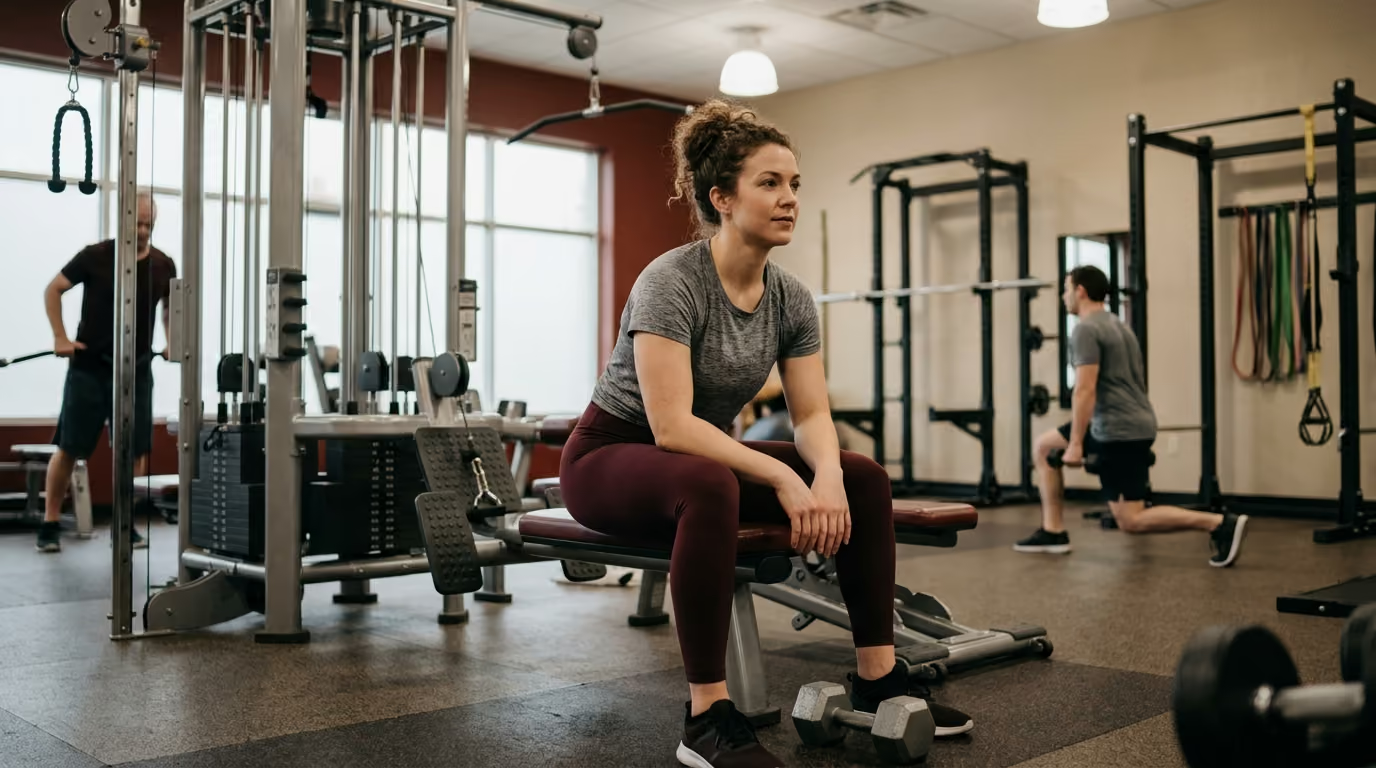

Stronger joints and reliable movement control develop when you combine flexibility training with active resistance across every degree of joint motion.





Most training programs treat flexibility and strength as two completely separate disciplines. People spend twenty minutes holding static floor stretches before moving to a barbell, or they treat yoga and resistance training as opposing philosophies. This separation is based on a flawed premise. Being able to passively pull a limb into a deep position does not mean you can use that position when dynamic sport, heavy loads, or unexpected terrain demand it.
True physical capability requires usable range of motion. Usable range of motion is the specific excursion of a joint that you can actively access, stabilize, and produce meaningful force within without external assistance. Flexibility is merely the passive length of a tissue when pulled by gravity or a partner. Mobility is your active neural control and strength expressed through that available space.
When you bridge the gap between passive capacity and active control, your movement efficiency changes entirely. You stop fighting your own joint stiffness, your joint resilience improves, and your athletic performance transfers directly to demanding environments. Whether you are navigating steep alpine descents, swinging a golf club, or carrying heavy luggage through an airport terminal, true freedom of movement comes from strength applied across full joint excursions.
To understand why traditional stretching often fails to produce lasting functional changes, we must examine the underlying biology of joint excursion, stretch tolerance, and neural force production.
Passive range of motion represents the mechanical boundary of a joint when an external force moves your body. A physical therapist lifting your leg into a hamstring stretch or gravity pulling your hips down into a supported split demonstrates passive capacity. Active range of motion, by contrast, is the excursion you can achieve using only your own muscular contraction.
The distance between these two points is the functional mobility gap. A wide mobility gap means you possess passive space that your nervous system cannot actively control or protect. When an unexpected slip on an icy trail or an awkward pivot on the tennis court forces your joint into this uncontrolled zone, your body cannot produce the muscular tension required to stabilize the joint.
Our understanding of joint mobility shifts dramatically when we view range through the lens of force production. Flexibility allows you to assume a position passively, but mobility ensures you can survive and perform within that position. If you can bend forward and place your palms on the floor while seated, but cannot perform a controlled hip hinge with your spine protected, your flexibility is largely cosmetic.
Modern physical preparation must prioritize end-range capacity. Building strength at the outer boundaries of your joint angles signals safety to your central nervous system. When the brain detects stability and active motor control across an entire movement arc, it willingly downregulates protective muscle stiffness, naturally expanding your active range of motion.
For those pursuing dedicated strength and physical performance resources, understanding this integration is the foundation of durable athletic longevity.
For decades, popular fitness literature claimed that static stretching physically lengthened muscle tissue in the same way you might pull an elastic band. Contemporary biomechanical research tells a very different story. A comprehensive 2025 review on joint range mechanisms published in sports medicine literature demonstrated that static stretching reduces passive muscle-tendon stiffness acutely, but does not increase muscle fascicle length over time.
When you feel an immediate increase in flexibility after a thirty-second stretch, you have not altered the physical structure of your muscle fibers. Instead, you have temporarily altered your stretch tolerance. Your nervous system has simply modulated its sensory perception, allowing you to tolerate the discomfort of the position without sending an immediate protective contraction signal.
True structural and neuromuscular adaptations require mechanical tension under load. Muscle fibers produce varying amounts of force depending on their working length, a principle known in physiology as the force-angle relationship. At extreme end ranges, actin and myosin filaments have minimal overlap, which drastically reduces your mechanical leverage and force production capacity.
If you never train your muscles to produce tension at long muscle lengths, your nervous system treats those joint angles as high-threat zones. In response, it increases resting muscle tone and restricts voluntary excursion to prevent tissue damage.
Systematic reviews demonstrate that resistance training through a full, controlled range of motion increases joint excursion just as effectively as traditional stretching. Loading a muscle while it is fully lengthened stimulates sarcomerogenesis, the addition of sarcomeres in series, while reinforcing motor unit recruitment at previously vulnerable joint angles.
Screening your usable range of motion requires separating passive reach from active motor control. When assessing any joint system, you can use a systematic progression to identify where your movement capacity breaks down.
Consider the deep squat. Many individuals can easily achieve a deep, parallel-breaking squat position when holding onto a doorframe or suspension strap. This demonstrates adequate passive hip and ankle excursion.
However, when asked to perform the same squat unsupported, their heels rise, the chest collapses forward, and the lower back rounds aggressively. The passive capacity exists, but the active control of ankle dorsiflexion, anterior core stability, and deep hip flexion force is entirely missing.
A similar breakdown occurs in the upper body during overhead pressing. An individual lying flat on a treatment table may allow a practitioner to passively move their arm flat overhead alongside their ear without resistance.
Yet, when standing, that same person cannot actively elevate the arm without arching their lumbar spine, flaring their rib cage, and tilting their neck forward. The passive glenohumeral joint allows the movement, but the active stabilizers, such as the serratus anterior and lower trapezius, lack the strength to position the scapula correctly against resistance.
A third common presentation is the discrepancy between touching one's toes and executing a loaded hip hinge. Reaching for the toes while seated or standing often relies on passive spinal flexion and ligamentous hang rather than active hamstring deceleration.
When an external load is introduced during a deadlift or Romanian deadlift, individuals with high passive flexibility frequently round their spine because they lack eccentric control and isometric trunk stiffness at long hamstring lengths.
To eliminate these blind spots, physical preparation must follow a structured hierarchy. You must first access the joint position, actively own it with internal muscular effort, stabilize it against perturbation, load it through full excursions, and finally transfer it into complex functional movements.
Integrating these active diagnostics into your regular training principles for performance and fitness ensures you never develop blind spots in your mechanical control.
A persistent belief in physical culture is that regular static stretching prevents athletic injuries. Controlled clinical trials and large-scale meta-analyses do not support this assumption. A landmark systematic review published in the British Journal of Sports Medicine analyzing over 26,000 participants found that stretching interventions showed no statistically significant reduction in acute or overuse sports injuries.
By contrast, the same meta-analysis revealed that progressive strength training reduced sports injury risk to less than one-third. Strength training builds physical resilience because it alters tissue load capacity, increases tendon stiffness, and optimizes motor unit coordination under stress. Static stretching alters none of these fundamental protective qualities.
Another widespread myth is that static stretching before explosive activity serves as an effective warm-up. Research demonstrates that sustained, intense static stretching immediately prior to maximal strength, sprinting, or jumping tasks can acutely impair force production by up to four to five percent. This temporary reduction occurs because stretching dampens the stretch reflex and temporarily reduces the neural drive to the stretched muscle group.
A modern warm-up should prioritize dynamic joint rotations, activation of stabilizing musculature, and progressively loaded movement patterns through the desired range. This prepares the nervous system for high force demands without blunting explosive output.
Finally, we must discard the belief that more range of motion is universally better. Joint mobility must match the anatomical constraints of your skeleton and the specific demands of your activities. Excessive passive range without corresponding active muscular control is known as joint laxity. Hypermobile individuals who aggressively stretch already loose joints frequently experience chronic joint irritation, micro-instability, and soft-tissue compensation.
For these individuals, the solution is never more stretching. The solution is aggressive end-range strengthening, isometric stabilization, and motor control training that builds structural tension around the joint capsule.
Last winter in Chamonix, I noticed something striking among a group of experienced mountain skiers. It was not the high altitude or lack of aerobic endurance that forced many capable adults off the mountain and into the lodge by noon. It was an absolute lack of rotational strength and poor recovery from long international travel.
We spend so much time debating the ideal recovery protocols or supplement stacks, yet we routinely neglect the basic foundational joint strength required to actually handle our physical pursuits. That trip reinforced how critical it is to train for true capability rather than aesthetic markers or arbitrary flexibility scores.
When descending steep, variable snow at speed, your skis will inevitably encounter unexpected ruts and heavy chop. In those split-second moments, your hips, knees, and ankles are forced into extreme, asymmetrical positions under high eccentric loads. If your training consists solely of seated leg extensions or passive floor stretching, your neuromuscular system has zero capacity to absorb and redirect force at those outer joint angles.
The same mechanical principles apply to demanding alpine hiking, ocean sports, and long-distance travel. Prolonged sitting in cramped airline seats places the hips in sustained flexion, deactivates the gluteal stabilizers, and tightens the anterior hip capsules. Stepping directly off a transcontinental flight into demanding mountain terrain requires an immediate restoration of active hip extension and thoracic rotation.
Without active end-range control, the lumbar spine and knee joints absorb the mechanical stress that should have been managed by the primary movers of your kinetic chain.
For dedicated adventurers navigating the unique demands of travel and adventure, building robust, usable joint excursions is the most reliable insurance policy against travel-related stiffness and sports injuries.
To build usable range of motion, your strength training must be carefully programmed to challenge tissues at long muscle lengths. Incorporating loaded movements through full excursions provides both a mobility stimulus and a profound strength stimulus.
The front-foot elevated split squat is an exceptional movement for building usable lower-body range. By elevating the front foot on a stable four to six-inch platform, you allow the front knee to travel forward into deep dorsiflexion while the trailing hip moves into loaded extension.
Lowering under a three-second tempo followed by a two-second pause at the bottom strengthens the knee stabilizers and lengthens the posterior hip musculature under load.
The Romanian deadlift trains the posterior chain at long muscle lengths. Unlike a standard deadlift from the floor, the movement initiates with an active hip hinge, pushing the pelvis backward while maintaining a rigid, neutral spine.
As the weights descend just below the patella, the hamstrings experience substantial mechanical tension in their fully lengthened state. Pausing momentarily at this reversal point develops immense eccentric control and actively trains the nervous system to stabilize the hip joint under heavy load.
For the upper body, deficit push-ups with hands elevated on parallettes, dumbbells, or weight plates force the chest and anterior shoulders into deep horizontal abduction. Performing slow, controlled repetitions through this extended excursion conditions the pectoral tendons, improves anterior shoulder stability, and reinforces rotator cuff function far more effectively than passive doorway stretching.
When you strengthen the shoulder at its mechanical boundaries, overhead pressing and carrying tasks become inherently more stable.
The deep goblet squat serves as both an assessment and a loaded corrective exercise. Holding a single dumbbell or kettlebell against the sternum shifts your center of mass backward, allowing you to achieve a deeper hip excursion while maintaining an upright torso.
Pausing in the bottom position for three to five seconds forces the deep hip rotators, adductors, and anterior core musculature to work synergistically, turning a passive squat position into an actively owned athletic posture.
Expanding usable range of motion does not require hours of daily stretching or complex multi-step mobility routines. A minimalist, highly focused framework integrated directly into your existing physical training yields superior results while respecting your schedule.
Dedicate eight to ten minutes prior to your primary strength or cardiovascular session to active joint preparation. Replace passive stretching with controlled articular rotations and end-range lift-offs for the hips, shoulders, and ankles.
Follow this with two warm-up sets of your primary compound movement using extended three-second eccentric lowering and two-second bottom pauses. This simple addition prepares your nervous system for heavy work while expanding active joint excursion.
You do not need separate mobility days if your primary strength training emphasizes full, controlled excursions. Select two to three compound exercises per workout that challenge your target joints at long muscle lengths.
Utilize full-range Romanian deadlifts, deficit split squats, deep dumbbell presses, and hanging leg raises as your primary strength exercises. By loading these ranges under significant tension, you develop strength, muscle mass, and joint excursion simultaneously.
On non-lifting days or during travel, perform a brief fifteen-minute standalone session focused on end-range isometrics and active positional holds. This maintains neural communication with your joint boundaries without creating systemic muscular fatigue.
Pairing this light active movement with structured nasal breathing promotes parasympathetic recovery, reduces perceived joint stiffness, and reinforces motor patterns.
Integrating these simple steps supports long-term physical independence, aligning with broader frameworks for healthy aging and living well. To further optimize your physical renewal between intense sessions, implement dedicated protocols for recovery and sleep alongside your movement practice.
The broader sports medicine and exercise science communities have reached a clear consensus regarding joint excursion and physical performance. Leading researchers agree that while passive stretching increases short-term tolerance to stretch, it does not produce meaningful long-term changes in muscle architecture or provide substantial protection against sports injuries.
Systematic reviews and meta-analyses consistently confirm that progressive resistance training performed through a complete range of motion produces joint excursion gains that equal or exceed traditional stretching programs. Furthermore, resistance training provides critical systemic adaptations that passive stretching cannot replicate, including increased bone mineral density, elevated tendon stiffness, improved motor unit recruitment, and muscular hypertrophy.
Full-range resistance training is particularly beneficial for lower-body strength and muscle development. When exercises such as squats, split squats, and lunges are trained to deep joint angles, mechanical tension on the quadriceps, adductors, and gluteal musculature is maximized, creating a potent stimulus for athletic development.
The scientific consensus is unambiguous. Usable mobility is not the absence of physical tension, but the presence of neuromuscular control across full joint excursions. When you train your body to produce force at the outer limits of its range, you build a physical structure that is capable, resilient, and ready for demanding physical performance.
True physical capability is measured not by how far an external force can push your joints, but by the strength and control you can actively exert across every degree of your movement.
Stay connected for research and practical guidance on longevity, strength, recovery, energy and active living. New ideas to help you stay capable, curious and ready for more.


Explore practical guidance on strength, recovery, energy, travel and longevity for a life that stays active.
explore the Blog