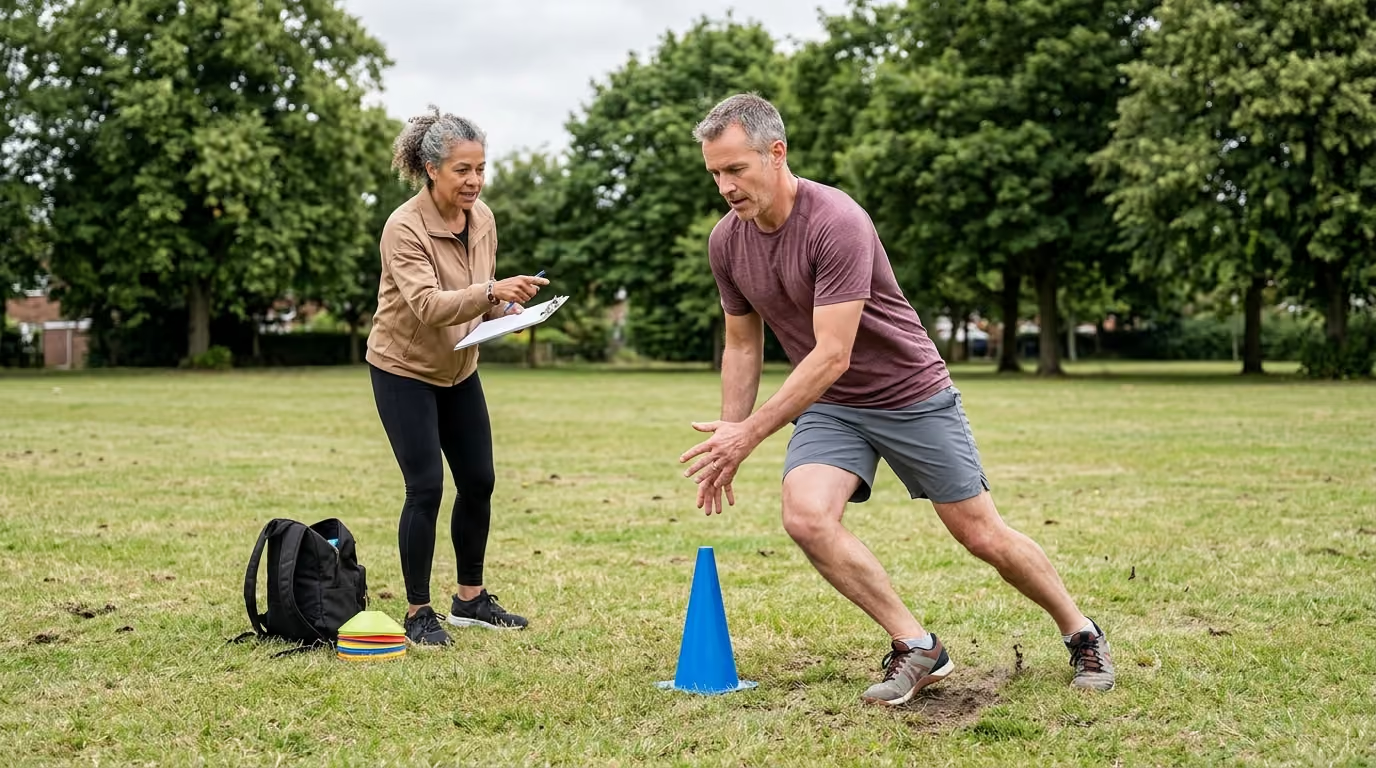

Mastering deceleration mechanics and multi-planar strength preserves athletic agility, protects joint health, and restores reactive movement capacity.





Most fitness advice for athletes past forty focuses almost entirely on propulsion. We obsess over sprint speed, vertical jump height, and how much weight we can lift off the floor.
In actual sport, moving forward is rarely the mechanism that causes breakdown. The true test of athletic capability is the capacity to stop, absorb force, and redirect momentum under control.
Deceleration is not simply running slower. It is the active mechanical ability to reduce whole-body momentum while controlling where your body travels next. Horizontal deceleration requires your neuromuscular system to manage massive braking forces, disperse those loads across multiple joints, and maintain balance.
If you cannot brake efficiently, your body will naturally limit how fast you run, how sharply you cut, and how confidently you move. Training this quality protects your joints, restores reactive athleticism, and preserves physical independence on the court, on the pitch, or down a mountain trail.
When you run, your body accumulates linear velocity and momentum. Stopping that forward mass requires opposing force generated across very brief timeframes.
Research by Harper and colleagues defines horizontal deceleration as the ability to reduce whole-body momentum within the specific constraints of a task while controlling and distributing braking forces. This process relies on two distinct mechanical demands: braking capacity and force attenuation.
Braking capacity is your ability to produce sufficient horizontal and vertical forces against the ground to arrest forward movement. Force attenuation is the subsequent absorption and distribution of those forces throughout the foot, ankle, knee, hip, and spine.
If your muscles and tendons cannot absorb these forces eccentrically, the mechanical stress transfers directly into passive structures like cartilage, ligaments, and joint capsules.
A complete change of direction integrates five distinct phases: the approach, the preliminary braking steps, the final plant step, the redirection of the torso, and the reacceleration into a new path. Studies examining the determinants of change of direction highlight that lower center-of-mass height, appropriate trunk inclination, and high lower-limb joint moments determine how rapidly an athlete turns.
Sharp cuts require substantial whole-body rotation rather than simply pushing laterally off a single leg. When approaching a sharp angle, the step taken immediately before the plant, known as the penultimate step, is crucial.
The penultimate step allows an athlete to lower their center of mass and absorb a large portion of momentum early. Relying entirely on a single, stiff plant step places extreme loads on the knee and increases the likelihood of joint irritation or tissue failure.
Agility is often misunderstood as running predetermined patterns around plastic cones. A planned agility drill tests your memory of a route and your ability to execute a known movement pattern.
True agility in sport requires reactive control. It demands perception, rapid decision-making, and physical reorganization in response to an external stimulus such as a tennis ball, an opponent, or loose gravel on a descent.
Last winter in Chamonix, I noticed something striking on the mountain slopes. It was not the high altitude that forced my peers into the lodge by noon, but a lack of rotational strength and poor recovery from the flight.
We spend so much time debating the ideal supplement stack, yet we neglect the basic foundational strength required to actually enjoy our travels. That trip changed how our team approaches physical performance. We stopped prioritizing vanity metrics and started training exclusively for real-world capability.
A capable adult needs training that scales with physical capacity rather than chronological age. Public health statistics from the CDC report that more than fourteen million adults aged sixty-five and older report a fall each year in the United States.
About thirty-seven percent of those falls result in injuries requiring medical care or restricted activity. While these statistics describe the general older population, the underlying lesson applies to active adults in their forties and fifties: the ability to handle unexpected momentum loss or balance perturbation declines unless deliberately trained.
Systematic reviews on gait perturbations demonstrate that exposing older adults to controlled balance disturbances significantly improves their reactive recovery mechanics. A controlled study of older individuals showed that practicing recovery responses to sudden balance disturbances produced immediate improvements that were maintained a week later.
By progressively introducing deceleration, landing drills, and multi-directional challenges, you build a robust physical buffer that keeps you resilient across diverse healthy aging and physical independence milestones.
Mainstream fitness culture often promotes rigid guidelines that restrict movement options for mature athletes. These misconceptions limit performance and prevent the development of genuine athletic resilience.
A pervasive myth claims that anyone over forty must avoid plyometrics, jumping, and rapid directional changes to save their joints. The scientific evidence directly contradicts this blanket restriction.
A systematic review by Vetrovsky and colleagues examined lower-limb plyometric training in older adults and found marked improvements in muscular strength, jump performance, and physical function without an increased occurrence of adverse events. Plyometric and deceleration training is feasible, safe, and highly productive when progression and intensity are managed carefully.
Athletes are frequently told to land as softly and quietly as possible. While minimizing unnecessary ground impact noise is a helpful initial cue, quiet landings are not the entire objective.
An athlete must balance impact absorption with stability, structural alignment, and readiness to produce force for the next movement. Research on landing interventions confirms that technique training improves knee-flexion angles, but absorbing force completely through extreme joint collapse leaves an athlete slow, unstable, and unable to redirect momentum.
Rigid cues regarding knee travel can disrupt natural movement mechanics. Rapid deceleration requires coordinated flexion across the ankle, knee, and hip joints alongside trunk inclination.
Artificially restricting forward knee travel forces the torso into awkward compensations, overloading the lumbar spine and reducing braking efficiency. The objective is balanced joint mechanics, not arbitrary anatomical restrictions.
Running through complex cone ladders and predetermined agility courses improves your skill at those specific drills. However, research reveals that unplanned tasks involving external cues yield fundamentally different joint moments and brain-body demands.
True reactive agility requires processing visual, auditory, or environmental information while executing braking mechanics. Cones are merely an introductory tool, not the final stage of functional agility.
Deceleration demands high levels of eccentric and isometric strength. When slowing down or cutting, your muscles must actively lengthen under high mechanical tension to absorb kinetic energy.
Integrating dedicated strength qualities ensures that your muscular system absorbs force rather than your joints. Developing these attributes directly supports overall strength and physical performance across all sporting domains.
Bilateral strength provides the structural base for force production and center-of-mass management. Compound movements like safety bar squats, trap bar deadlifts, and split squats train the hips and thighs to handle compressive loads.
However, sporting deceleration is overwhelmingly unilateral. Single-leg exercises such as rear-foot elevated split squats, lateral step-downs, and single-leg Romanian deadlifts train the pelvis to remain level while the foot interacts with the ground.
Eccentric strength is the engine of effective braking. Studies examining lower-limb eccentric muscle function demonstrate that specific eccentric strength measures directly correlate with change-of-direction performance.
When your muscles can handle heavy eccentric loading, your stopping distance shortens and your deceleration mechanics become more reliable.
Practical ways to train eccentric strength include:
Most traditional gym programs exist exclusively in the sagittal plane, moving only forward and backward. Field sports, racquet sports, and alpine skiing demand high capacity in the frontal and transverse planes.
Lateral strength requires balanced output between the hip abductors and hip adductors to control the position of the femur and pelvis. Copenhagen planks, band-resisted lateral walks, cable adductor pulls, and wide lateral lunges reinforce these critical tissues.
Trunk stability must also be multi-planar. Anti-rotation and anti-lateral flexion exercises teach the spine to remain resilient under shifting loads. Exercises like suitcase carries, Pallof presses, and offset farmer walks ensure your upper body does not pitch or twist uncontrollably when braking hard.
The foot and ankle complex represents your direct mechanical interface with the playing surface. Inadequate calf strength and stiff ankles impair force transmission and increase stress on the knee and Achilles tendon.
Incorporate both straight-knee calf raises for the gastrocnemius and bent-knee seated calf raises for the soleus. Add tibialis anterior raises and barefoot single-leg balance holds to build intrinsic foot control and lateral ankle stability.
Landing is a fundamental skill that must be trained systematically through graded exposure. Rather than jumping directly into high-intensity plyometrics, work through a structured five-stage progression.
Master each phase by demonstrating quiet, balanced, and pain-free repetitions before advancing to higher heights or faster velocities. This structured progression supports long-term capability while complementing comprehensive performance and fitness goals.
The first stage builds the neuromuscular coordination required to catch your body weight without bouncing or wobbling.
Once static absorption is consistent, introduce low-level vertical and horizontal displacement.
Field and court sports require controlling forward and lateral momentum, not just vertical drops.
Single-leg landings dramatically increase the demand on the hip abductors, ankle stabilizers, and core musculature.
The final stage bridges static deceleration with dynamic athletic redirection.
Once basic force absorption and landing mechanics are established, you can introduce structured change-of-direction drills. Progress from closed, predictable patterns to open, reactive tasks.
Focus on crisp technique, balanced center-of-mass management, and consistent posture rather than uncontrolled speed.
Mark an acceleration zone of ten yards followed by a braking zone of three to five yards. Accelerate smoothly to a designated pace, then initiate rapid braking as soon as you enter the zone.
Set two cones eight to ten feet apart. Stand in an athletic posture at the first cone.
Set a start cone, a plant cone ten yards straight ahead, and an exit cone set at a 45-degree angle five yards away.
Set three cones in an L-shape, five yards apart. This sharper angle demands significantly higher braking forces.
Set two lines five to ten yards apart. Run toward the line, execute a complete reversal, and accelerate back to the start.
Set two cones ten feet apart and face a training partner. One person acts as the leader, moving unpredictably between the cones, while the other mirrors their lateral movements.
Modulating mechanical stress is essential for consistent athletic development past forty. Adjusting your training variables allows you to build braking capability without overloading joints or soft tissues.
Training surface directly influences impact forces and joint shear. Match the surface to your current level of conditioning and the specific sport you are preparing for:
Speed multiplies kinetic energy exponentially. A doubling of velocity quadruples the kinetic energy your body must dissipate upon stopping.
Begin all new movement patterns at walking and jogging speeds before progressing to sprint velocities. An athlete who looks flawless at sixty percent speed may completely collapse at ninety percent speed.
The sharper the change-of-direction angle, the greater the braking demand placed on the lower limbs. Use a clear geometric hierarchy in your programming:
Progress from two-leg bilateral landings to split-stance catches, and finally to unilateral single-leg stops.
Simultaneously progress from closed drills where you know the exact route to open drills where you must react to a visual or audible signal. Never increase speed, angle sharpness, and unpredictability in the exact same session.
The ability to stop, adjust, and redirect momentum becomes exceptionally valuable when traveling for active pursuits. Whether navigating steep alpine descents, running uneven single-track trails, or playing a pickup match after a long flight, deceleration protects your body from unexpected mechanical overload.
Downhill hiking and trail running represent continuous, repeated horizontal and vertical deceleration. Every step downhill requires your quadriceps, hamstrings, and calves to contract eccentrically to slow your descent.
If you lack eccentric capacity, your muscles fatigue rapidly, shifting impact forces directly onto your knees and lower back. Incorporating lateral step-downs, snap-downs, and single-leg landing drills provides the specific tissue tolerance needed to handle steep mountain terrain without knee soreness.
Travel also introduces systemic fatigue, joint stiffness, and impaired neuromuscular coordination from prolonged sitting in airplanes and vehicles. Jumping straight from a cross-country flight onto a ski slope or tennis court with stiff, unprimed tissues significantly increases injury risk.
Prioritize proper sleep, hydration, and targeted rest and systemic recovery routines before demanding high-speed directional changes from your body.
When preparing for active travel and adventure pursuits, dedicate four to six weeks prior to departure to multi-planar strength, lateral bounds, and rotational control. This proactive preparation ensures you arrive at your destination capable, resilient, and ready to handle demanding physical environments with complete confidence.
Integrating deceleration and change-of-direction work does not require a complete overhaul of your current fitness routine. It simply requires intelligent placement of movement skills when your central nervous system is fresh.
Follow the minimal effective dose principle. High-quality deceleration drills demand intense neural focus and rapid force absorption. Keep overall drill volume low, prioritize technique over exhaustion, and allow full recovery between sets.
A balanced routine for an active adult past forty can be structured across three main training days:
The benefits of structured neuromuscular training are well documented in sports medicine research. Large-scale systematic reviews of the FIFA 11+ injury prevention program demonstrate overall injury risk reductions between thirty and forty-six percent across athletic cohorts.
A meta-analysis published in sports medicine literature found that structured neuromuscular warm-ups reduced ankle injury incidence by thirty-eight percent across multiple clinical trials. While originally developed for soccer, the underlying principles of the program translate directly to recreational tennis, basketball, and trail running:
Dedicate ten to fifteen minutes before every sport session or heavy workout to structured neuromuscular preparation. This simple habit warms up core temperature, optimizes motor unit recruitment, and primes your nervous system for rapid force absorption.
Monitoring your deceleration mechanics ensures that you progress safely while identifying potential movement compensations. Rather than focusing solely on how fast you complete a drill, evaluate the mechanical quality of every movement.
Consider a 48-year-old recreational tennis or pickleball player who experiences persistent knee discomfort and sluggishness when chasing wide balls. In the gym, they focus almost entirely on traditional barbell squats and stationary cycling.
On the court, their movement is characterized by tall, stiff-legged stops and abrupt, reaching plant steps that overload the patellar tendon.
By restructuring their routine around deceleration mechanics, their on-court capability transforms:
Training your ability to brake, absorb force, and redirect momentum gives you the physical freedom to enjoy demanding sports with total confidence. Prioritizing movement quality and progressive exposure ensures your athleticism remains strong, sharp, and durable for decades to come.
Building exceptional braking mechanics restores your dynamic athletic capacity and protects your physical independence for every adventure ahead.
Stay connected for research and practical guidance on longevity, strength, recovery, energy and active living. New ideas to help you stay capable, curious and ready for more.


Explore practical guidance on strength, recovery, energy, travel and longevity for a life that stays active.
explore the Blog