
Master functional trunk stability, spine protection, and dynamic force transfer across key anti-movement patterns to maintain athletic longevity.





You step onto the tennis court, load your back leg for a forehand, and drive through the hips. Instead of crisp power flowing cleanly into the racket, your lower back absorbs a sharp shear force. The next morning, getting out of bed requires cautious negotiation.
This scenario plays out across ski slopes, golf courses, and mountain trails every weekend. Athletes over 40 often believe they need more crunches, longer plank holds, or visible abdominal definition to protect their spines.
Traditional abdominal workouts train the torso to flex repeatedly. Athletic capability requires the exact opposite. Your trunk functions primarily as a brake, a stabilizer, and a conduit for transferring force between the ground and your limbs.
Training the torso to resist unwanted motion builds genuine physical resilience. When you master anti-movement training, you protect your spinal structures, improve athletic efficiency, and preserve joint longevity for decades of adventure.
The anatomical core extends far beyond the surface-level rectus abdominis. It operates as a complex, three-dimensional cylinder connecting your upper and lower body.
This cylinder includes the abdominal wall, the spinal extensors, the deep multifidus, and the quadratus lumborum. It also integrates the diaphragm at the top, the pelvic floor at the base, and the gluteal and hip musculature below. A comprehensive review by Dr. Stuart McGill on spinal stability highlights how balanced stiffening across this entire muscular ring stabilizes the spine under heavy loads.
In athletic movement, the trunk serves two vital roles. It acts as a force-transfer platform and a motion-control system. When you swing a golf club, the power originates in the legs and hips. The trunk must stiffen sufficiently to transfer that rotational momentum into the shoulders and arms without energy leaks.
Distinguishing between core strength, core endurance, and core stiffness is critical. Core strength represents the maximum force the trunk muscles can generate against resistance. Core endurance is the ability of these stabilizers to maintain positional control over prolonged periods.
Core stiffness is the rapid, coordinated contraction that locks the spine into a safe position during high-velocity impacts or heavy lifting. For athletes over 40, building endurance and stiffness provides far greater injury protection than pursuing raw muscular strength alone.
Athletic movement requires an ongoing balance between stiffness and mobility. The goal is never to turn the spine into an immovable steel rod. Instead, the trunk must create stiffness where protection is needed, while allowing free movement at the hips, shoulders, and thoracic spine.
True core stability is the ability to control the position of the trunk and pelvis while producing, transferring, or absorbing force. Research published in the Journal of Strength and Conditioning Research indicates that multi-joint free-weight movements challenge this stability far more effectively than isolated machines.
Bracing teaches your body to coordinate this stabilizing system. Proper bracing does not mean sucking the stomach inward toward the spine. Sucking the navel in reduces intra-abdominal pressure and compromises spinal support.
Effective bracing requires expanding the midsection outward in 360 degrees. Imagine preparing your midsection to absorb a light impact from any direction. You engage the diaphragm, the lateral obliques, the lower back muscles, and the pelvic floor simultaneously. This continuous pressure ring secures the lumbar vertebrae and provides a solid foundation for strength and physical performance.
Anti-movement training conditions the trunk to resist external forces that attempt to bend, twist, or shear the spine. Rather than creating spinal movement, these exercises train your musculature to prevent unwanted displacement.
When your limbs move rapidly during running, throwing, or skiing, external forces pull on your spine. If the deep stabilizers cannot resist these forces, the passive structures of the spine take the brunt of the load. This leads to facet joint irritation, ligament strain, and disc wear over time.
Anti-movement training builds the capacity to maintain a neutral spinal position under unpredictable conditions. A neutral spine is not a single rigid posture. It is a safe functional range where compressive and shear forces are distributed evenly across spinal discs and vertebrae.
This style of training mirrors real-world mechanics. When you carry a heavy suitcase through an airport terminal, your trunk works continuously to prevent you from leaning sideways. When you sprint, your torso resists excessive extension and rotation so your hips can produce forward propulsion.
By training the trunk to act as a dynamic stabilizer, you reduce cumulative wear on your lower back. You also create an efficient transmission system for athletic power.
Research published in Sports Medicine in 2023 evaluated core training interventions across multiple athletic disciplines. The meta-analysis revealed that systematic core training yielded substantial improvements in dynamic balance and jumping performance.
The data showed large effect sizes for balance (ES 1.17) and vertical jump performance (ES 0.69). Balance and jump height rely directly on the trunk's ability to resist collapse and transfer ground reaction forces.
However, targeted trunk stability training produces specific rather than universal adaptations. A 2024 systematic review from the Mayo Clinic highlighted that core stability exercises provide modest benefits when used in isolation. To maximize performance, trunk training must be combined with whole-body resistance work, mobility development, and sport-specific conditioning.
The anti-movement framework divides trunk demands into four distinct mechanical categories. These categories are anti-extension, anti-rotation, anti-lateral-flexion, and anti-flexion.
Each pattern addresses a specific vulnerability in the kinetic chain. Together, they create a robust defense system that keeps active adults capable, mobile, and resilient across demanding pursuits.
A structured training regimen addresses all four primary movement planes. Implementing specific exercises within each category ensures complete athletic preparation.
Anti-extension training develops the capacity to resist excessive lumbar extension and anterior pelvic tilt. When the arms move overhead or the legs extend behind you, the lower back naturally wants to arch. Anti-extension strength keeps the ribcage anchored over the pelvis, protecting the posterior lumbar elements.
This pattern challenges the anterior abdominal wall, the internal and external obliques, and the deep transversus abdominis. It requires clear dissociation between hip movement and spinal alignment.
Athletes over 40 frequently lose this dissociation. When hip extension mobility declines, the body compensates by over-extending the lumbar spine during running, swimming, or overhead lifting.
Lie flat on your back with your arms pointing toward the ceiling and your knees bent at 90 degrees. Press your lower back gently into the floor to establish a neutral pelvic position.
Slowly lower your right arm overhead while extending your left leg outward just above the floor. Maintain abdominal tension and keep your lower back in steady contact with the floor.
Return to the starting position with control, then alternate to the opposite arm and leg. Perform 3 sets of 6 to 8 slow repetitions per side.
Kneel on a padded mat with your hands resting on a stability ball in front of you. Maintain a straight line from your knees through your hips to your shoulders, bracing your midsection firmly.
Roll the ball forward by extending your arms, allowing your hips to move forward with your torso. Only extend as far as you can control without allowing your lower back to sag or arch.
Contract your abdominals and pull through your lats to return to the starting position. Complete 3 sets of 8 to 10 controlled repetitions.
Set up in a standard forearm plank position with your feet resting on slide boards, sliders, or a smooth towel on a slick floor. Maintain a rigid, neutral spine from your head to your heels without allowing your hips to drop.
Gently push your forearms into the floor to slide your entire body backward several inches. As your lever arm lengthens, the demand on your anterior core increases significantly.
Pull through your shoulders and forearms to slide forward back to the starting plank position. Perform 3 sets of 8 to 10 smooth, slow repetitions.
Anti-rotation training teaches your trunk to resist twisting forces while the limbs produce unilateral power. Many athletic actions involve asymmetric forces, such as swinging an implement, throwing a ball, or changing direction on the trail. Anti-rotation exercises build the stiffness necessary to hold your ground and prevent rotational strain on the lumbar spine.
This quality relies on diagonal slings connecting the opposite obliques, hips, and shoulders. Sports physical therapy protocols published in the International Journal of Sports Physical Therapy frequently use anti-rotation movements to restore trunk control after injury.
Mastering anti-rotation does not mean avoiding rotation altogether. Rather, it gives you the stability to brake unwanted twisting before initiating intentional, powerful rotation through the hips and thoracic spine.
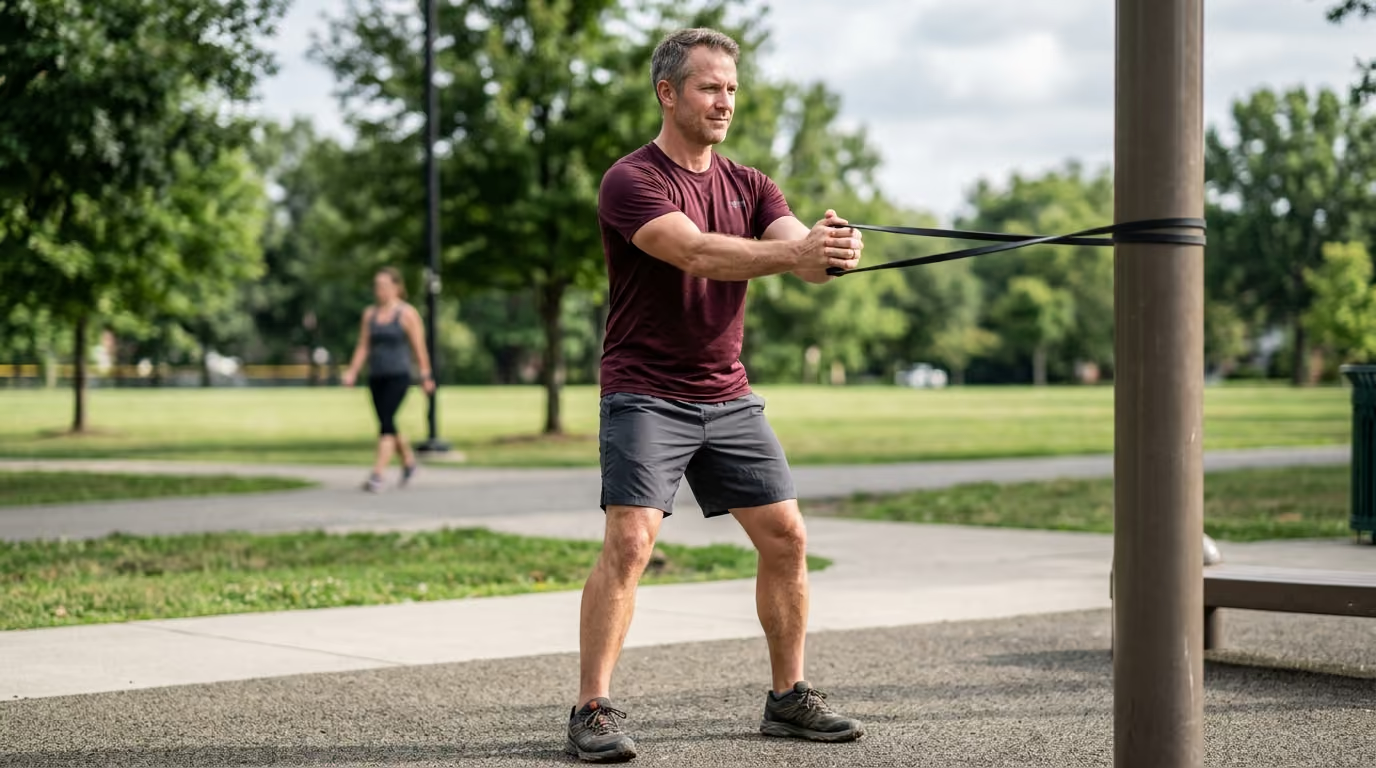
Attach a resistance band or cable pulley at mid-chest height. Stand perpendicular to the anchor point with your feet shoulder-width apart, holding the handle with both hands at your sternum.
Sink into an athletic quarter-squat and brace your torso. Press the handle straight out in front of your chest until your elbows are nearly straight.
The band will attempt to rotate your torso back toward the anchor point. Resist this rotational torque completely, holding the extended position for two full seconds before drawing the hands back to your chest. Perform 3 sets of 8 to 10 repetitions per side.
Set up in a half-kneeling position with your inside knee down on a padded mat and your outside foot planted forward. Hold a cable or resistance band anchored at chest height out directly in front of your sternum with both hands.
Brace your glute on the down-knee side to stabilize your pelvis. Maintain complete stillness in your torso while resisting the band's pull toward the anchor point.
Breathe naturally into your lower abdomen while holding this position for 20 to 30 seconds. Complete 3 sets on each side.
Position yourself on a flat bench with your left knee and left hand supporting your weight in a tabletop position. Hold a light dumbbell in your right hand while extending your right leg straight out behind you parallel to the floor.
Maintain a level pelvis and keep your spine perfectly neutral, resisting any tilt or rotation toward the weighted side. Row the dumbbell upward toward your hip crease, pausing briefly at the top of the movement.
Lower the weight with control while keeping your torso completely still. Perform 3 sets of 8 repetitions per side.
Anti-lateral-flexion training conditions the body to resist side bending under asymmetric loads. Every time you take a step during running or hiking, you spend a moment balanced on one leg. Your quadratus lumborum, gluteus medius, and oblique wall must fire instantly to keep your pelvis level and your spine upright.
This quality is essential for preventing pelvic drop and lateral spinal compression. When lateral stability fails, the knee on the weight-bearing side often collapses inward, increasing stress on the hip, knee, and lower back.
Building anti-lateral-flexion capacity improves single-leg stability, reduces stride fatigue, and protects the spine during uneven terrain navigation.
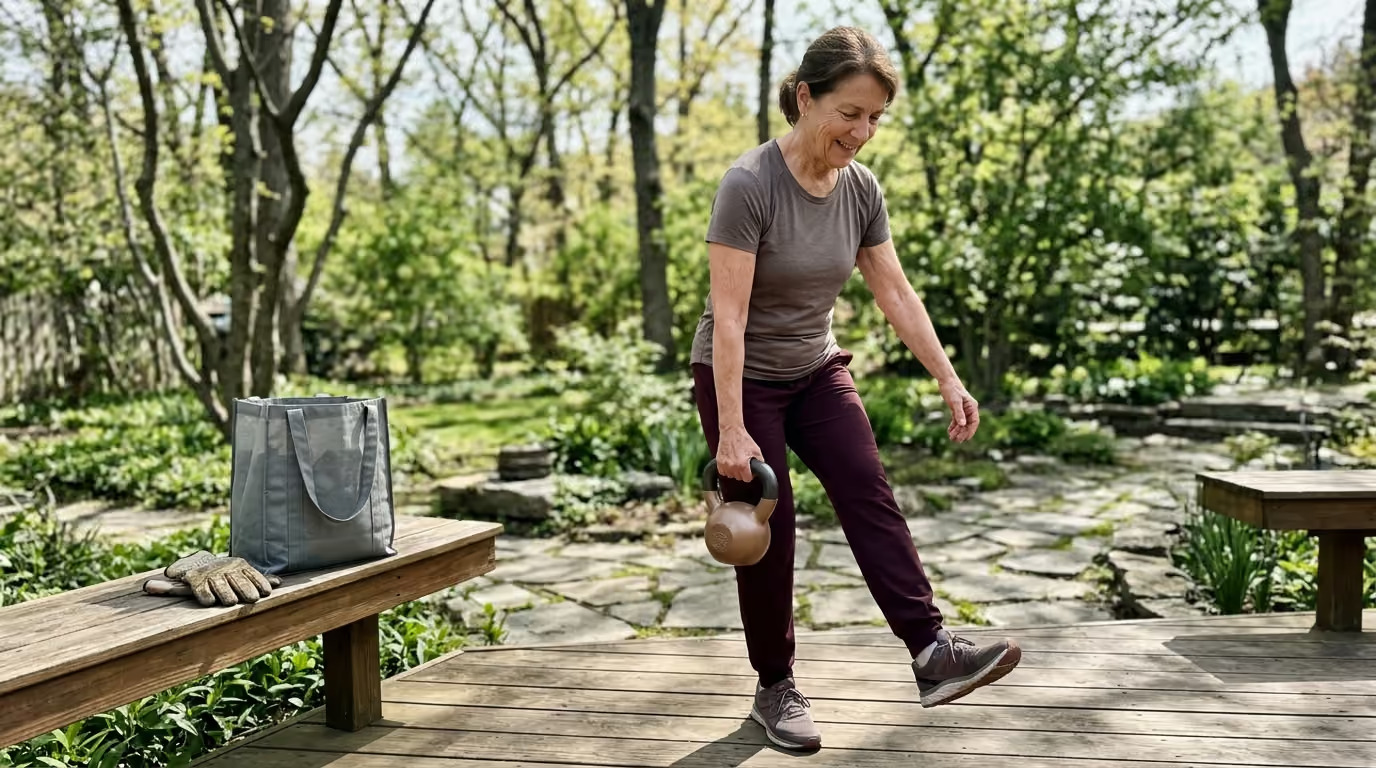
Pick up a heavy kettlebell or dumbbell in one hand while standing tall with your shoulders level. Keep your ribs down and your pelvis square, resisting the temptation to lean away from or collapse toward the weight.
Walk forward in a slow, measured cadence for 30 to 40 yards. Maintain an upright posture and avoid any visible side bending or hip sway.
Switch hands and walk back the same distance. Complete 3 to 4 trips per side.
Lie on your side on the floor in front of a sturdy bench or plyo box. Place the inside of your top ankle on top of the bench and support your upper body on your bottom forearm.
Lift your hips off the floor until your body forms a straight line from your head to your ankles, keeping your bottom leg suspended in the air beneath the bench. Hold this position without letting your hips sag downward or rotate forward.
This movement places high demands on both the lateral trunk and the hip adductors. Hold for 15 to 25 seconds per side across 3 sets.
Attach a resistance band to a secure anchor a few inches off the floor. Lie on your side facing the anchor point and set up in a standard forearm side plank, lifting your hips to form a straight line.
Grasp the band handle with your top hand. Maintaining a rigid side plank, row the band toward your ribcage by driving your elbow backward.
Resist the forward pull of the band, keeping your hips elevated and your shoulders stacked. Perform 3 sets of 8 to 10 repetitions per side.
Anti-flexion training teaches your trunk to resist forward rounding of the spine under heavy compressive loads. When you lift a heavy object from the floor or hold a load in front of your chest, gravity pulls your torso into forward flexion. Anti-flexion strength ensures the spinal extensors, latissimus dorsi, and deep multifidus maintain a neutral arch to protect the intervertebral discs.
Spinal flexion is not inherently dangerous in unloaded, everyday movements. However, loaded repetitive flexion combined with fatigue significantly increases spinal strain.
For athletes over 40, building anti-flexion endurance preserves spinal alignment during heavy lifting, cycling, and prolonged endurance sports. Clinical guidance on strength and balance for older adults underscores the importance of progressing loaded anti-flexion work carefully to protect spinal bone mineral density.
Place a barbell in the crook of your elbows, clasping your hands together tightly against your chest. Stand tall with your chest upright and your ribs anchored down over your pelvis.
Walk forward with slow, deliberate steps for 30 yards. The front-loaded position creates a powerful forward-bending torque that forces your entire posterior chain and anterior wall to work together.
Maintain an upright posture throughout the walk without leaning backward to compensate. Perform 3 to 4 rounds.
Hold a heavy kettlebell or dumbbell vertically against your chest with both hands. Set your feet shoulder-width apart, brace your trunk, and squat down until your thighs are parallel to the floor.
Pause in the bottom position for two full seconds while maintaining an upright torso and a neutral spine. Drive through the floor to return to the top position, keeping your midsection braced throughout the ascent.
Complete 3 sets of 6 to 8 repetitions.
Lift a heavy sandbag from the floor and wrap both arms tightly around the center of the bag, holding it against your sternum. Stand tall with your glutes squeezed, your hips fully extended, and your midsection braced.
Resist the weight pulling your upper back into a rounded slouch. Hold this position for 30 to 45 seconds while maintaining steady, rhythmic diaphragmatic breathing.
Perform 3 sets with adequate rest between efforts.
Once an athlete builds positional control through anti-movement exercises, the next step is training the dynamic transfer of force. Athletic movement rarely involves holding static positions. Sports like golf, tennis, skiing, and swimming require coordinated, explosive rotations driven by the hips and channeled through a stable torso.
Dynamic core training bridges the gap between static stiffness and high-velocity sport execution. The goal is to generate power through the lower body, direct it through the trunk, and deliver it to the upper extremities without losing control.
The kinetic chain functions on alternating levels of joint mobility and joint stability. The ankle needs mobility, the knee requires stability, the hip requires wide multi-planar mobility, the lumbar spine demands stability, and the thoracic spine requires rotational mobility.
When hip or thoracic mobility is restricted, the body forces the lumbar spine to twist beyond its anatomical design. Dynamic core drills train the hips and upper back to move freely while the mid-torso maintains structural integrity.
To train dynamic core qualities safely, divide your exercises into three distinct categories based on their physical demands:
These exercises introduce deliberate, smooth movement through the hips and upper torso under moderate loading. They build active mobility and muscular endurance across multi-planar movement patterns.
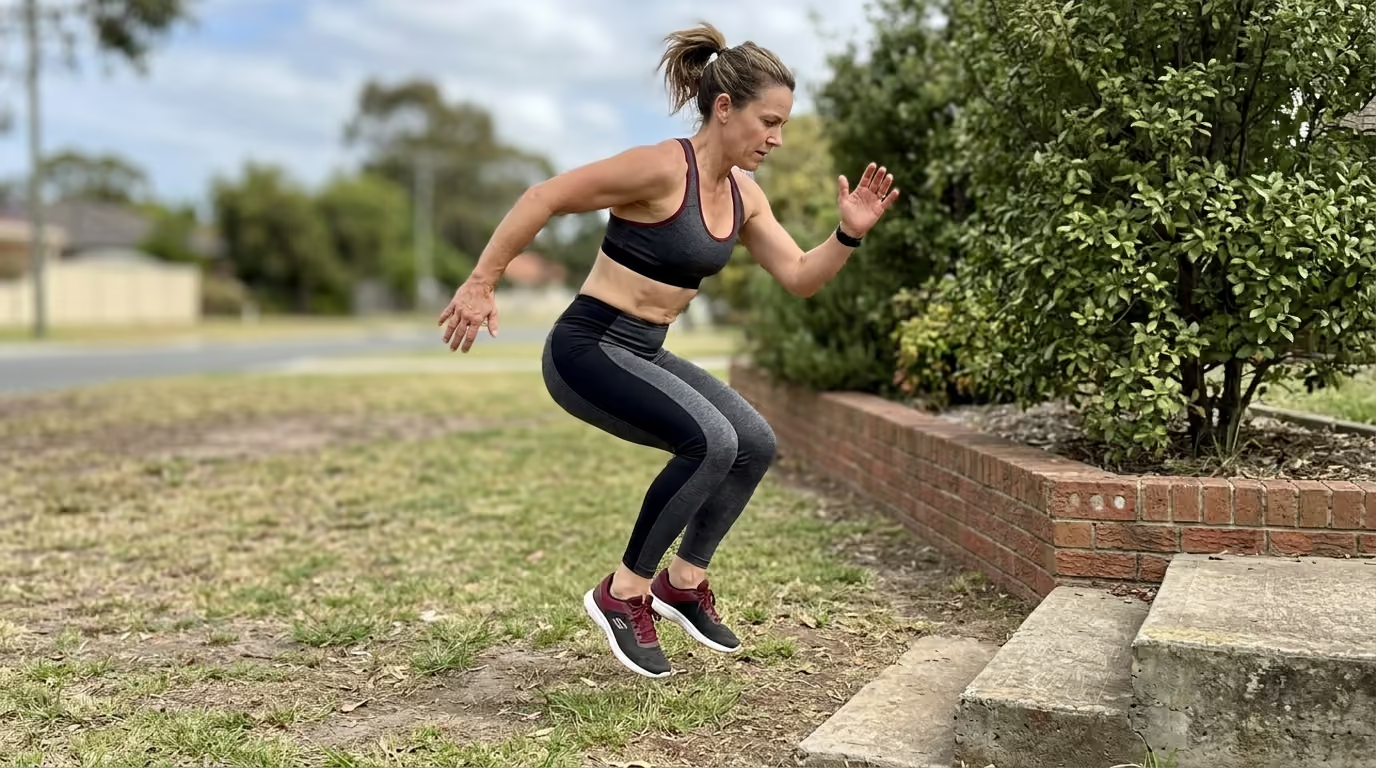
These movements train rapid force transfer through the trunk. They emphasize explosive triple extension from the hips through the ankles, channeled through a braced core to launch an external object.
Deceleration is the most neglected quality in training for athletes over 40. Most non-contact athletic injuries occur while braking, landing, or changing direction rather than during acceleration. Deceleration drills train your trunk to absorb high-velocity rotational and lateral forces, dampening shock before it reaches your joints.
The ultimate purpose of building trunk strength is enjoying physical independence and high-output recreation outside the gym. Whether you are navigating backcountry trails, carving through fresh snow, or traveling across time zones, your trunk stability dictates your endurance and injury resilience.
Last winter in Chamonix, I noticed something striking. It was not the altitude that forced my peers into the lodge by noon, it was a lack of rotational strength and poor recovery from the flight.
We spend so much time debating the perfect supplement stack, yet we neglect the basic foundational strength required to actually enjoy our travels. That trip changed how I approach fitness. I stopped training for aesthetics and started training exclusively for capability.
When skiing steep terrain, your lower body must absorb rapid terrain changes while your upper body remains oriented down the fall line. If your anti-rotational endurance fails, your upper torso rotates with every turn. This throws your center of mass backward, loads your quadriceps excessively, and leaves your lower back vulnerable to jarring compression over moguls.
Building strong anti-lateral-flexion and rotational braking capacity lets you maintain edge control on hard snow without spinal fatigue.
Rotational force transfer directly dictates performance in court and field sports. In tennis, power does not come from the shoulder or arm. It is generated through ground contact, amplified through hip internal rotation, and transferred across a braced midsection into the upper extremity.
When your trunk lacks stability, energy dissipates in the lumbar region. This reduces shot velocity and forces your shoulder and elbow to overcompensate, often leading to joint irritation.
Travel itself places unique demands on the musculoskeletal system. Long-haul flights force the hips into prolonged flexion, which inhibits glute activation and tightens the hip flexors.
Arriving at your destination and immediately hoisting heavy luggage into overhead bins requires combined anti-extension and anti-rotation control. Incorporating anti-movement training into your travel and adventure preparation keeps your body capable and pain-free on demanding itineraries.
Many active adults continue using training routines designed for aesthetic goals rather than functional longevity. Correcting these common missteps will accelerate your progress and protect your joints.
The presence of a visible six-pack indicates low body fat, not functional spinal stability. The rectus abdominis is only one superficial component of the trunk complex.
Focusing exclusively on flexing this muscle through crunches neglects the deep stabilizers that protect the spine. Prioritize structural stiffness, pelvic alignment, and force transfer over superficial aesthetics.
Performing hundreds of repetitive loaded crunches or sit-ups places repeated bending stress on the lumbar discs. As we age, intervertebral discs lose hydration and proteoglycan content, reducing their tolerance for repetitive loaded flexion.
Replace repetitive flexion with anti-extension and anti-flexion movements that challenge the abdominal wall without flexing the spine.
Holding a passive plank for three minutes does not translate to athletic performance. Long, low-tension planks build local muscular endurance in a static position, but they do not teach the rapid, high-tension bracing needed for sport.
Focus on short, maximum-tension holds of 10 to 20 seconds, or dynamic anti-movement variations like body-saw planks and stir-the-pot rollouts.
Performing exercises while standing on balance boards, wobble cushions, or Swiss balls is often promoted as superior core training. However, unstable surfaces significantly reduce the external load you can handle, blunting your strength adaptations.
A systematic review published in the Journal of Strength and Conditioning Research demonstrated that multi-joint free-weight exercises on solid ground produce greater core muscle activation than exercises performed on unstable devices.
Some athletes interpret spinal protection advice as a mandate to avoid all twisting movements forever. This leads to rigid movement patterns and fragile joints.
Rotation is a fundamental human movement quality. The goal is to ensure that rotation occurs primarily at the mobile hips and thoracic spine, while the lumbar spine remains protected by surrounding musculature.
Treating trunk training as an isolated five-minute afterthought at the end of a workout limits your progress. The trunk works hardest during heavy compound movements such as front squats, deadlifts, overhead presses, and loaded carries.
Program your anti-movement drills as deliberate primary exercises or pair them intelligently between sets of compound lifts.
Designing an effective core routine does not require hours of additional gym time. Integrating targeted anti-movement exercises into your existing performance and fitness sessions provides a potent stimulus while leaving adequate energy for recovery.
Athletes over 40 thrive on consistency, progressive overload, and intelligent recovery management. The following progressive four-phase framework establishes foundational stability before advancing to loaded carries and explosive power work.
The objective is to master pelvic positioning, learn 360-degree diaphragmatic bracing, and build low-fatigue isometric endurance without compromising joint alignment.
The objective is to introduce unilateral loading, increase external resistance, and challenge your lateral and rotational stability under moderate fatigue.
The objective is to channel force dynamically through the trunk, introduce explosive hip-driven power, and train rapid deceleration mechanics.
The objective is to match the directional and speed demands of your chosen sport while maintaining spinal control under sport-specific fatigue levels.
For ongoing maintenance, perform two dedicated trunk sessions per week lasting 15 to 20 minutes, or distribute individual exercises throughout your strength workouts.
Progress your training gradually by altering one variable at a time: lengthen the lever arm, increase external load, introduce asymmetry, or increase movement speed. Always prioritize movement quality over load or repetition volume.
Athletes over 40 must account for individual structural histories, previous joint flare-ups, and varying recovery rates. Adapting your training allows you to build high-level performance while respecting joint tolerance.
If you have a history of lower back sensitivity or disc irritation, avoid performing spinal flexion or heavy rotational loading first thing in the morning. Intervertebral discs absorb fluid overnight, increasing hydrostatic pressure within the disc during the first hour after waking. Schedule demanding trunk sessions for later in the day when the spine is properly hydrated and mobile.
For individuals with diagnosed osteopenia, osteoporosis, or past vertebral fractures, specific precautions are essential. Clinical consensus published in Current Osteoporosis Reports advises avoiding loaded, rapid, or end-range spinal flexion and extreme rotational twists.
Focus instead on neutral-spine anti-extension, anti-lateral-flexion, and moderate-load anti-flexion movements such as step-ups, goblet squats, and suitcase carries.
When recovering from a joint flare-up, use an isometric-first progression. Isometrics stimulate local stabilizing musculature, increase blood flow, and down-regulate pain sensitivity without creating mechanical friction at irritated joints.
Begin with low-threshold exercises like supine dead bugs, bird dogs, and gentle Pallof holds. As symptoms settle, reintroduce dynamic carries and controlled multi-joint movements before adding high-speed rotational throws.
Support your structural training with dedicated attention to recovery and sleep. Tendons, ligaments, and fascial sheaths adapt to training stress more slowly than muscular tissue, especially after age 40. Ensuring adequate sleep, managing life stress, and allowing 48 hours of recovery between intense training sessions prevents chronic joint irritation and supports healthy aging.
Tracking your progress requires objective, reliable assessments that measure functional capacity rather than aesthetic change. Use this simple four-part assessment battery every eight to twelve weeks to evaluate your trunk stability, endurance, and symmetry.
Lie on your side and elevate your hips into a rigid side plank supported on your forearm and the edges of your feet. Time how long you can maintain a straight body line without dropping your hips or rotating your shoulders forward.
Rest for three minutes, then repeat on the opposite side. Compare the times between your left and right sides. A side-to-side difference greater than five percent indicates a lateral imbalance that requires dedicated unilateral carry work.
Select a dumbbell or kettlebell equal to 25 percent of your body weight for men, or 20 percent for women. Pick up the weight in one hand and walk along a straight 25-yard line.
Assess your ability to maintain a level shoulder line, an upright torso, and a smooth gait without leaning away from the weight. Repeat on the other side.
Your goal is to complete 50 continuous yards per side with complete postural control and zero spinal tilt.
Sit upright on the floor with your legs extended straight in front of you, holding a 6-to-8-pound medicine ball with both hands at your chest. Rotate your torso 45 degrees to the right, then explosively toss the ball forward using only your trunk and arms.
Measure the distance of the throw, then repeat from the left side. A distance difference of more than ten percent between sides highlights an asymmetry in rotational force transfer that should be addressed with half-kneeling chops and Pallof presses.
Stand on your right leg, bend your knee into an athletic loading position, and bound laterally to your left, landing solely on your left foot. Hold the landing in a stable single-leg quarter squat for three full seconds without placing your right foot down or letting your torso lean excessively.
Perform three repetitions in each direction. Notice whether your trunk stays upright and aligned over your hip, or whether your chest collapses forward or to the side upon landing.
Document your test results in a training journal. Focus on closing side-to-side imbalances and improving movement quality rather than chasing maximum numbers.
Balanced strength and clean movement mechanics are the ultimate markers of athletic resilience. For further insights on structuring your long-term training, visit our comprehensive health and performance resources.
When to revisit this resource: Review this guide whenever you prepare for a new sports season, notice lower back tightness during activity, or update your strength programming every twelve weeks.
Building true trunk strength is a progressive investment in physical capability that will keep you active, powerful, and injury-free across a lifetime of movement.
Stay connected for research and practical guidance on longevity, strength, recovery, energy and active living. New ideas to help you stay capable, curious and ready for more.


Explore practical guidance on strength, recovery, energy, travel and longevity for a life that stays active.
explore the Blog