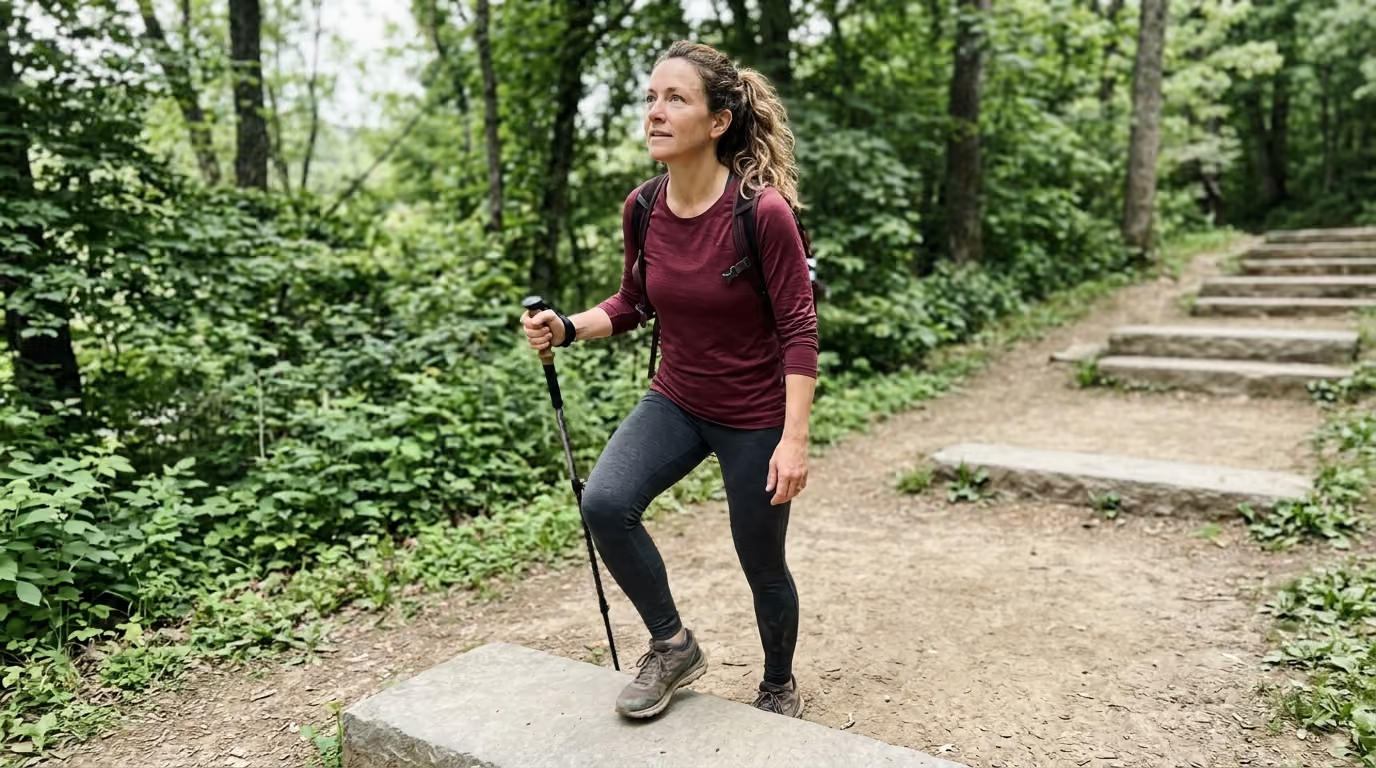

Long days of walking cobblestone streets and climbing stairs require targeted conditioning plans that build joint resilience and loaded stamina after forty.





Most travelers believe that having good general cardiovascular fitness makes them ready for any itinerary. They spend hours on stationary bikes, rowers, or treadmills, assuming this stamina will carry over to five days of European cobblestones. Yet, even seasoned endurance enthusiasts frequently return to their hotel rooms with agonizing lower back tightness, aching foot arches, and blown-out quadriceps.
Travel fitness is not simple aerobic endurance. It is a distinct, multicomponent physical reserve that combines joint tolerance, eccentric muscular braking, postural stamina under load, and dynamic balance. Preparing your body after age 40 requires a targeted conditioning strategy that respects tissue recovery while building real-world resilience.
A successful journey requires more than the ability to move continuously. You must withstand repeated, unpredictable bouts of walking, standing in long museum queues, and negotiating steep stone staircases. You must also manage heavy luggage, navigate uneven pavements, and adapt to heat, altitude, and poor sleep.
At its core, travel readiness requires multicomponent conditioning. Cardiovascular efficiency supplies the energy for long days on your feet, while functional strength produces force for climbs, curbs, and heavy bags. Muscular endurance ensures you can repeat these movements thousands of times each day without your posture collapsing.
Dynamic balance and spatial coordination protect you from unexpected missteps on wet stones or crowded transit platforms. Usable joint mobility in the ankles, hips, and upper spine allows your body to absorb ground forces efficiently. Finally, load tolerance conditions your feet, calves, and tendons to bear the cumulative weight of daily backpacks.
When you prepare all of these qualities together, your planned itinerary feels manageable. You create a physical surplus that allows you to focus on the experience rather than your physical discomfort. For a broader look at physical readiness, review our foundational guide on strength and physical performance.
General fitness often fails during travel because everyday city life rarely replicates the specific mechanical stresses of an active itinerary. Understanding how these distinct physical stresses affect your body helps you choose the right training exercises.
Aerobic capacity measures the ability of your heart and lungs to deliver oxygen to working muscles. Travel endurance is far broader. It integrates cardiovascular efficiency with local muscular fatigue resistance, connective tissue resilience, and pacing strategy.
A person may possess an excellent cardiovascular system from swimming or cycling. However, after four hours of walking on hard pavement, the limiting factor is rarely lung capacity. Instead, fatigue strikes the intrinsic foot muscles, the Achilles tendons, the gluteal stabilizers, and the lumbar spine. If your tissues cannot handle ground reaction forces, aerobic capacity alone will not prevent physical exhaustion.
Walking uphill or climbing stairs requires concentric muscle action, where muscles shorten to generate upward power. Descending stairs or walking down steep hills requires eccentric muscle action, where muscle fibers lengthen under tension to slow your body down.
Eccentric contractions generate substantial mechanical tension and produce more micro-damage in muscle fibers than upward climbing. If you have not conditioned your quadriceps and calves for downhill braking, descending a few hundred ancient stone steps can leave you with severe muscle soreness for several days. Conditioning must intentionally train these decelerating forces through controlled step-downs and split squats.
Carrying a shoulder bag or backpack shifts your center of mass and places continuous demand on your postural muscles. The muscles along your spine, deep abdominal wall, and shoulder girdle must work continuously to keep you upright.
When these stabilizing muscles fatigue, your gait changes. You may lean forward, compress your lower back, or overstride, which increases stress on your knees and hips. Building travel fitness means developing muscular stamina in the upper back, core, and hips so you can carry gear comfortably for hours.
Conditioning for travel should follow a structured progression over several weeks or months. This progression should depend on your starting physical capacity rather than your chronological age.
The goal of the first phase is to make physical activity a regular habit without causing joint irritation or lasting soreness. You will establish regular walking volume, learn basic functional movement patterns, and practice brief balance drills.
Begin with two or three easy walking sessions each week, lasting 20 to 30 minutes. Add one or two brief strength sessions using simple bodyweight movements such as chair squats, wall push-ups, and calf raises. Keep at least one full recovery day between your strength workouts to allow your connective tissues to adapt.
Once movement is a consistent habit, focus on increasing the duration of your walking sessions. This phase conditions the plantar fascia, calves, and hips to handle long periods on your feet.
Add time gradually to one session each week until you can walk comfortably for 45 to 60 minutes. A solid weekly routine during this phase includes two moderate walks, one longer easy walk, and two full-body strength sessions. Always finish your longest walk feeling as though you could have continued for another ten minutes.
This phase prepares your legs and cardiovascular system for hills, bridges, and staircases. It builds both the climbing power and the eccentric braking strength required for descending terrain safely.
Incorporate one dedicated elevation session each week. Start with a five-minute easy warm-up, followed by four to six intervals of 30 to 60 seconds of brisk stair climbing or uphill walking. Walk down slowly and easily between efforts to recover, and conclude with a five-minute cool-down walk. If outdoor hills or stairs are unavailable, use an inclined treadmill or perform controlled step-ups on a sturdy bench.
Travel requires being active for several days in a row while carrying personal items. This phase safely introduces external loads and consecutive training days to test your recovery capacity.
Wear your actual travel daypack, loaded with two to four kilograms, during your longer weekly walks. Structure your training week so that an elevation session is followed the next day by an easy-to-moderate walk. This sequence trains your body to move comfortably even when your legs carry mild residual fatigue.
Two to three weeks before departure, perform a full rehearsal to confirm your physical readiness. This rehearsal validates your pacing, your choice of footwear, and your recovery strategies.
Combine a morning walk of 60 minutes, a midday rest stop, and an afternoon walk of 45 minutes over varying terrain while carrying your daypack. Follow this with a moderate walk the next morning. If you recover comfortably by the second afternoon without persistent joint pain, your physical reserve is ready for your itinerary.
A conditioning program must match your individual starting point. Use these scalable profiles to adjust the training volume and intensity to your specific needs.
If you currently have a sedentary routine or feel breathless when climbing a single flight of stairs, start with manageable doses. Begin with three 10-minute walks per day, spaced out across the morning, afternoon, and evening.
Incorporate basic strength movements from a seated position or using stable supports. Perform chair rises, counter-supported heel raises, and wall push-ups twice per week. Focus on consistency and movement quality before adding extra distance, speed, or elevation.
If you exercise regularly but rarely tackle hills, long stairs, or heavy backpacks, focus on exercise specificity. Maintain your baseline aerobic work while adding structured elevation and carrying sessions.
Aim for 150 to 200 minutes of weekly walking or equivalent aerobic work, distributed across three or four sessions. Dedicate one session weekly to stair intervals, and perform two comprehensive strength workouts focusing on single-leg exercises and loaded carries. Practice wearing your daypack on your longest weekend walks.
Athletes with high cardiovascular fitness often assume they are immune to travel fatigue. However, a dedicated road cyclist or lap swimmer may lack the specific bone and tendon conditioning required for all-day urban walking.
Maintain your normal aerobic training, but replace one weekly workout with a travel-specific walking session over varied surfaces. Add unilateral strength exercises, eccentric step-downs, and suitcase carries to your gym routine. This strategy converts your broad cardiovascular engine into functional walking and carrying capacity.
If you manage osteoarthritis or joint stiffness, low-impact cross-training helps build cardiovascular capacity without irritating sensitive cartilage. Stationary cycling, water aerobics, and elliptical training are excellent tools for building endurance.
When walking, use shorter and more frequent bouts rather than one exhausting march. Choose flat, softer surfaces where possible, and consider using lightweight trekking poles on hilly terrain. Emphasize strength training for the quadriceps, hamstrings, and gluteal muscles to provide greater active stability for your knees and hips. To explore additional strategies on physical longevity, read our detailed work on healthy aging and living well.
Strength training for travel is about movement competency rather than maximum lifting numbers. Your routine should train the primary movement patterns you will encounter on the road.
Step-ups build the strength needed to climb steep hills, step onto trains, and conquer monuments. Step onto a stable box or step, driving through the heel of the lead foot without pushing off the back toes. Lower yourself back down under control to train the eccentric braking mechanism.
Split squats and reverse lunges develop balance and single-leg strength. Stand upright, step one foot back, and lower your back knee toward the floor while keeping your front knee tracking over your middle toes. Return to the starting position smoothly, keeping your torso tall and your core engaged.
Chair stands and bodyweight squats train the fundamental movement pattern of standing up from deep seats, low sofas, or public transit benches. Sit on a sturdy chair with feet flat on the floor. Lean slightly forward from your hips, stand up without using your hands, and lower yourself back down slowly.
The hip hinge is the most critical pattern for protecting your lower back when lifting bags from the floor, car trunks, or airport carousels. Stand with feet hip-width apart and knees soft. Push your hips backward while keeping your spine straight and chest proud, then squeeze your glutes to return to standing.
Calf raises condition the lower leg, Achilles tendon, and plantar fascia for thousands of daily foot strikes. Stand near a wall for balance, rise onto the balls of both feet, hold the top position for one second, and lower down slowly. Progress to single-leg calf raises as your strength improves.
The suitcase carry develops lateral core stability, grip strength, and upright posture under uneven loads. Hold a dumbbell or kettlebell in one hand like a suitcase, keep your shoulders level, and walk forward in a smooth, straight line. Avoid leaning away from or toward the weight, and switch sides after 30 to 45 seconds.
The farmer carry uses weights in both hands to build total-body posture and carrying capacity for airport transit. Hold an equal weight in each hand, retract your shoulder blades slightly, and walk with measured, confident steps. This movement conditions your upper back and neck to resist the strain of heavy shoulder bags.
Perform your strength workouts two to three times per week on non-consecutive days. Aim for one to three sets of 8 to 12 repetitions per exercise, using a weight that feels challenging while allowing you to maintain clean technique. For deeper guidance on strength frameworks, see our resource on performance and fitness.
Navigating crowded streets, broken sidewalks, and slippery cobblestones demands rapid balance corrections. Balance is an adaptable skill that responds quickly to regular practice.
You can practice balance exercises throughout your day in short micro-sessions. While waiting for your coffee to brew or brushing your teeth, stand on one foot with your eyes open for 30 seconds. As this becomes easier, try closing your eyes or performing slow head turns from left to right.
Tandem standing and heel-to-toe walking challenge your lateral stability. Place the heel of one foot directly in front of the toes of the other foot, and practice balancing in this narrow stance. Progress to walking slowly forward along an imaginary straight line, pausing briefly on each step.
Stiff ankles reduce your shock absorption and increase your risk of tripping on uneven surfaces. Improve ankle mobility by performing gentle ankle circles and calf stretches against a wall after your walks. Ensure your ankle joint can move freely into dorsiflexion, which is essential for walking down slopes.
Never debut new footwear during your trip. Wear your chosen travel shoes throughout your training phases to allow your feet to adapt to the pressure points and sole stiffness. Test your footwear on varied surfaces, including concrete, dirt paths, stairs, and grass.
Physical fitness is only one part of travel performance. Environmental conditions and logistical stresses can drain your energy if you do not prepare for them.
High temperatures increase your cardiovascular strain, elevating your heart rate even at an easy walking pace. When traveling to warm climates, plan strenuous sightseeing or walking tours during the cooler morning or late afternoon hours. Wear loose, light-colored clothing, carry adequate water, and take regular rest breaks in shaded or air-conditioned spaces.
If you cannot acclimatize to the heat before leaving home, reduce your walking intensity and distance during your first few days. Early fatigue in hot weather is a normal physiological response, not a sign of poor fitness.
High altitudes reduce the oxygen available to your working muscles, which makes ordinary hill walks and stair climbs feel exhausting. The Centers for Disease Control and Prevention recommends gradual ascent and limiting physical exertion during your first 48 hours above 8,000 feet.
If your destination involves significant elevation, schedule light walking and rest days at the start of your itinerary. Avoid heavy physical exertion and alcohol during these initial days to give your body time to adapt. Pacing yourself conservatively at high altitudes preserves your stamina for the remainder of your trip.
Long transit times and time-zone shifts disrupt your natural sleep architecture and reduce your recovery capacity. In our experience, failing to manage travel fatigue can derail an otherwise well-planned itinerary.
After a grueling thirty hour transit to Tokyo, I realized my old strategy of just powering through was no longer working. I felt foggy for three days. I started digging into circadian biology and realized that timing my light exposure and fasting during the flight could completely shift my recovery. Now, I never board a long haul flight without a precise schedule for when to eat and when to put on an eye mask. It is the difference between losing a week of your trip and hitting the ground running.
Protecting your sleep during travel directly supports your physical performance. Plan an easy first day after long-haul flights, and allow your body to adjust before attempting challenging physical excursions. For detailed recovery protocols, explore our articles on recovery and sleep.
Many active adults undermine their travel preparation by falling into predictable training traps. Avoiding these common mistakes will keep your preparation safe and effective.
Pedaling a stationary bike or using an indoor rower builds cardiovascular health, but it does not prepare your feet for long days of walking. Non-impact training fails to condition the bones, ligaments, and tendons of the lower legs for repetitive impacts. Always include real walking on varied outdoor surfaces as the foundation of your plan.
A frequent training error is adding distance, hill steepness, carrying weight, and walking speed all in the same week. This sudden increase in mechanical stress can cause tendonitis, plantar fasciitis, or joint flare-ups. Change only one variable at a time, allowing your body to adapt before introducing another challenge.
The traditional rule of thumb suggesting you should only increase weekly training volume by 10 percent is often applied too rigidly. Scientific reviews show that rigid progression formulas do not account for individual recovery rates or historical training experience. Instead of following an arbitrary percentage, use a symptom-guided approach that adjusts your workload based on joint comfort, sleep quality, and daily energy.
Many travelers condition their legs by climbing hills or stepping upward on gym machines, but they completely forget about the return trip. Descending terrain creates significant muscle micro-trauma through eccentric braking forces. Incorporate controlled step-downs, reverse lunges, and downhill walks into your program to protect your knees and quadriceps.
Mild muscle fatigue and temporary stiffness are normal responses to new physical exercise. However, sharp joint pain, swelling, limping, or persistent discomfort that worsens during a walk are clear signals to stop. If you experience these symptoms, scale back your training volume and consult a physical therapist or medical professional. For broader travel strategies, see our guide on travel and adventure.
You do not need hours of daily workouts to build meaningful travel resilience. A targeted, minimal dose of specific exercises can produce exceptional results when performed consistently.
If your weekly schedule is constrained, prioritize three high-yield training touchpoints. This compact framework builds the essential physical qualities required for demanding travel days.
By focusing on these essential exercises, you build sufficient physical reserves in under three hours of total weekly training. Consistency and movement quality matter far more than long, exhausting workouts.
The framework outlined here aligns directly with recommendations from leading global health organizations. The World Health Organization and the Centers for Disease Control and Prevention recommend that all adults achieve at least 150 to 300 minutes of moderate-intensity aerobic activity each week. They also recommend muscle-strengthening activities involving all major muscle groups on two or more days weekly.
For adults aged 65 and older, public health guidelines emphasize multicomponent physical activity that incorporates balance training and functional strength alongside aerobic exercise. The National Institute on Aging highlights that regular resistance training preserves muscle mass, enhances joint stability, and maintains independent mobility throughout your life.
The American College of Sports Medicine advises that functional resistance training should focus on multi-joint movement patterns performed through full, pain-free ranges of motion. By building your travel fitness plan around these evidence-based principles, you enhance your travel adventures while investing in your long-term physical vitality. To discover more about building endurance and vitality, explore our dedicated materials on travel and human performance.
Conditioning your body before departure transforms how you experience the world, ensuring that physical fatigue never dictates the boundaries of your journey.
Stay connected for research and practical guidance on longevity, strength, recovery, energy and active living. New ideas to help you stay capable, curious and ready for more.


Explore practical guidance on strength, recovery, energy, travel and longevity for a life that stays active.
explore the Blog