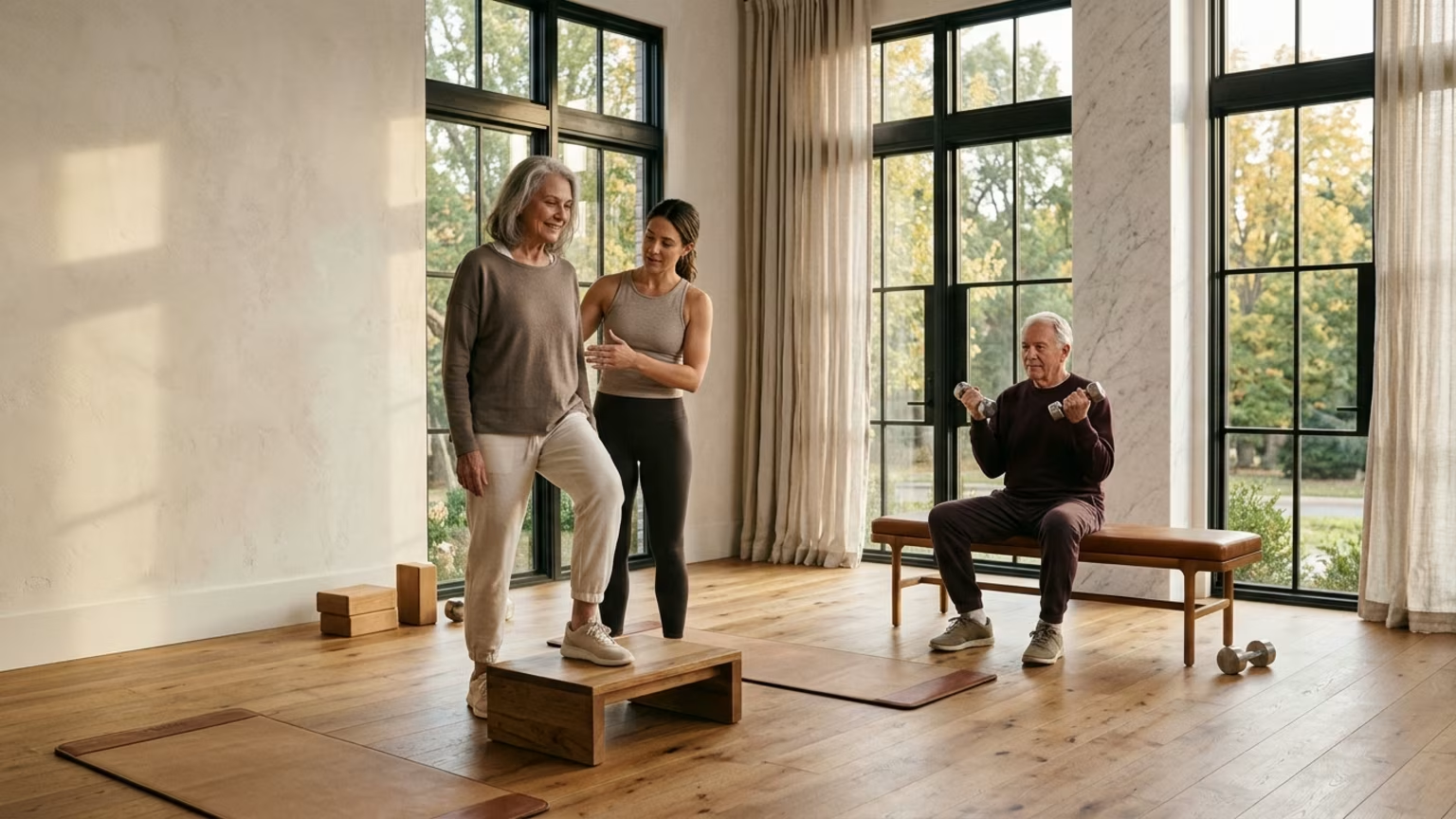

A year-long exercise analysis found varied strength and walking gains after 70, with resistance-training attendance linked to broader responses.





On October 24, 2026, an analysis published online in the European Journal of Applied Physiology reported average improvements in strength and walking performance among older adults following a year-long exercise program. If you value the freedom to travel on foot and remain active for decades, its most useful finding concerns how to recognize progress.
In the study’s analysis, 46% of participants met the authors’ high-response criteria in two to five outcomes. That is encouraging evidence about several dimensions of physical capability. It is not a promise that nearly half of all older adults will improve across the board.
The paper examined individual responses within the PASSWORD randomized trial. That trial ran from 2017 to 2019, so the news is a closer analysis of existing results rather than a newly completed exercise program.
According to the paper, the trial enrolled 314 community-dwelling adults aged 70 to 85. Participants were assigned to physical training alone or physical training combined with cognitive training. The response analysis included 288 people who completed assessments at baseline and after 12 months.
Their physical training combined several elements:
This was not a test of resistance training in isolation. Strength work sat alongside walking and balance practice within a broader program. The results therefore describe responses to that combination rather than identifying one exercise as responsible for every improvement.
For readers interested in long-term independence, that breadth is worth noticing. The researchers assessed several abilities rather than reducing physical progress to a single score.
The analysis reported significant average improvements in grip strength and knee-extension strength. Walking speed and six-minute walking distance also improved significantly. There was no significant average change in appendicular lean mass, a measure of lean tissue in the limbs.
The useful distinction is between how the body performs and what a body-composition measure records. In this study, those results told different stories. Judging the program only by lean mass would have missed the group’s improvements in strength and walking performance.
In coverage by Medical Xpress, the researchers emphasized assessing exercise through multiple outcomes because walking ability may improve without substantial change in muscle mass. That suggests a more useful question than whether a program simply “worked”: which abilities changed?
To examine individual responses, the authors used thresholds intended to account for measurement error and normal biological variation. The percentage classified as a high responder differed by measure:
Across the measured outcomes, 46% met high-response criteria in two to five areas. Meanwhile, 22% had no high response in any outcome and 8% had high responses in four or five.
The pattern matters more than any single percentage. Broad responses occurred in a substantial share of this sample, but participants did not follow one uniform path. The group average was useful without being a complete description of any individual’s experience.
The paper found that higher adherence to supervised resistance training was associated with a greater likelihood of high responses across multiple outcomes. This makes participation an important part of the story alongside the exercise program itself.
The authors also proposed adapting programs to people’s preferences and capabilities while addressing barriers to participation. That was a suggested implication rather than a tested comparison of ways to improve attendance. Its practical relevance is nevertheless clear: a program’s suitability deserves attention alongside its content.
For an active adult, the useful discussion is about making a strength commitment workable within a broader routine. It is not about assuming that the most ambitious calendar will produce the broadest gains.
The authors describe this work as an exploratory secondary analysis. There was no non-exercise control group for assessing individual responses, which limits certainty about whether a particular person’s observed change reflected training rather than random variation. The analysis does not prove that every recorded change was caused by exercise.
The high-response categories also require care. Their study-specific thresholds should not automatically be treated as noticeable or clinically meaningful improvements for every participant. Equally, failing to cross a high-response threshold is not the same as showing no improvement at all.
The population was selected. Participants reported not meeting physical-activity recommendations at baseline, and severe conditions that could make participation unsafe were excluded. Common chronic diseases among those included were mainly well controlled. These findings are therefore not an individual forecast for younger readers or people with substantially different activity levels or health profiles.
The attendance finding was an association rather than proof of cause and effect. The authors note that baseline physical and mental health or previous exercise experience could influence both participation and results. The analysis does not establish how much extra attendance would change an individual’s outcome.
Finally, the reported strength and walking outcomes do not establish faster travel recovery or better altitude adjustment. They also do not demonstrate improved skiing performance. Where chronic conditions affect exercise choices, decisions about a suitable program belong with a qualified health professional.
The practical connection is preparation for several demands rather than confidence in one fitness number. For a walking holiday, walking capacity deserves explicit attention. For a ski trip, strength belongs in the preparation conversation rather than assuming that a good walking result describes overall readiness.
These are ways to apply the study’s approach to assessing capability. Start with the activities you want to retain, then consider strength and walking capacity separately. A capability-centered view of progress keeps that discussion tied to life outside a test rather than to one measurement in isolation.
The clearest routine priority is a repeatable resistance-training commitment within a varied activity plan. The association with broader responses makes consistency a reasonable topic to discuss with a qualified exercise professional. The study’s exact timetable should not be assumed to suit every reader.
For someone whose calendar includes frequent travel, the first planning question is what makes participation difficult. That keeps attention on fitting strength work around a busy life rather than copying a research schedule regardless of circumstances. It also follows the authors’ emphasis on considering preferences and barriers.
Keep that conversation focused on one practical adjustment at a time. If scheduling is the obstacle, address scheduling before adding more complexity. The aim is to make the existing commitment realistic rather than turning an encouraging study into a wholesale overhaul of training and travel.
Use more than one aspect of function when reviewing a program. The study offers two clear categories: strength and walking capacity. A qualified exercise professional can help select appropriate assessments without making daily life revolve around testing.
Give each result its proper place. A change in walking performance answers a different question from a change in strength. Reviewing both creates a more complete account of progress than asking one measurement to stand for the whole person.
If results point in different directions, bring that pattern to the review rather than assigning yourself a permanent responder label. The useful next conversation concerns the program and your goals. It need not become a verdict on your capacity to benefit from exercise.
This approach leaves room for ambition without demanding that every outcome improve together. For readers planning future journeys and active years, that is a more practical interpretation of the news than treating one threshold as the definition of success.
Keep a repeatable strength commitment within a varied exercise routine and judge progress across both strength and walking capacity, with professional input where health considerations or program choices are personal.
Stay connected for research and practical guidance on longevity, strength, recovery, energy and active living. New ideas to help you stay capable, curious and ready for more.




Explore practical guidance on strength, recovery, energy, travel and longevity for a life that stays active.
explore the Blog
