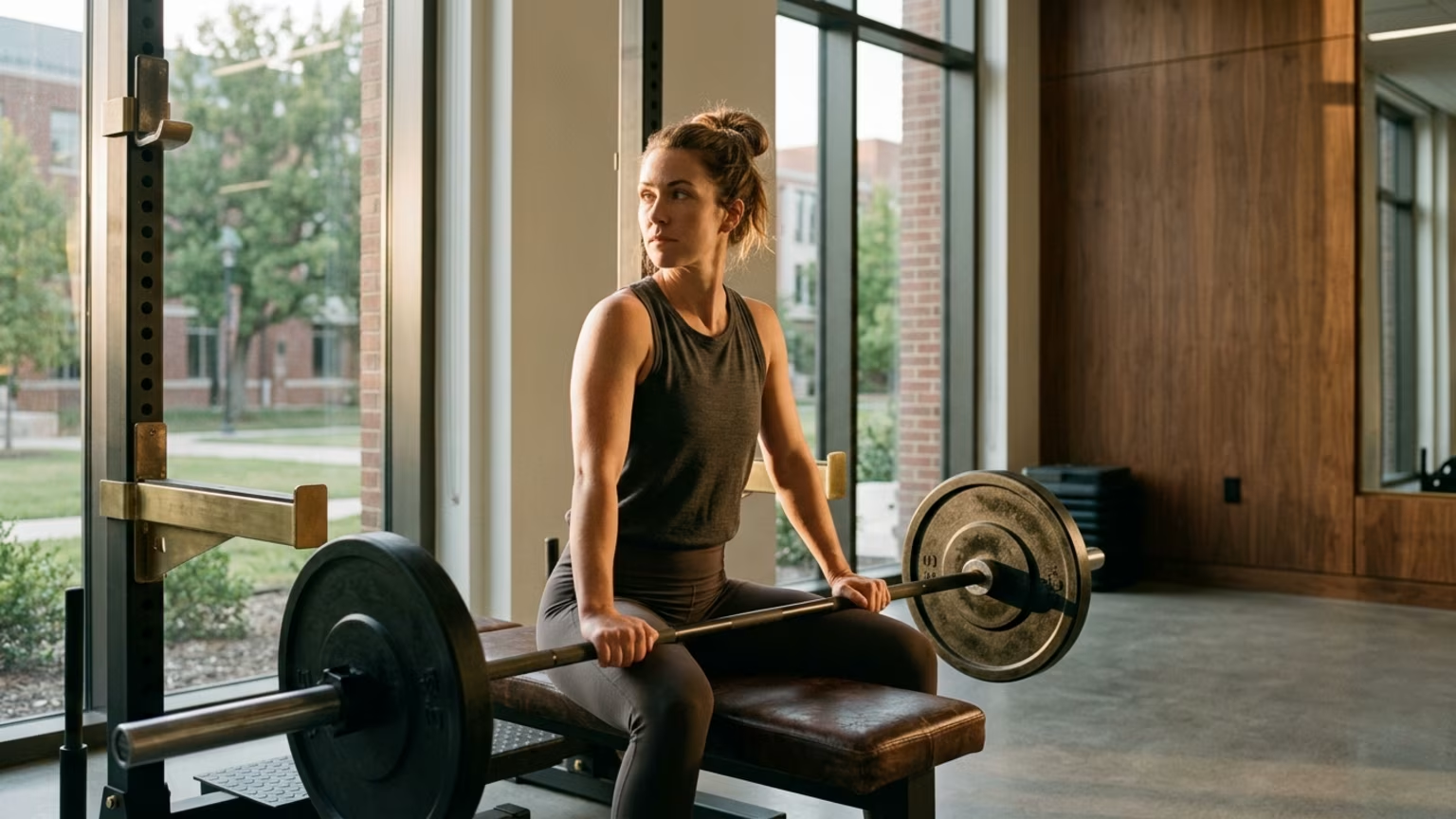

The 2026 ACSM position stand reveals how adjusting lifting load, volume, and concentric speed can break your physical plateau and enhance lifelong travel capacity.





On March 5, 2026, the American College of Sports Medicine published a highly anticipated update to its fundamental exercise guidelines. The new position stand appeared in the April 2026 issue of Medicine & Science in Sports & Exercise. This comprehensive report updated the organization's previous guidance from 2009. The researchers synthesized data from 137 systematic reviews involving more than 30,000 participants.
The goal was to determine exactly how resistance training variables impact muscle function, hypertrophy and physical performance in healthy adults. For active adults who value lifelong capability, this research provides a vital and timely framework. Many people hit a physical plateau and assume they just need to work harder. The new evidence challenges that assumption entirely.
The authors concluded that healthy adults should engage in progressive resistance training, but they must select specific variables based on desired outcomes. Doing generic exercises without a clear target is no longer the recommended approach. You cannot simply apply a single training variable and expect improvements across every physical domain. The latest guidance proves that breaking through a plateau requires total precision.
The importance of this targeted approach extends far beyond the weight room. These specific findings provide crucial context for anyone interested in maintaining everyday capacity. The position stand adds critical detail to broader longevity recommendations. It confirms that resistance training improves contraction velocity, gait speed, balance and multiple measures of physical function.
The new position stand makes a clear distinction between training for strength, muscle size and power. The eligible reviews covered randomized trials in healthy adults aged 18 and older. These resistance training interventions lasted between six and 52 weeks. The literature search ran through October 2024, making this an incredibly current synthesis of exercise science.
When your primary goal is absolute strength, the research identifies several non-negotiable variables. The position stand reports better results with heavier loads. Specifically, you need to lift at least 80 percent of your one-repetition maximum. You must also use a complete range of motion during these exercises.
The evidence suggests that performing two to three sets is ideal for strength adaptations. Furthermore, the timing and frequency of your exercises matter significantly for strength gains. The review found that key exercises must be placed early in the training session. You also need to train at least twice per week to see optimal improvements.
This targeted approach builds the kind of deep structural resilience that maintains independent physical capability throughout adulthood. You do not need endless volume to get stronger, but you do need sufficient intensity. If your workouts lack this heavier loading, your progress will likely stall. Matching these specific variables to your strength goals is the most efficient path forward.
If your goal is to increase muscle size, the required variables shift dramatically away from those used for pure strength. The review identifies higher weekly training volume as the primary driver for hypertrophy. The research specifically notes that at least 10 sets per week are associated with greater muscle growth. This finding contradicts the idea that heavy, low-volume lifting alone is optimal for building tissue.
The evidence also highlights eccentric overload as a key variable associated with hypertrophy. The eccentric phase is the lowering portion of a lift, and emphasizing it creates the stimulus required for tissue growth. This approach is essential for active adults who want to break through a strength plateau after 40 by adding functional lean mass. It is important to note that 10 sets per week is a review finding related to hypertrophy, rather than a universal minimum for strength.
Power development requires an entirely different approach, focusing on speed rather than maximum load or high volume. The review identifies moderate loads of 30 to 70 percent of your one-repetition maximum as ideal. The researchers recommend low to moderate volume for these power adaptations. Olympic style weightlifting is highlighted as a highly effective method for this specific goal.
The speed of your movement is the most critical variable during these specific exercises. The findings point to power focused resistance training with a fast concentric phase. The concentric phase is the lifting or pushing portion of the physical movement. Importantly, the review reports that this specific type of power training enhanced overall physical function.
Perhaps the most surprising findings in the 2026 update relate to the variables that do not actually matter. The review found that several popular fitness concepts did not consistently affect the main training outcomes. For instance, training to momentary muscle fatigue is not universally required for success. Exercise complexity and specific set structures also failed to show consistent impact across the synthesized trials.
Additionally, the equipment type you use does not dictate your final physical results. The evidence shows that time under tension, blood-flow restriction and complex periodization did not consistently affect outcomes. This is reassuring news for people who train in varied environments across the globe. You can achieve excellent results without relying on highly specialized machinery or overly complicated programming.
The position stand authors describe progressive overload as fundamental to any resistance training programming. This principle involves gradually increasing the stimulus placed on your muscles over a training program. The researchers emphasize that healthy adults should do progressive resistance training as their baseline activity. Without this consistent progression, manipulating sets or lifting speeds will not yield meaningful adaptations over time.
While the findings are robust, the authors note several practical caveats for real-world application. The pooled findings represent healthy adults and should not be viewed as personalized prescriptions for people with injuries. Adults returning after a break or managing health concerns should consider qualified coaching before making substantial adjustments. The review identifies associations between variables and outcomes, rather than mandating immediate changes for every single person.
Adults who are completely new to heavier lifting need to proceed with intentional care and strategy. The review itself does not provide individualized screening or a tailored program for distinct medical situations. Identifying your specific goal is the necessary first step before radically altering your current physical routine. These findings are evidence-informed programming considerations, not individualized medical advice for managing complex health issues.
Understanding these specific training variables directly impacts how you experience demanding travel and outdoor sports. When you carry heavy luggage through a sprawling international terminal, your absolute strength determines your overall fatigue level. Lifting loads of at least 80 percent of your maximum builds the exact structural capacity needed for these physical demands. This targeted preparation helps prevent the physical exhaustion that often ruins the first day of an ambitious trip.
Power development plays a crucial role in injury prevention during dynamic activities like skiing or mountain hiking. When you hit an unexpected patch of ice, your ability to recover depends entirely on rapid muscle contraction. A fast concentric phase during your workouts trains your nervous system to react instantly to sudden physical shifts. This explosive capability helps you maintain your balance on unpredictable terrain in remote environments.
Hypertrophy and increased muscle size contribute significantly to sustained energy and high-altitude adjustment. Muscle tissue acts as a metabolic reserve that your body draws upon during long days of sustained physical effort. If you are hiking at high elevations, this increased reserve helps buffer the severe physical stress of the thinner air. The recommendation to perform at least 10 sets per week ensures you have the physical substance required for endurance.
The benefits of improved physical function extend to the subtle demands of adjusting to new environments. Simple actions like lifting a heavy backpack into an overhead bin require a baseline of functional power. The moderate loads and low volume recommended for power training directly mimic these quick, real-world physical exertions. Cultivating this specific type of fitness ensures that minor travel hurdles never escalate into severe muscle strains.
These physical adaptations also profoundly impact your overall travel recovery and daily mobility. The review explicitly noted improvements in both balance and gait speed among participants who engaged in regular resistance training. A brisk gait speed allows you to move effortlessly through crowded transit hubs without experiencing early fatigue. You can easily incorporate a brief strength routine while traveling to maintain these valuable adaptations on the road.
Finally, a stronger body recovers from demanding long-haul flights much faster than a detrained one. Resistance training improves your endurance and contraction velocity, making your body naturally more resilient to environmental stress. When you arrive in a drastically different time zone, your body must rapidly adjust to shifting circadian rhythms. By matching your training variables to your specific goals, you ensure your body is always ready for the next departure.
Active adults should review their current training programs and deliberately adjust their exercise volume, lifting load and movement speed to match their exact goals for strength, muscle growth or power.
Stay connected for research and practical guidance on longevity, strength, recovery, energy and active living. New ideas to help you stay capable, curious and ready for more.




Explore practical guidance on strength, recovery, energy, travel and longevity for a life that stays active.
explore the Blog