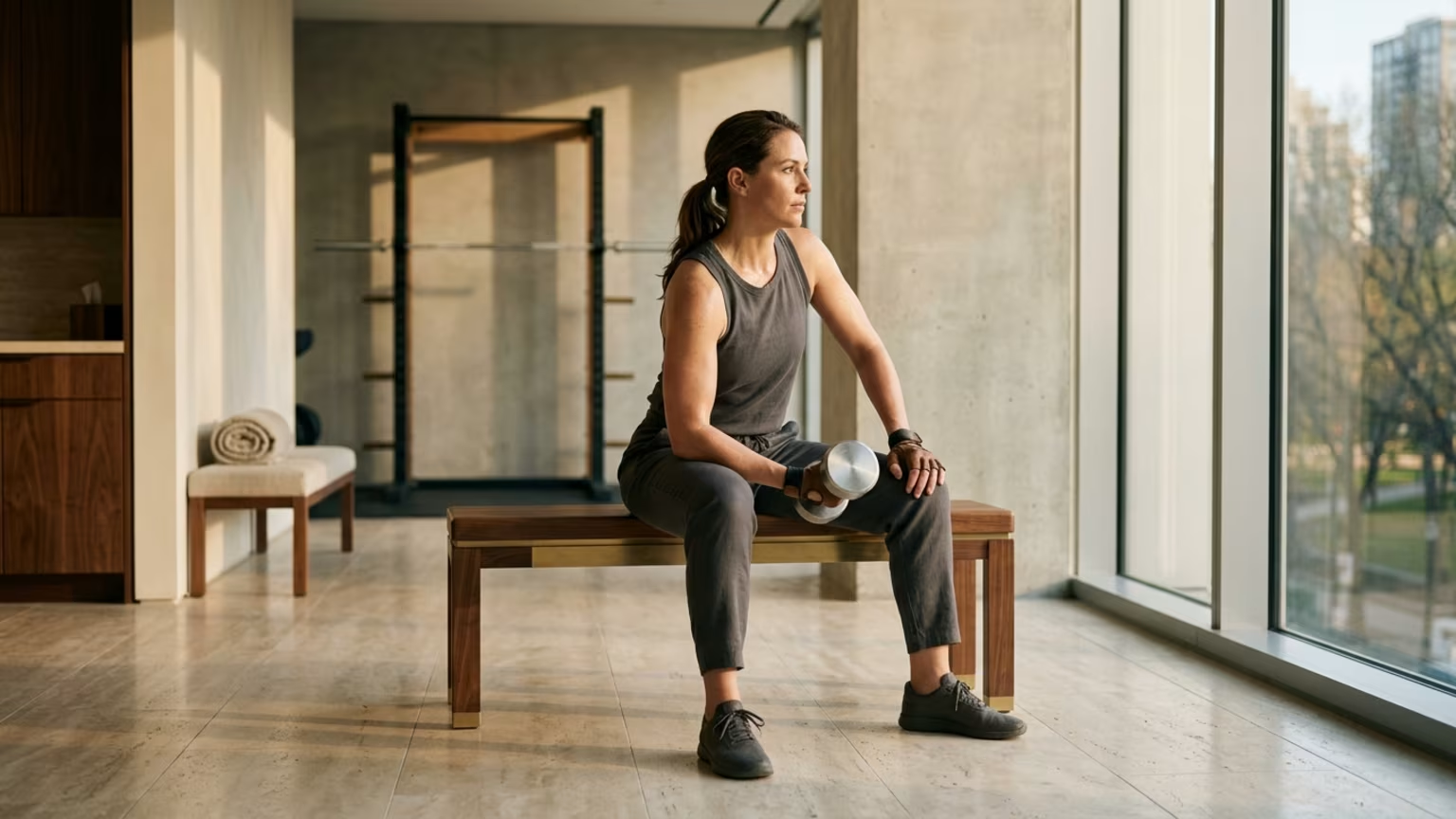

Stop obsessing over skeletal muscle mass. Learn why treating sarcopenia as a disease of the aging motor system protects physical independence.





An active adult stares at a body composition scan, worrying over a fractional drop in muscle mass. The real tension lies entirely off the page, hidden in a slight stumble on an uneven hiking trail. Stop obsessing over skeletal muscle mass alone, because tracking size without function ruins your ability to stay independent.
The health industry loves visible metrics and simple data points. Clinics readily sell advanced body scans to measure the exact quantity of muscle on your frame. This hyper-focus on muscle size suggests that looking strong is the same thing as being strong. However, that assumption fails busy adults who just want to stay capable and active. Two people with the exact same muscle mass can have vastly different levels of coordination, balance, and functional independence.
A recent scientific review confirms what practical observation has long suggested. In August 2026, a review titled “Reframing sarcopenia as a disease of the ageing motor system” was published in The Lancet Healthy Longevity. According to the ZRS Koper Institute for Kinesiology Research, this paper proposes an important conceptual shift. Sarcopenia should not be understood exclusively as a disease of skeletal muscle. Instead, the authors argue that we must view it as a disease of the aging motor system.
This motor system is incredibly complex and deeply interconnected. The proposed model includes the central nervous system and spinal cord alongside peripheral nerves, the neuromuscular junction and the muscle itself. Measuring only the muscle is like evaluating a vehicle by weighing its tires. You completely ignore the engine, the wiring, and the steering mechanisms that drive movement. When you only track muscle quantity, you miss the neural pathways required to actually use your strength in daily life.
The medical community is already recognizing this fundamental difference between mass and function. The European consensus framework places low muscle strength at the center of case finding. It uses reduced muscle quantity or quality to confirm sarcopenia, and it treats reduced physical performance as an indicator of severity. This clinical shift proves that an exclusive focus on muscle size is an outdated approach to healthy aging.
Existing diagnostic approaches clearly illustrate the critical distinction between sheer mass and actual function. A recent review lists specific clinical thresholds used in the European consensus framework. These include a grip strength reading below 27 kilograms for men or 16 kilograms for women. It also notes a five-chair-stand time above 15 seconds, and a gait speed at or below 0.8 metres per second. These cutoffs serve as clinical screening and classification tools, not a substitute for individualized medical assessment. They emphasize that speed and physical force matter far more than visual muscularity.
Stressing over perfect body composition can actively detract from your actual life goals. Many adults in their 50s and 60s spend hours pursuing pure muscle growth. They might maintain a stable body weight and perform conventional gym exercises with absolute ease. Yet, they often experience declining reactive balance, slower movement speed, and reduced task-specific power.
This capability cost becomes glaringly obvious outside the controlled environment of a gym. The ability to step over a sudden obstacle requires rapid neural activation and coordination. Regaining your balance after a misstep depends on your nervous system recruiting muscle quickly and accurately. If you only train for size, your nervous system loses its sharp edge over time. You trade the physical capacity needed for adventure for a slightly better body scan.
This narrow focus ruins the enjoyment of travel, recreational sports, and spontaneous activities. Long flights, unfamiliar stairs, and uneven cobblestone streets demand integrated motor performance. Your body needs a highly responsive nervous system to navigate these unpredictable challenges safely. When you ignore motor-unit preservation, you risk losing the very independence you are trying to protect.
The danger of ignoring motor function is especially visible in modern weight-loss therapies. A 2026 narrative review found that skeletal muscle represented between 8.5% and 24.5% of total weight loss in some studies of GLP-1 receptor agonists. However, only four of the 21 studies reviewed specifically examined older adults. The evidence in this population remains limited and methodologically heterogeneous. This does not prove that these medicines inherently cause clinically meaningful sarcopenia in all older adults. It does suggest, however, that anyone undergoing substantial weight loss must monitor their strength carefully. A hyper-focus on dropping total body weight without preserving the nervous system leaves active adults vulnerable to sudden frailty.
Sarcopenia can also overlap with bone health issues. Osteosarcopenia refers to the coexistence of skeletal-muscle and bone deficits. Treating your body as a collection of isolated parts costs you the resilience required for a fully active life. A comprehensive balance training and physical capability approach is far more valuable than carrying extra, unresponsive muscle mass.
WealthAtPlay champions a much simpler alternative for affluent, active adults. Focus on practical physical performance rather than isolating individual muscle fibers. This means tracking how your body actually moves in the real world instead of stressing over lab metrics. You achieve superior physical resilience with significantly less mental stress.
Resistance exercise remains a foundational tool for preserving your physical capability over time. A 2026 meta-analysis of 41 randomized controlled trials involving 3,141 participants investigated this exact topic. The study found that resistance exercise significantly improved muscle-specific strength. The researchers reported a standardized mean difference of 0.61 and a 95% confidence interval of 0.27 to 0.94.
However, that same analysis reported substantial heterogeneity, noting an I² value of 81%. It also found that aerobic exercise, combined training, and nutrition supplementation did not produce statistically significant improvements in muscle-specific strength. This indicates that while lifting weights is crucial, the exact outcomes vary wildly among individuals. You must apply strength training principles intelligently, adapting the load to your personal recovery timeline and medical status.
A sensible program should progressively train the major fundamental movement patterns. You need to practice pushing, pulling, squatting, and hinging on a regular basis. Traditional strength training alone may not fully reproduce the specific physical demands of hiking, skiing, or cycling. Therefore, adding deliberate coordination work bridges the gap between gym strength and worldly capability.
Your training routine should directly mimic the physical demands of an active, travel-rich life. Incorporate multidirectional movement, loaded carries, and deliberate balance challenges into your weekly schedule. Practice stepping up onto varied surfaces, or safely introduce faster movements to improve your reaction capacity. If you need to rebuild capability after a setback, prioritize coordination and technique over raw load.
Treat your next vacation or outdoor excursion as a practical functional test. Luggage handling, sustained walking, and navigating unfamiliar environments expose weaknesses that are rarely obvious in a gym setting. Preparing with loaded carries and repeated sit-to-stand practice makes your training immediately transferable to travel. This integrated approach prepares your entire motor system for the unpredictability of daily life, delivering strong results with a fraction of the anxiety.
You can easily test your own functional readiness without needing a clinical laboratory. Alongside standard weight or body-fat measurements, consider tracking highly practical physical measures on your own. Monitor your grip strength, your repeated chair-rise performance, and your single-leg balance when performed safely. Assess your stair-climbing capacity and your ability to change direction seamlessly.
These measures align perfectly with the clinical emphasis on strength and physical performance over mere size. By shifting your attention to these practical metrics, you build a body that actually supports your lifestyle.
Are you training to look capable on a laboratory spreadsheet, or are you training to actually stay independent and adventurous in the real world?
The next time you train, add a single dynamic balance exercise, such as a safely controlled step-up with a slow descent, to challenge your nervous system today.
Stay connected for research and practical guidance on longevity, strength, recovery, energy and active living. New ideas to help you stay capable, curious and ready for more.





Explore practical guidance on strength, recovery, energy, travel and longevity for a life that stays active.
explore the Blog