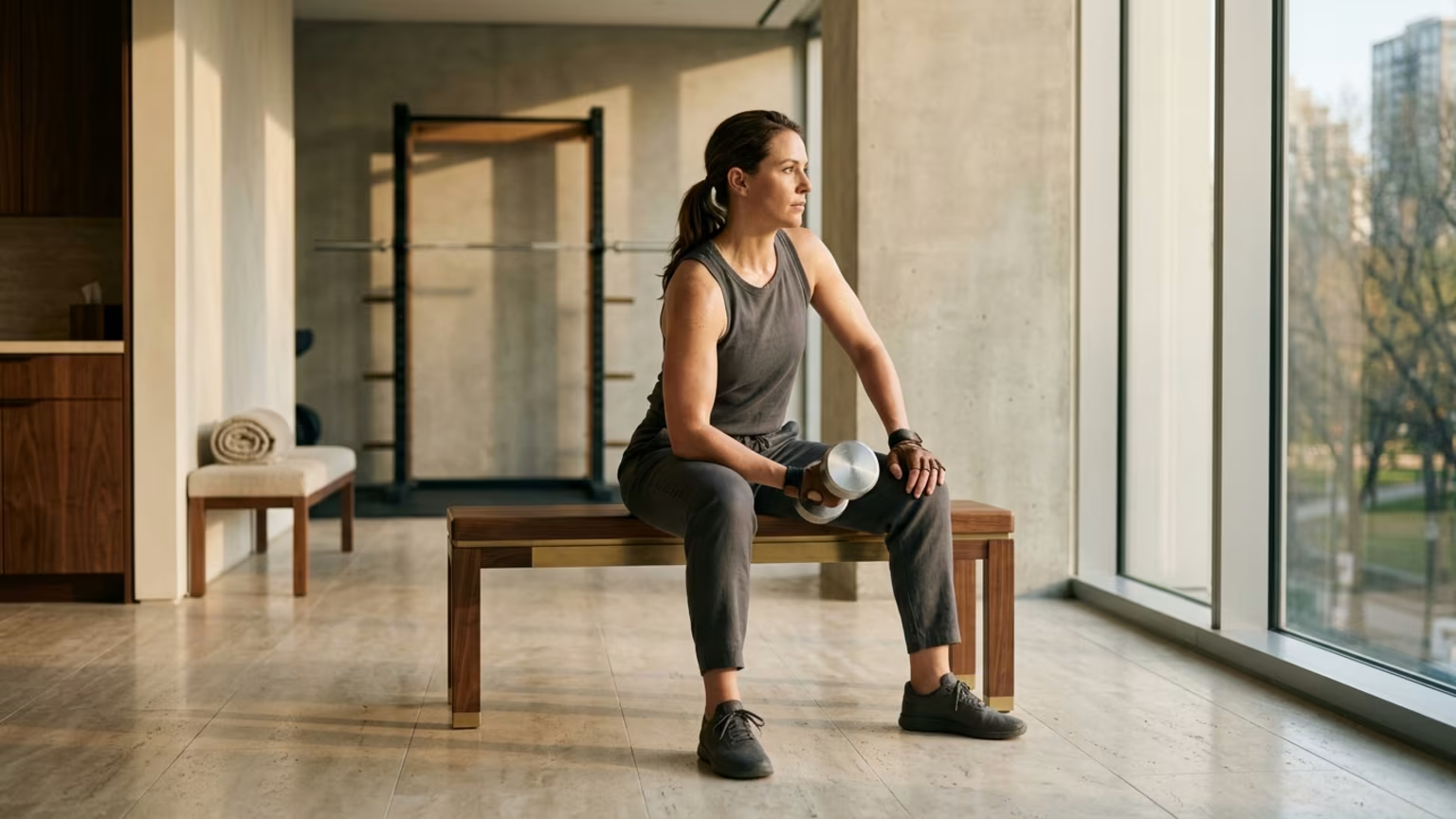

A 2026 UK DRI study reveals consumer sleep trackers struggle with exact sleep staging. Active adults should focus on weekly duration trends instead.





In August 2026, new research from the UK Dementia Research Institute revealed that consumer sleep technologies show poor agreement for sleep stage durations. This recent study adds crucial context for active older adults who rely on daily data to manage their recovery. For those of us who value our physical independence and performance, optimizing rest is nonnegotiable. However, this new evidence suggests that obsessing over nightly readouts of deep or REM sleep might be a flawed strategy.
To understand the limitations of modern wearables, we must first look at how they actually work. According to analysis from Welltory, consumer sleep trackers infer sleep architecture from indirect physical markers. They monitor movement, heart rate, heart rate variability, and optical photoplethysmography. Some products also track temperature, breathing, or sound to estimate your nightly rest.
In contrast, clinical polysomnography relies on direct physiological recordings. A laboratory setup measures brain activity, eye movements, and muscle activity directly. It also tracks breathing, oxygen levels, body position, and cardiac signals. This fundamental difference in methodology explains why consumer devices struggle to map exact sleep architecture.
They are guessing your brain state based on your wrist or finger movements. Welltory notes that even finger worn devices simply infer sleep stages. A strong pulse signal on your finger does not equal direct brain wave monitoring. Therefore, these tools are highly convenient, but they have strict clinical limitations.
A major 2025 meta-analysis published in the Journal of Clinical Sleep Medicine provides a clear look at this measurement gap. Published on March 1, 2025, the review examined 24 prospective studies. The research included 798 participants using devices from popular brands including Fitbit, Apple, and Garmin. The authors advised consumers to interpret wrist worn sleep tracker results cautiously.
The researchers found a pooled total sleep time difference of negative 16.854 minutes versus polysomnography. This finding came with a 95 percent confidence interval of negative 26.332 to negative 7.375 minutes. The review also revealed substantial heterogeneity across the studies. Across 18 of those studies, the pooled sleep efficiency difference was negative 4.691 percentage points.
The initial pooled analysis also found differences in sleep latency of 2.574 minutes. Wake after sleep onset differed by 13.255 minutes on average. The authors noted potential publication bias concerns for those specific measures. Importantly, this major meta-analysis did not pool or evaluate light, deep, or REM sleep staging at all.
Because the review explicitly excluded sleep staging, its results cannot support claims about exact sleep architecture. The paper explicitly states that sleep staging performance was not considered. The authors concluded that wrist worn consumer devices should not yet be treated as valid substitutes for polysomnography. They noted that further clinical studies and algorithm improvements are urgently needed.
The review included a wide range of healthy adults, shift workers, and people with suspected sleep disorders. Because the meta-analysis included such a diverse population, its pooled estimate should not be treated as the expected error of your particular watch. Statistical significance is not the same as practical importance for every individual.
The 2026 UK Dementia Research Institute study filled the measurement gap regarding sleep architecture. The research team examined 74 older adults across 752 paired at-home nights. The participants, including 20 people living with dementia, used research grade actigraphy alongside consumer devices. They utilized a Withings Watch and a Withings Sleep Analyser before completing an in-lab assessment.
The UK DRI researchers found that single night correlations with clinical measurements were remarkably weak. Most measures showed a correlation coefficient of less than 0.3 for individual nights. The researchers noted that consumer technologies overestimated total sleep time and sleep efficiency. They also underestimated wake after sleep onset and showed poor agreement for sleep stage durations.
The clinical consensus is clear that most consumer technologies do not measure the exact same aspects of sleep as polysomnography. However, the data is not entirely negative for fitness enthusiasts seeking sleep optimization for longevity and performance. The UK DRI team concluded that total sleep duration was the only aspect showing consistent moderate transferability. Duration and timing measures generally showed moderate correlations between 0.3 and 0.7.
Reliability also improved significantly when multiple nights were aggregated together. The study reported that 71 percent of measures reached an intraclass correlation coefficient of at least 0.7 within seven nights. Of course, the exact number of nights needed varied by measure, device, and participant group. The authors concluded that multi-night interpretation is far more defensible than isolated night interpretation.
The sector is moving rapidly toward low burden, longitudinal monitoring systems. The UK DRI study describes consumer sleep technologies as attractive because they allow repeated home measurements without the burden of laboratory testing. That convenience creates a necessary measurement trade-off. The devices give you months of continuous data, but sacrifice the precise clinical accuracy of a single night in a dedicated lab.
Device performance is also far from uniform across the modern market. The 2025 meta-analysis found important device specific variation during its review. For example, Fitbit did not differ significantly from polysomnography for total sleep time in subgroup analyses. Meanwhile, non Fitbit devices showed larger differences for some specific sleep measures.
Understanding these data limitations completely changes how we should approach athletic recovery. Active adults frequently cross time zones and face demanding physical environments. When managing travel fatigue, prioritizing consistent wear and stable device placement is essential. You should compare new readings against your own historical baseline rather than striving for a perfect clinical score.
After a grueling thirty hour transit to Tokyo, I realized my old strategy of just powering through was no longer working. I felt foggy for three days. I started digging into circadian biology and realized that timing my light exposure and fasting during the flight could completely shift my recovery.
Now, I never board a long haul flight without a precise schedule for when to eat and when to put on an eye mask. It is the difference between losing a week of your trip and hitting the ground running.
When recovering from such intense travel, reviewing your wearable health data provides helpful longitudinal context. Welltory advises treating consumer sleep trackers as tools for identifying broad patterns. A repeated decline in sleep duration or increasingly late bedtimes should prompt a routine adjustment. These sustained shifts are far more actionable than one unusually low REM reading.
This multi-night approach is equally critical during demanding sports like skiing or high altitude hiking. Strenuous late exercise, alcohol, disrupted schedules, and cold conditions can affect the optical sensors of your device. A sudden drop in deep sleep after a long day on the mountain is a prompt to review your broader context. It is not a definitive physiological measurement of your true brain state.
Instead of chasing perfect nightly scores, pair your wearable data with subjective recovery markers. Pay close attention to your energy, mood, perceived exertion, and physical concentration. Welltory specifically frames heart rate variability and sleep metrics as wellness context rather than medical diagnosis. If an app reports poor recovery but you feel physically strong, trust your own body.
You should also use your device to test specific behavior changes over time. Try moving your dinner earlier, reducing alcohol, or restoring a regular morning wake time. Observe the trend over several weeks to see how your sleep duration responds. Establishing this personal baseline takes time, but the UK DRI findings confirm that reliability improves with repeated measurements.
It is vital to separate wellness tracking from medical screening when reviewing your travel recovery framework. Welltory cautions that consumer trackers are not substitutes for clinical testing. Wearables cannot diagnose insomnia, sleep apnea, or other serious medical disorders. If you experience loud snoring or major daytime sleepiness, you must discuss these symptoms with a clinician.
Polysomnography remains the clinical standard method for evaluating sleep disorders. Consumer oxygen readings should be treated as screening clues rather than definitive medical conclusions. Welltory notes that repeated unexplained awakenings or repeated oxygen concerns always warrant professional medical evaluation. Your watch is a highly capable wellness companion, but it is not your doctor.
Active adults should treat daily sleep stage scores as rough estimates, choosing instead to focus on weekly sleep duration trends and their own physical readiness to perform.
Stay connected for research and practical guidance on longevity, strength, recovery, energy and active living. New ideas to help you stay capable, curious and ready for more.


Explore practical guidance on strength, recovery, energy, travel and longevity for a life that stays active.
explore the Blog