
A Nature Aging study shows human organs age at completely different rates. Learn why relying on a single biological age score is flawed and what to do instead.





A well-meaning clinician hands you a glossy printout with a single number printed in bold font. This number supposedly represents your precise biological age. You are expected to adjust your diet, sleep schedule, and training routine based entirely on this unified metric. Stop letting a single laboratory calculation dictate how you manage your health.
Chasing one master score is a fundamentally flawed approach to human performance. The wellness industry loves to package aging into a neat, easily tracked number. However, a landmark study published on August 31, 2026, in Nature Aging thoroughly dismantles this idea. Scientists at Sanford Burnham Prebys Medical Discovery Institute, working with researchers at the U.S. National Institutes of Health, reported that human tissues follow distinct structural-aging trajectories rather than aging uniformly across the body.
Your body simply does not age at one steady speed. Relying on a single biological age is like trying to measure the health of an entire economy using only the price of bread. Active adults need to abandon this overly simplistic metric. True capability requires a more nuanced understanding of how our physical systems change over time.
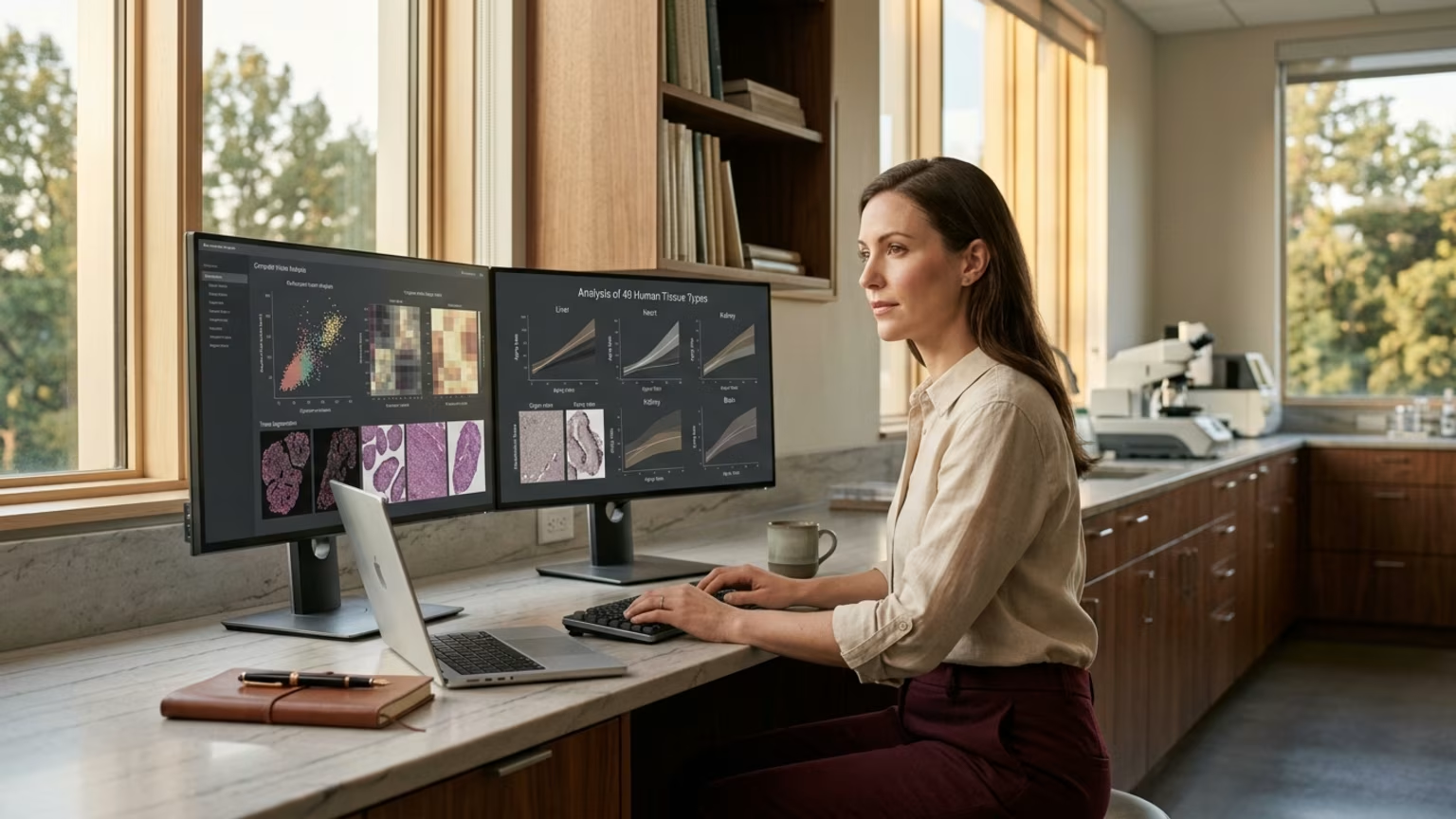
The research team developed a deep-learning computer-vision model called Pathology-based Structural Aging Rate, or PathStAR. They analyzed more than 25,000 scanned biopsy images representing 40 types of normal human tissue. These samples came from nearly 1,000 people in the NIH Genotype-Tissue Expression, or GTEx, project. The model segmented the pathology slides into more than 30 million smaller image patches and extracted visual features associated with tissue structure.
The dataset coverage describes this material as a largely untapped imaging archive containing between 20 and 50 terabytes of data. While the overall dataset covered 40 tissue types, the broader aging-pattern analysis was narrowed to 15 tissues with at least 200 samples each and a broad age range. Rather than simply predicting a chronological age, PathStAR examined changes in microscopic tissue architecture across different age groups. This allowed the researchers to estimate exactly when structural aging accelerated or slowed.
Through this focused analysis, researchers identified three major structural-aging patterns: early, late, and biphasic aging. The vascular system was among the tissues showing accelerated structural aging during ages 30–39, followed by a slower rate later. Conversely, the uterus and vagina remained comparatively stable during early adulthood and showed their most rapid structural changes around ages 50–55. The most common pattern appeared in nine tissue types and involved two separate periods of faster structural change.
Sinha said the GTEx project is widely used for molecular research, while its imaging archive had received comparatively little attention. The study therefore illustrates how existing pathology archives may contain information about aging that was not the original focus of the biobank. The researchers hypothesized that affordable clinical imaging could provide enough visual information to track how tissues age. That is an important potential direction for healthy-aging research, but the current study did not demonstrate that PathStAR can already be used as a routine clinical test.
The study’s article is titled "Mapping structural aging across human tissues reveals tissue-specific trajectories and coordinated deterioration," and its DOI is 10.1038/s43587-026-01200-4. These findings provide a profound shift in how we understand longevity. A separate 2026 Nature Medicine study used deep learning on 25,712 whole-slide histopathology images from 40 tissue types and 983 GTEx participants to develop tissue-specific clocks that predicted biological age from tissue structure. Both studies highlight that healthy aging is a localized, multi-system process.
Tracking a singular biological age score often leads to extreme optimization that actively degrades your quality of life. Busy adults easily fall into the trap of scheduling their days around restrictive diets, endless supplement regimens, and constant metric monitoring. This hyper-focus creates a rigid lifestyle that makes spontaneous travel or demanding athletic pursuits nearly impossible. You cannot fully enjoy a remote hiking expedition when you are paralyzed by the fear of missing an optimized recovery window.
The capability cost of this obsession is immense. True capability requires resilience, adaptability, and the freedom to test your limits in unpredictable environments. When you obsess over a generic metric, you miss the nuanced signals your own body sends during intense physical activity. This disconnect undermines the very independence and vitality you are trying to preserve.
Furthermore, trying to treat a single biological age ignores the specific needs of distinct organ systems. Attempting to reverse a single metric often leads to generalized, ineffective protocols that do nothing to support actual movement or stamina. We must focus on real-world function rather than artificial laboratory scores. Understanding the science of travel and human performance is far more valuable than a generic blood test result.
The separate 2026 Nature Medicine study reported that its tissue clocks reflected structural integrity and physiological fitness. That research also identified disease-relevant organ-aging signals across independent cohorts for eight diseases, including Alzheimer’s disease, stroke, and Crohn’s disease. However, neither study establishes that consumers can currently obtain a clinically validated, organ-by-organ aging assessment for personal longevity planning. We must avoid treating emerging computational models as if they are ready-to-use clinical diagnostics.
The current study does not provide a consumer-ready method for making a comprehensive organ-by-organ assessment. The source does not provide a detailed participant demographic breakdown, independent validation cohort, disease-specific analysis, or quantitative effect sizes for each tissue’s aging rate. The research relied on archived pathology images from the GTEx project rather than prospective scans collected specifically to monitor the same people over time. Therefore, we should treat commercial organ age scores and biological-age dashboards cautiously unless they disclose their underlying data and validation population.
When active adults mistake early research for immediate clinical mandates, they sacrifice their peace of mind. Obsessing over a hypothetical organ age creates unnecessary anxiety that detracts from actual lived experiences. A healthy, robust lifestyle should enhance your ability to navigate the world, not confine you to a laboratory setting. This is why understanding healthy aging & performance | WealthAtPlay is about actionable wisdom rather than rigid data worship.
Instead of agonizing over a master score, you can adopt a much simpler, highly practical alternative. Focus on protecting specific systems that directly impact your daily capability and independence. The PathStAR study specifically identified vascular tissue among the tissues with earlier accelerated structural aging, making cardiovascular risk management a practical priority. A strong cardiovascular system allows you to maintain energy and endurance during demanding trips.
In a proof-of-concept analysis of 250 ovarian histopathology slides from people aged 21 to 70, the PathStAR model identified accelerated structural aging around ages 35–40 and again around ages 55–60. The first period coincided with fertility decline, while the second corresponded to menopause. Sanju Sinha described the ovaries as a possible "pacemaker for whole-body aging," though that interpretation is a research hypothesis rather than an established clinical conclusion. Managing these changes practically, much like understanding travel and menopause, allows active women to maintain peak capability without relying on a single flawed metric.
Across periods of accelerated structural aging, the study found a shared molecular pattern. This pattern involved increased expression of inflammation-related genes and reduced expression of genes linked to energy production, cell growth, and cellular quality control. The molecular analysis used gene-expression and gene-regulation information from the same GTEx project cohort that supplied the imaging data.
The shared molecular signature shows a correlation between molecular activity and structural-aging periods, not proof that suppressing those pathways will slow aging in humans. This allowed the researchers to connect visible changes in tissue architecture with molecular activity, although the study did not establish that any one molecular change directly causes the observed structural aging. You can take sensible actions, like managing cardiovascular health and maintaining mobility, without waiting for a perfect molecular intervention.
Managing systemic inflammation through fundamental practices like adequate rest, using clear types of strength explained for conditioning, and basic nutrition is highly effective. Sinha said the findings could provide a foundation for a structural aging atlas to help design and assess future interventions. The study did not test any specific drug, supplement, exercise protocol or hormone treatment.
Managing fundamental health pillars and prioritizing regular periodized recovery delivers the vast majority of your longevity results with a fraction of the effort. You should prioritize age-appropriate screening and metabolic health with qualified clinicians, avoiding the anxiety of endless bio-tracking.
We now know that distinct organ systems age at their own unique pace. Will you continue to let a generalized score dictate your daily routine, or will you focus your energy on tangible actions that keep you strong, mobile and ready for your next adventure?
Life is meant to be experienced in the field, not managed in a spreadsheet. Stay capable.
Stay connected for research and practical guidance on longevity, strength, recovery, energy and active living. New ideas to help you stay capable, curious and ready for more.





Explore practical guidance on strength, recovery, energy, travel and longevity for a life that stays active.
explore the Blog