
A new UT Austin study reveals a wearable ultrasound patch that accelerates REM sleep by 43 minutes, pointing toward future non-drug recovery tools.





Most wearables merely record your restless nights without actually improving your recovery. This passive approach to human capability is quickly becoming outdated. On June 4, 2026, new research in Nature Communications revealed a wearable ultrasound patch that actively influences sleep architecture. This non-pharmacological development points toward future at-home tools that could help active adults deepen restorative rest between demanding days.
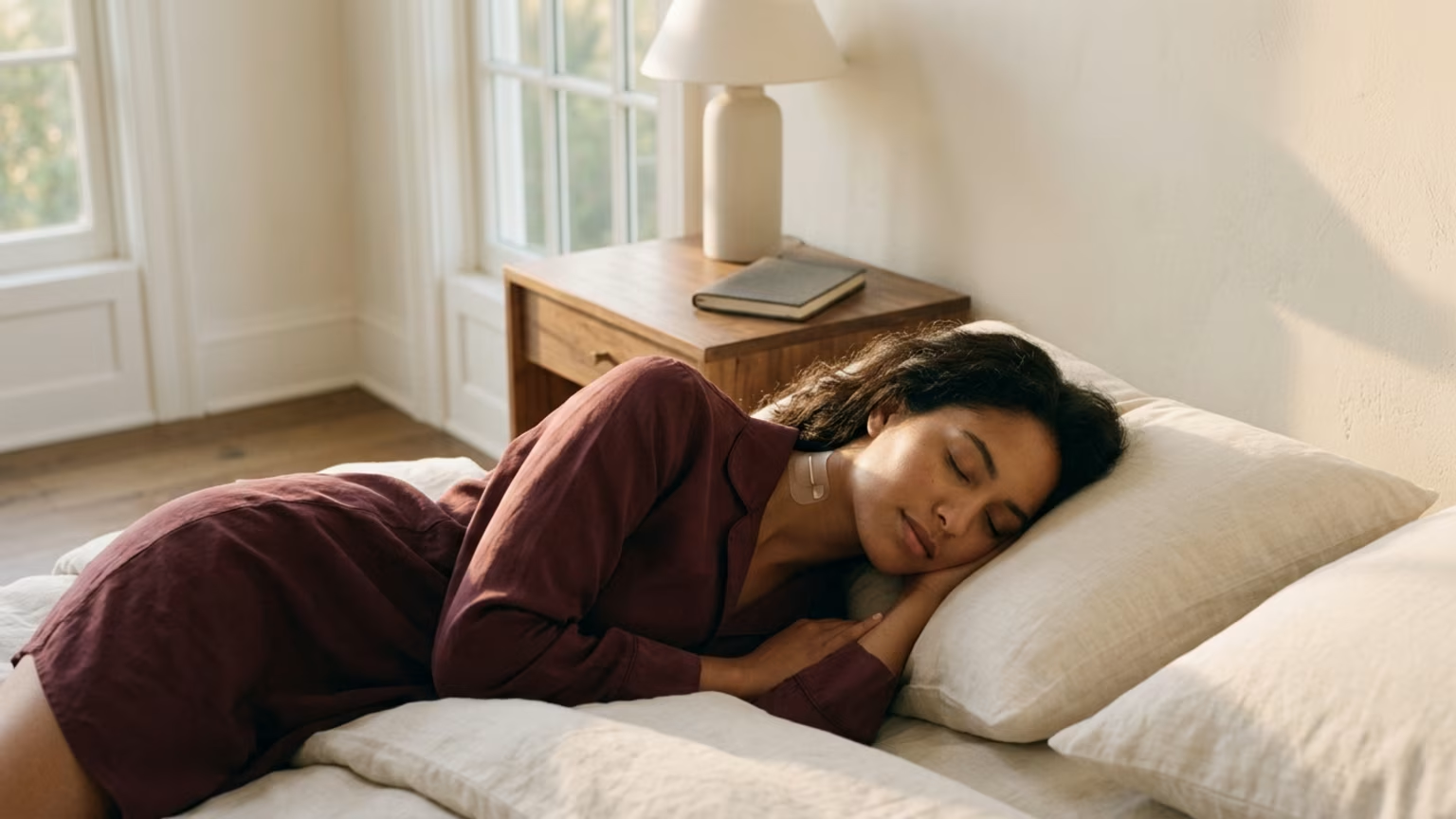
Researchers at the University of Texas at Austin developed NEUSLeeP as a soft, skin-attached wearable patch. The device combines transcranial focused ultrasound with electrophysiological sensors. This unique hardware allows it to stimulate and monitor deep brain activity during sleep simultaneously. This combination is critical because the system is intended to observe electrical signals rather than merely deliver a preset stimulus.
The technology targets the subthalamic nucleus, a deep brain structure involved in sleep and wake regulation. This specific region connects directly with neural circuits associated with REM sleep. By utilizing a tunable concentric-ring ultrasound array and hydrogel electrodes, the flexible bioadhesive patch directs acoustic energy through the skull. The researchers designed compliant interconnects specifically for overnight wear.
The research builds on earlier work involving subthalamic stimulation. Study coverage notes that prior efforts produced REM increases ranging from approximately 1.3 percent to 6.2 percent. Those previous studies also showed latency reductions of roughly 15 minutes. The UT Austin team is now advancing their patent-pending prototype with support from their commercialization unit.
The reported human study included 28 adults between the ages of 19 and 38. Researchers secured usable overnight recordings for 26 participants in total. This cohort featured 16 healthy sleepers alongside 12 participants presenting with mild insomnia symptoms. The single-blind study relied on a rater who was blinded to the condition for sleep scoring.
Participants completed two consecutive overnight sessions to test the device efficacy. A sham night without ultrasound always occurred first, followed by an active stimulation night. During the active stimulation night, participants entered their first REM period approximately 43 minutes earlier than during the sham night. The research team also reported a 24 percent reduction in REM latency overall.
The active stimulation also extended the total duration of this specific sleep phase. REM sleep increased from approximately 16.3 percent to 20.9 percent of total sleep time. This 4.6 percentage point rise is equivalent to roughly 16 additional minutes of REM sleep on average. The reported results focus heavily on altering sleep architecture rather than simply increasing total sleep time.
The research team included Kai Wing Tang, who led the research effort, along with UT Austin researchers including Huiliang Wang and Gregory Fonzo. Gregory Fonzo provided context regarding the physiological importance of these findings. He explained that REM sleep is relevant not only to dreaming but also to emotional reset and stress adaptation. Tang stated that the work represented the first reported ability to noninvasively target deep brain regions involved in REM sleep while monitoring brain activity at the same time.
Support for the project came from several prominent scientific institutions. Funding sources included the National Institutes of Health, the National Science Foundation, and the DARPA REM-REST program. The researchers identified future applications including at-home monitoring, neuroscience research, and personalized sleep therapies. They published their work under the title "Skin-attached bioadhesive patch enabling ultrasound deep brain stimulation and real-time electrophysiological monitoring for REM sleep enhancement."
In our experience, long travel days demand serious recovery protocols. After a grueling thirty hour transit to Tokyo, our team realized our old strategy of just powering through was no longer working. We felt foggy for three days. We started digging into circadian biology and realized that timing our light exposure and fasting during the flight could completely shift our recovery. Now, our team never boards a long haul flight without a precise schedule for when to eat and when to put on an eye mask. It is the difference between losing a week of your trip and hitting the ground running.
Devices like NEUSLeeP could eventually integrate into similar travel routines for active professionals. For the healthy aging market, altering sleep architecture without medication offers a highly compelling proposition. Affluent older travelers frequently seek non-pharmacological tools for recovery after demanding sport or work periods. Maintaining a structured approach to rest during demanding trips often determines physical readiness.
The study provided exploratory physiological observations regarding physical recovery metrics. Among healthy participants, overnight heart rate variability improved from a decline of approximately 5.89 percent during sham stimulation to an increase of approximately 41.5 percent during active stimulation. This result featured a reported p-value of 0.014. However, the mild insomnia subgroup did not show a clear comparable stimulation effect.
WealthAtPlay readers should note that this evidence supports a proof of concept finding rather than a proven longevity intervention. The study did not include an active control condition where ultrasound was delivered to a non-target site. The fixed order of a sham session followed by an active session creates possible expectancy and adaptation effects. A randomized, counterbalanced design would provide stronger evidence that the ultrasound caused the change.
Safety remains preliminary, though initial metrics are encouraging. Participants reportedly found the patch comfortable. They experienced minimal adverse effects and no meaningful changes in blood oxygen, heart rate, or blood pressure during monitoring. Skin redness after eight hours was described as very low. Follow-up checks conducted one week later confirmed these minor skin responses.
The ultrasound beam passes through the temporal bone, which may affect nearby structures and limit spatial precision. NEUSLeeP is not currently available for purchase and is not a consumer product. Larger randomized trials, further safety work, regulatory review, and manufacturing scale-up would be required before home use claims could be supported.
Furthermore, REM quantity is not identical to restorative benefit. The study did not report daytime cognitive testing, memory outcomes, or executive function measures. It also lacked driving performance data. It did not test travelers dealing with jet lag, altitude, or alcohol exposure. True sleep quality depends on the continuity of multiple stages, making informed monitoring of recovery data a complex process.
Prospective users should look for evidence from larger randomized, double-blind trials that include adults over 40. True consumer readiness will require testing that measures daytime function rather than merely changing a sleep stage percentage. Until NEUSLeeP or similar devices reach commercial availability, active adults must focus on the basics. Addressing sleep apnea, pain, and inconsistent schedules remains the most effective approach to recovery.
Most wearables merely record your restless nights, but future technologies are actively aiming to change that passive paradigm. While we wait for active ultrasound patches to enter the market, maintaining a strict circadian schedule remains your most effective strategy for capable performance.
Stay connected for research and practical guidance on longevity, strength, recovery, energy and active living. New ideas to help you stay capable, curious and ready for more.


Explore practical guidance on strength, recovery, energy, travel and longevity for a life that stays active.
explore the Blog