
A sleep review reported a modest signal but gaps in consumer red-light evidence. Here is the practical context for travel and sport recovery.





On October 21, 2026, an evidence report examined a 2026 sleep review published in Lasers in Medical Science and raised a practical question: does research on light treatment justify buying a red-light sleep device? For an active adult who values physical independence, the outcome that matters is readiness for another demanding day. That might mean walking through a city after an overnight flight or returning to the slopes tomorrow.
The useful way to read this news is to distinguish an interesting research finding from a dependable recovery strategy. That distinction starts with what the researchers actually tested.
According to the report, the systematic review and meta-analysis pooled five randomized trials involving 240 participants. It examined photobiomodulation, the broad category of light treatment discussed in this research. The main sleep measure was the Pittsburgh Sleep Quality Index, or PSQI, a questionnaire about perceived sleep quality.
The reported average advantage for light treatment over sham was 1.25 PSQI points. The report's narrative gives a 95% confidence interval of 0.11 to 2.38 points. In plain language, the pooled result favored treatment on participants' ratings of their sleep.
That finding deserves attention without being stretched into a promise about how someone will feel or perform the following morning. A sleep questionnaire answers a particular question. It does not automatically answer every question about recovery.
The report says all five trials were judged at high risk of bias. It also describes the pooled estimate as imprecise and potentially too small to reach the level generally considered clinically meaningful on the PSQI. A statistically significant result is not necessarily a difference large enough to matter in daily life.
All sleep outcomes came from questionnaires rather than objective sleep measurements. According to the report, none of the trials used polysomnography or actigraphy. This is a measurement distinction worth keeping separate from the broader question of whether participants felt better.
Our coverage of the limits of wearable sleep estimates addresses another side of interpreting sleep data. Here, the important point is simply to understand which kind of outcome the review measured.
The treatment label hides substantial differences. The report lists wavelengths from 360 to 850 nanometres. Three trials used near-infrared light, one used violet light, and one did not report its wavelength.
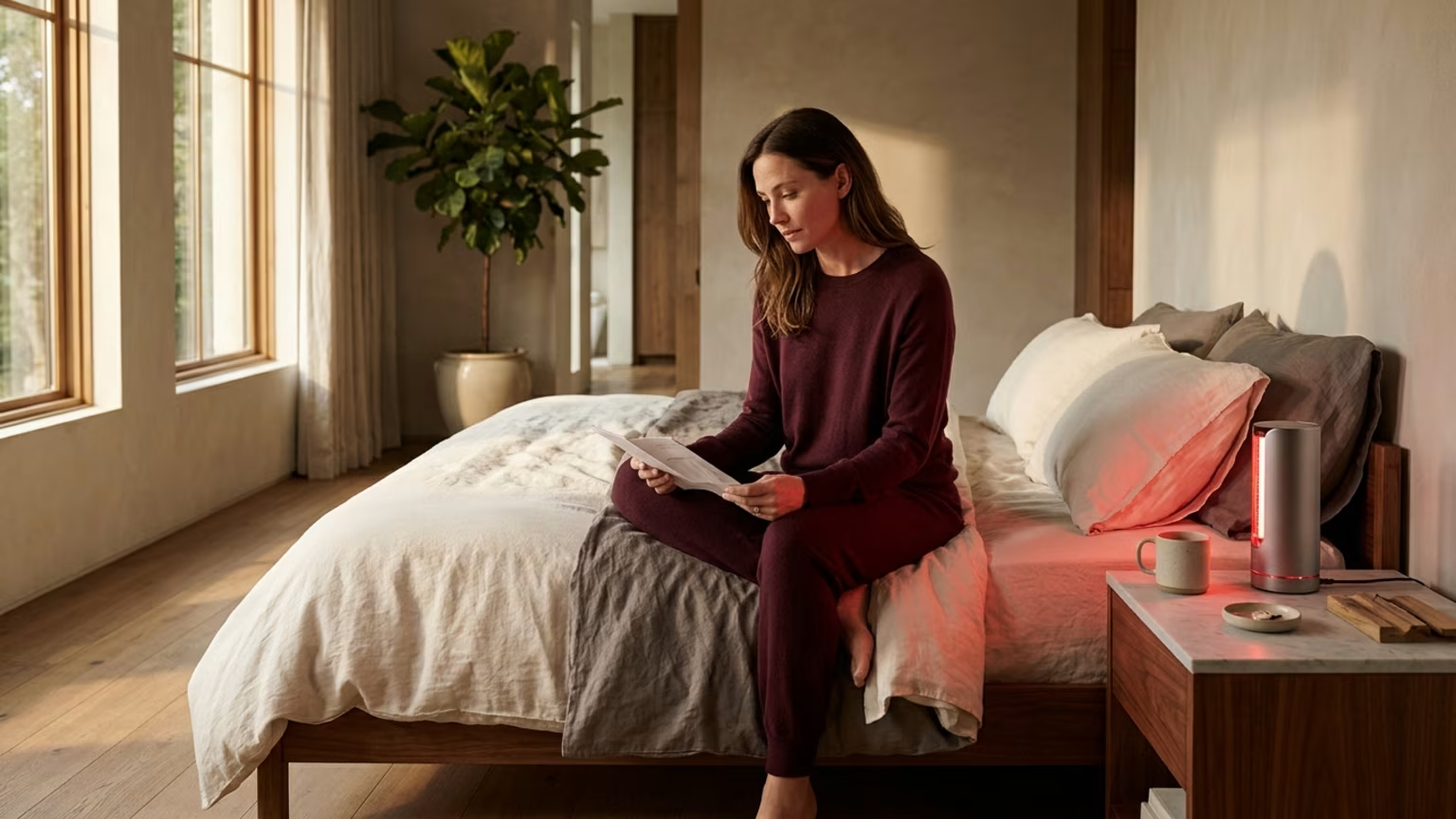
Near-infrared light is invisible. According to the report, none of the five trials used the 600-nanometre-range visible red light common in consumer panels and bedside lamps. Pooling those studies therefore does not establish the effectiveness of the familiar red-glowing device someone might place beside a bed.
The report also says it found no sham-controlled trial testing a red-light panel, lamp, or mask for sleep. It found no trial comparing panel use in the morning with use at bedtime. These are product and timing questions that the pooled result does not resolve.
The research purposes varied as well. Three of the five trials primarily investigated dry mouth or depression, with sleep measured as a secondary outcome. They were not all designed around sleep as the central research question.
Duration added another complication. The report says trials lasting four weeks or less showed a statistically significant result, while those lasting five weeks or longer did not. It explicitly cautions that this pattern does not establish that shorter treatment works better.
The report also revisits a 2012 study involving 20 female basketball players on a Chinese army team. They were divided into groups of 10. The treatment group received whole-body red-light exposure nightly for 14 days.
According to the report, that group showed improved PSQI scores and higher serum melatonin. It also performed better on a 12-minute run after two weeks. Those findings help explain why the study attracts attention from people interested in both sleep and sport.
The comparison deserves equal attention. Although labelled “placebo,” the other group received no light illumination rather than a sham light treatment. That design does not rule out the influence of expecting to receive an active intervention.
The report identifies the paper as a cohort study rather than a robust sham-controlled trial. Its small sample of elite athletes and self-rated sleep outcomes further limit how confidently the findings transfer to other adults. It is an interesting historical result, not a reliable forecast of personal sleep or running gains.
A separate September 2026 double-blind randomized trial tested a specific near-infrared head-worn prototype in 40 people. The report describes lower insomnia severity and shorter sleep latency, meaning less time taken to fall asleep. This was a distinct device and intervention rather than an ordinary red-light panel or lamp.
The report also notes that two authors disclosed co-founding the company supplying the prototype devices. That relationship belongs alongside the result when assessing the evidence. The finding concerns that particular prototype and should remain attached to it.
The practical change is not a new light routine. It is a more disciplined way to judge whether a recovery product deserves a place in your plans. Start with one question: what precise benefit are you expecting it to deliver?
For an active traveler, that benefit might be easier mornings after a long-haul flight. For a skier, it might be feeling ready for another day outside. Those are useful goals because they connect a purchase decision to the capability you actually value.
Keep the device decision separate from the trip's sleep planning. A claim about sleep quality is not automatically a claim about recovering from travel or adjusting to altitude. There is no defensible leap from the findings described here to a promise of easier mountain acclimatization.
For a long-haul journey, our coverage of planning sleep across time zones addresses the travel-specific question. The distinction matters because “better recovery” can otherwise become a catch-all phrase for very different needs.
Time and attention also deserve consideration, even when price is not the main obstacle. A device adds something to pack or fit into an evening. In WealthAtPlay's view, that space should be earned by evidence relevant to the benefit being sought.
Do not use this report as a reason to expect a light session to compensate for a difficult night. Nor should it justify making an itinerary more demanding on the assumption that recovery has been improved. The sensible application is to keep performance expectations separate from enthusiasm for a device.
If the goal is sustained energy on a walking holiday, assess the claim against that goal. If the goal is readiness for another ski day, keep that outcome explicit. This avoids quietly turning a finding about one aspect of sleep into a much larger promise about physical capability.
A purchase is one decision. How to organize a demanding trip is another. Keeping them separate allows room for curiosity without letting an emerging technology carry responsibilities the evidence has not earned.
For ongoing sleep difficulties, the report identifies cognitive behavioural therapy for insomnia, or CBT-I, as a first-line treatment for chronic insomnia. It also advises medical assessment for persistent or concerning symptoms. Decisions about individual care belong with a qualified clinician rather than a device-led experiment.
The report makes another useful distinction: a dim red night light is not the same intervention as a bright therapy panel. It cautions that bright red light is not necessarily biologically inert. Color alone is therefore not a sufficient basis for deciding how a product fits into sleep care.
The practical priority is to address the sleep problem itself rather than allowing a recovery purchase to stand in for that assessment.
For travel and sport, keep sleep planning central to your routine rather than reorganizing recovery around a red-light device.
Stay connected for research and practical guidance on longevity, strength, recovery, energy and active living. New ideas to help you stay capable, curious and ready for more.



Explore practical guidance on strength, recovery, energy, travel and longevity for a life that stays active.
explore the Blog