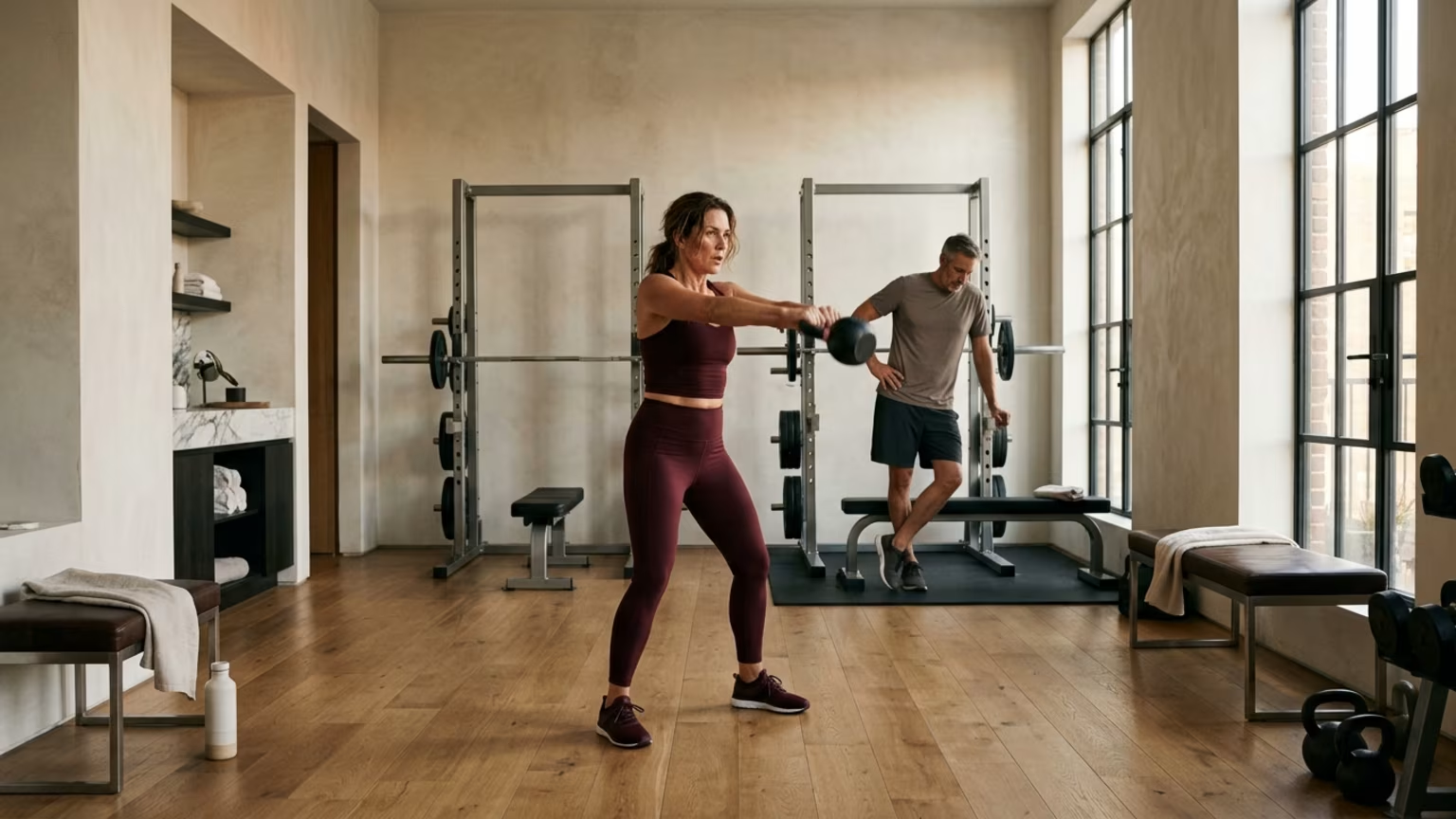

A new paper in Aging & Disease introduces peakspan to measure time spent near maximum physical capability. Learn how this impacts active aging and sports.





On October 8, 2026, La Gazzetta dello Sport reported that a new paper in Aging & Disease introduced the concept of "peakspan" to longevity science. The paper defines this term as the specific time a person spends at or near the peak of their physical and cognitive capabilities. For active adults who prioritize physical independence over simply extending their lifespan, this newly proposed framework offers a much sharper way to measure success. Instead of just tracking years lived without illness, the focus moves toward actively preserving the high-level functions that make demanding travel and mountain sports possible.
The scientific community has long divided human aging into two main categories. Lifespan measures the total length of life. Healthspan attempts to measure the total time spent in general good health. According to the coverage of the Aging & Disease paper, peakspan introduces a third and much more precise category.
It looks specifically at individual capability rather than broad population health averages. Alex Zhavoronkov, the founder of Insilico Medicine and a co-author of the paper, is cited in the reporting regarding this new concept. Secondary coverage describes the peakspan proposal as highly specific to individual functions.
Rather than assigning one universal score for overall aging, the framework compares your current performance in a specific function against your own personal best. Some secondary reports suggest a threshold where peakspan means maintaining performance within 10 percent of that personal maximum.
It is highly important to understand that peakspan is currently a proposed conceptual framework. The event coverage presents peakspan as a proposed concept rather than a clinically demonstrated intervention outcome. Polish news reports explicitly note that healthspan still lacks a universal definition and that no single drug exists for longevity. The introduction of peakspan is a new way for researchers to discuss longevity rather than a validated clinical metric.
While the Aging & Disease paper introduces the peakspan terminology, other recent research supports the possibility of maintaining high capability later in life. A secondary report on a separate 2026 study notes that researchers followed more than 11,000 older Americans for up to 12 years. The findings showed that about 45 percent of participants improved in at least one measured domain, such as cognition or walking speed. While that finding was not a peakspan result, it highlights that functional decline is not always a permanent downward slope.
Adults can often maintain or even regain specific functional capacities as they age. This aligns seamlessly with the principle that consistent movement strategies are essential for preserving vital systems. A 2026 review in The Journals of Gerontology: Series A discusses evidence on physical and sensory activities in relation to motor and cognitive function in aging. The review reinforces the idea that consistent physical activity protects long-term function. The authors summarize extensive research on aerobic training, resistance work, mind-body exercises, and multimodal activity.
This body of evidence reinforces the idea that functional outcomes must be evaluated alongside traditional disease prevention. Aerobic capacity dictates how well your body utilizes oxygen during sustained effort. Resistance training builds the muscular strength and bone density required for carrying heavy luggage and protecting vulnerable joints. Both systems require dedicated attention to prevent age-related decline.
Mind-body exercises contribute heavily to balance, spatial awareness, and stress regulation. These sensory activities help maintain the neurological connections that prevent falls and improve movement efficiency. When you combine these different training modalities into a cohesive weekly routine, you create a powerful multimodal stimulus. This comprehensive approach is the most effective way to protect your overall physical independence.
The proposal of peakspan highlights a reality that many active adults already understand from personal experience. Physical and cognitive functions do not peak at the exact same time in life. A person might reach their absolute peak in explosive athletic power in their twenties. Meanwhile, their peak in endurance pacing or complex cognitive tasks might occur decades later.
Because these peaks arrive at different times, the proposed near-peak threshold would apply differently across various abilities. If you want to maintain your ability to handle demanding environments, you must look at your capabilities individually. For instance, maintaining your cardiovascular output requires a different focus than preserving your joint mobility or grip strength. Discussing these specific functions with a qualified clinician or trainer allows you to structure a highly targeted physical routine.
Currently, there is no standardized clinical test for peakspan. The concept serves as a useful question for personal planning rather than a personalized forecast. Asking yourself how long you can preserve the abilities you value most is a powerful exercise. It shifts your attention away from broad promises and toward measurable daily habits for physical preservation.
Applying a function-specific mindset to real life requires a sharp focus on the demands of your activities. Demanding travel and mountain sports expose the body to significant physiological stress. When you evaluate your performance function by function, you can better prepare for these specific stressors. The goal is to keep your recovery time, altitude adaptation, and sustained energy as close to your lifetime best as possible.
Consider the physical toll of a multi-day hiking expedition in a remote mountain range. Your cardiovascular endurance determines your pace on the initial ascent. Your muscular strength dictates your ability to carry your equipment without fatigue. Your core stability ensures that uneven terrain does not compromise your posture. Your joint mobility and balance prevent acute injuries on steep descents.
If you allow any one of these individual functions to drop significantly below your personal peak, the entire trip suffers. A severe drop in lower body strength means your knees will absorb excessive impact on the trail. This leads to extended recovery times and limits your ability to participate in activities the following day. Maintaining your strength near its historical maximum ensures your muscles handle the load properly. You can handle a long descent without experiencing debilitating joint pain, proving that true physical capability is actively built.
Altitude adaptation is another critical area where function-specific tracking proves invaluable. Your metabolic efficiency and cardiovascular output are severely tested when oxygen levels drop at elevation. An active adult who maintains a high aerobic capacity will adjust to mountain environments much faster than someone with average fitness. This rapid adjustment prevents the severe fatigue and headaches that often ruin the first few days of a ski holiday.
The same principles apply to the cognitive demands of international travel. Crossing time zones creates significant fatigue and challenges your executive function. A resilient nervous system recovers from circadian disruption with much greater efficiency. By preserving your cognitive and physical stamina, your jet lag recovery becomes much more efficient.
You can step off a plane in a new time zone and immediately engage with your itinerary. This means less time suffering from hotel room fatigue and more time actively enjoying your destination. The most important takeaway is that capability requires highly specific maintenance. You cannot rely on general health guidelines to keep your athletic performance near its historical maximum. You must actively train the exact systems that your favorite sports and travel destinations demand.
Worldly adults should view this newly proposed peakspan metric as a prompt to identify the specific physical and cognitive abilities they value most and structure their daily routines to actively preserve them.
Stay connected for research and practical guidance on longevity, strength, recovery, energy and active living. New ideas to help you stay capable, curious and ready for more.



Explore practical guidance on strength, recovery, energy, travel and longevity for a life that stays active.
explore the Blog