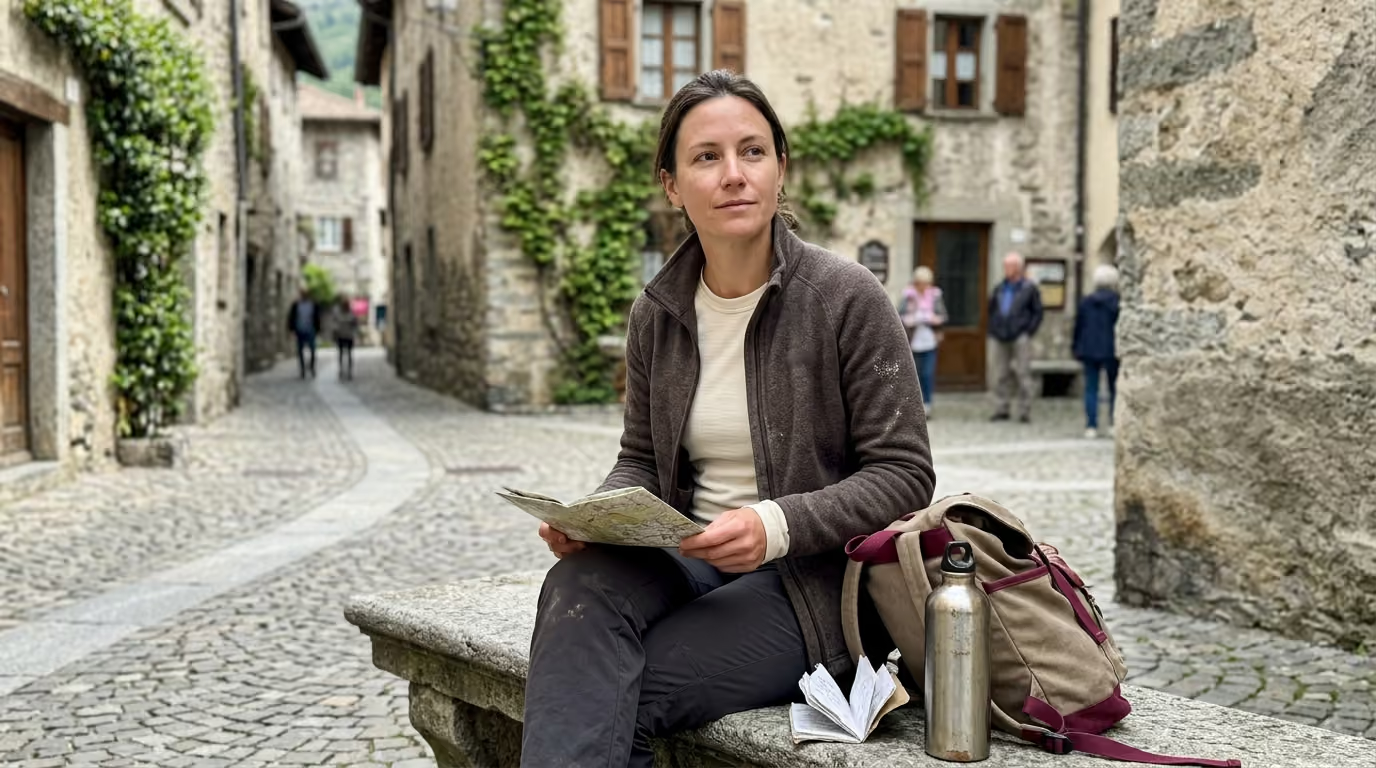

Sustained physical stamina and sharp cognitive judgment across multi-day expeditions require systematic pacing strategies, operating signal monitoring.





You are three days into a high alpine route through the Dolomites. You spent months training your legs in the gym, logging elevation on local trails, and dialing in your lightweight kit. On paper, your cardiovascular fitness is more than sufficient for the six thousand feet of daily climbing.
By mid afternoon on the third day, however, a strange fog settles over your thinking. You stumble slightly on an ordinary root. You misread a trail marker at a crucial junction. When your partner asks a simple question about water reserves, you find yourself unusually irritable.
Your legs are not the problem. Your capacity to process information, regulate body temperature, and sustain steady output has quietly unraveled.
Multi-day mountain travel, remote gravel cycling, ski touring, and coastal sailing are not purely physical challenges. They are complex energy management problems. Success on a demanding journey depends on your ability to balance fueling, hydration, thermoregulation, sleep quality, and cognitive bandwidth across consecutive days.
This playbook provides an operating manual for active adults who want to undertake challenging journeys with strength, sharp judgment, and physical resilience. By treating your daily output as a coordinated biological system, you can protect your performance on day four and beyond just as easily as on day one.
To manage your physical output on an extended trip, you must understand the difference between acute performance and multi-day sustainability. Acute performance is the amount of work you can generate in a single afternoon. Sustainability is the workload you can repeat tomorrow, the day after, and on the journey home.
In the laboratory, exercise scientists study energy availability. Energy availability is the dietary energy remaining for baseline physiological functions after accounting for the energy burned during movement. When energy intake consistently falls short of total energy expenditure, your body begins rationing fuel.
The consequences of low energy availability rarely show up as sudden muscular failure. Instead, they appear as subtle shifts in coordination, impaired thermoregulation, disrupted sleep architecture, and degraded cognitive function. You might still be able to push your pedals or step up a slope, but your brain loses the reserve capacity required to manage risk.
Carbohydrate storage plays a central role in this balance. The human body can store only a limited amount of glycogen in the liver and skeletal muscles. The joint sports nutrition position stand from the Academy of Nutrition and Dietetics, Dietitians of Canada, and the American College of Sports Medicine notes that moderate to high intensity training requires between 6 and 10 grams of carbohydrate per kilogram of body weight each day.
When muscle glycogen drops during long days in rough terrain, your liver must work harder to maintain circulating blood glucose. Blood glucose fuels the central nervous system. When circulating glucose drops, your perception of effort rises, your vigilance declines, and your motor control becomes sloppy.
Protein needs also rise during repetitive multi-day loading. The International Society of Sports Nutrition position stand recommends a daily intake of 1.4 to 2.0 grams of protein per kilogram of body weight for exercising individuals to support muscle repair and structural recovery. Research on endurance athletes suggests that consuming roughly 0.25 grams of protein per kilogram for each hour of exercise alongside carbohydrate can help limit markers of muscle damage.
At the same time, your brain is under distinct physiological stress. Research on sleep loss shows that partial sleep deprivation, such as losing just 90 minutes of sleep over several consecutive nights, produces measurable declines in attention, reaction time, and emotional regulation. A meta-analysis examining sleep loss found that sleep deprivation impairs cognitive performance across nearly every domain, even when individuals believe they are performing adequately.
Understanding these mechanics allows you to manage physical output as a closed loop. You predict terrain and environmental demand before you start. You pace your effort conservatively to leave room for eating, drinking, and navigating. You refuel continuously rather than waiting for hunger, and you aggressively protect your recovery each night.
Managing your physical state in the backcountry requires objective operational signals. When you are fatigued, your internal perception becomes unreliable. Tracking a simple six-domain dashboard keeps you aware of your true physical reserve.
The fuel signal tracks when you last consumed carbohydrate and protein. The fluid signal monitors thirst, fluid access, and urination frequency. The heat signal assesses whether you are sweating excessively, shivering, damp, or exposed to wind.
The sleep signal evaluates your accumulated rest deficit over the prior two to three nights. The route signal monitors how easily you are tracking your physical location against your map. The risk signal evaluates dynamic external variables like fading daylight, incoming weather systems, and trail exposure.
To make this dashboard easy to use while moving, you can translate these six signals into a simple color-coded operating status.
In green status, your breathing is controlled and you can speak in full sentences without gasping. You are eating small amounts of food every hour, and you drink comfortably when you feel thirsty.
Your physical coordination is crisp, and your feet land cleanly on rocky or uneven terrain. You pass navigation checkpoints on schedule, and you confirm trail markers without hesitation. In green status, your energy expenditure is well matched to your intake, and your group is operating safely.
Amber status appears when fatigue begins to outpace your fueling and recovery. Your pace slows unexpectedly on moderate inclines, or you notice that your group has grown unusually quiet or irritable.
You find yourself making small navigation errors, such as walking past an unmarked junction before catching the mistake. You may feel reluctant to stop and pull a rain shell from your pack, or you may notice that sweet foods have become unappealing.
When amber signals appear, you must take immediate operational action. Drop your pace by twenty percent, stop to consume savory food and water, adjust your clothing layers, and review your map. Amber status is your opportunity to correct small deficits before they become serious hazards.
Red status represents a critical loss of capacity. In this state, an individual displays slurred speech, clumsy movement, severe shivering, or a complete loss of appetite.
At high elevation, red status presents as a worsening headache accompanied by nausea, dizziness, or confusion. In hot environments, it manifests as disorientation, vomiting, or hot, dry skin.
When any member of a team enters red status, the objective changes immediately. You must halt forward movement, find or construct shelter, address acute temperature or hydration emergencies, and prepare for evacuation if symptoms do not rapidly resolve. Red status is not a problem you can solve by trying harder.
Every adventure discipline places unique physiological and mechanical demands on your body. Applying a generic endurance pace to varied terrain often leads to premature exhaustion. Tailoring your pacing to the specific mechanics of your sport preserves your capacity for the full itinerary.
To build long-term stamina for multi-day expeditions, explore our in-depth guides on travel and human performance.
The most common mistake in multi-day trekking is attacking the trail with the intensity of a morning workout. Single-day hiking allows you to exhaust your glycogen reserves because you can return home to a warm meal and a long sleep. Multi-day trekking requires strict conservation of muscular and connective tissue.
When climbing steep slopes with a loaded pack, shorten your stride length significantly. Keep your cadence steady and adjust your foot placement so your heels make contact with the ground, which shifts load from your calves to your larger gluteal muscles. Maintain a conversational pace where your breath remains steady and rhythmic.
Downhill pacing requires even greater discipline. Eccentric muscular contractions during long descents cause micro-tears in muscle fibers and place high mechanical stress on knee joints.
Slow your descent pace, use trekking poles to absorb impact, and avoid jumping down large rock steps. A measured descent protects your quadriceps, ensuring you can walk with normal mechanics on subsequent mornings.
Gravel touring and bikepacking introduce non-linear energetic costs. Aerodynamic drag, head winds, and rolling resistance on loose gravel increase energy expenditure dramatically compared to smooth asphalt.
On a loaded bicycle, avoid muscular surges over short hills. Shift into low gears early, spinning at a cadence between 80 and 90 revolutions per minute to spare your knee joints and reduce neuromuscular fatigue. Keep your upper body relaxed to prevent chronic tension in your neck, shoulders, and hands.
Plan your stops around caloric intake and hydration access rather than arbitrary mileage goals. If you face a severe headwind, drop your speed and focus on continuous micro-fueling. Trying to maintain your calm-weather cruising speed into a 25-knot headwind will empty your glycogen reserves in less than two hours.
Skiing combines cold environmental exposure with high-intensity eccentric muscular loading. Skiers often underestimate their total daily energy output because downhill movement feels gravity-assisted.
On the skin track or climbing trail, establish a slow, rhythmic glide that keeps your heart rate well below your anaerobic threshold. Strip off heavy insulating layers before you begin climbing so you do not soak your base layers in sweat.
When descending, take deliberate breaks every few hundred vertical feet rather than skiing long pitches without stopping. Research shows that attention and motor coordination decline rapidly under fatigue, increasing the risk of technical falls.
Be exceptionally conservative on your final descent of the day. The combination of tired quadriceps, flat afternoon light, and dropping temperatures makes the last run the most hazardous window of the day.
Expedition sailing and paddling present an inverse physical pattern compared to mountain sports. They involve long periods of static posture or rhythmic movement interspersed with brief bursts of intense physical exertion.
On a sailboat, energy management centers on watch rotations and cold protection. Operating a winch or reefing a sail in heavy weather demands immediate anaerobic power, but the surrounding hours require vigilant stillness in cold wind and spray.
Crew members must eat calorie-dense meals even when nausea or rough seas reduce appetite. Hand dexterity must be protected using warm, waterproof gloves, because cold hands make basic line handling and knot tying dangerous.
In sea kayaking or canoeing, pacing depends on efficient torso rotation rather than arm pulling. Over-reliance on small shoulder muscles leads to rapid fatigue and tendon inflammation. Maintain a steady, sustainable stroke rate, use tidal currents strategically, and land on beaches to stretch hip flexors and refuel every two hours.
Nutrition in the field must be practical, palatable, and easy to digest under physical stress. A sports nutrition plan that looks brilliant on paper is useless if your stomach cannot tolerate it on day three of a trek.
To learn more about optimizing your daily metabolic health, read our guide on practical nutrition and metabolism.
During prolonged endurance activity, aim to consume between 30 and 60 grams of carbohydrate per hour. For exceptionally long or demanding days lasting over four hours, trained individuals can utilize up to 90 grams per hour using mixed carbohydrate sources like glucose and fructose.
Rather than stopping for large, infrequent meals that pull blood flow away from working muscles to your digestive tract, use an hourly feeding pattern. Set a repeating timer on your watch for every forty-five to sixty minutes. Consume a small, easily digestible portion of food at each chime.
Early in the day, sweet foods such as dried fruit, carbohydrate chews, and energy bars are generally well tolerated. As the hours accumulate, many people experience sensory-specific satiety, commonly known as palate fatigue.
Pack a balanced mix of savory options, including salted nuts, pretzels, cheese, cured meats, and savory rice cakes. Savory foods stimulate appetite when sweet snacks become unpalatable, and their natural sodium content encourages fluid retention.
Your recovery for tomorrow begins the moment you stop moving today. Follow a structured four-step sequence as soon as you reach your camp or accommodation.
Consuming carbohydrate promptly after finishing activity accelerates the replenishment of muscle glycogen stores. Pairing this carbohydrate with protein provides the essential amino acids needed to repair damaged muscle fibers.
If you are cooking dehydrated meals in the backcountry, look for options that contain balanced proportions of complex carbohydrates, lean protein, and healthy fats. If your appetite is suppressed from altitude or hard exertion, begin with a warm powdered recovery drink or soup before transitioning to solid food.
Hydration advice has long been clouded by the misconception that more water is always better. Forcing fluid intake beyond your natural thirst mechanism does not improve performance and can introduce serious medical risks.
The Wilderness Medical Society clinical practice guidelines on heat illness emphasize a drink-to-thirst strategy during exertion. Drinking compulsively on a fixed schedule can lead to exercise-associated hyponatremia.
This condition occurs when blood sodium levels become dangerously diluted by excessive water intake. Its early symptoms, including headache, nausea, malaise, and mild confusion, closely mimic heat exhaustion or altitude sickness.
If a traveler with hyponatremia is mistakenly given more plain water, the condition can progress to cerebral edema, seizures, and collapse.
Listen to your body's physiological thirst cues. Carry sufficient water capacity to travel between reliable sources with a safety margin, but drink according to thirst rather than a rigid timer.
In cold environments, cold water from a hydration bladder often suppresses the desire to drink. Carry an insulated flask with warm tea or broth to maintain regular, comfortable fluid intake throughout the day.
To sharpen your broader understanding of sustainable daily vitality, explore our resources on daily energy and mental focus.
Physical stamina is useless if your cognitive processing fails. Navigation, hazard evaluation, and emergency response require sharp executive function. Sleep is the primary biological mechanism that restores cognitive bandwidth.
Explore our collection of articles on science-backed recovery and sleep routines to improve your nightly restoration.
Sleeping in unfamiliar environments, mountain huts, tents, or moving boats invariably reduces sleep quality. Thin camping pads, ambient noise, changes in barometric pressure, and temperature fluctuations all contribute to fragmented sleep architecture.
Research on sleep restriction demonstrates that losing even one to two hours of sleep per night impairs sustained attention, working memory, and risk calculation. Sleep-deprived individuals consistently underestimate their own cognitive impairment while exhibiting slower reaction times and higher rates of impulsive decision-making.
Protect your sleep opportunity by treating your sleeping gear as safety equipment. Invest in an insulated sleeping pad with an appropriate thermal rating for cold ground. Use quality earplugs and a sleep mask in communal alpine huts or shared cabins.
When your body is tired, your brain naturally seeks cognitive shortcuts. You become vulnerable to confirmation bias, interpreting ambiguous trail signs as evidence that you are on the right path simply because you want to believe you are.
To prevent critical errors, implement a formal confirmation protocol at every trail junction or route transition. Stop moving entirely. Take your map or digital device out, verify your current location using distinct terrain features, and state your intended heading aloud to your partner.
Implement the two-error rule in your group safety plan. If your team makes two minor navigation errors in a single day, or makes one error during deteriorating weather, you must stop immediately.
Sit down, consume carbohydrate and water, put on warm layers, and re-evaluate your position as a group. Never attempt to correct a navigation mistake by rushing forward while flustered and tired.
Commitment bias is the psychological tendency to continue toward an objective because of the time, money, and physical effort already invested. In adventure travel, commitment bias is a leading contributor to accidents in deteriorating conditions.
Establish objective decision gates before you leave your morning shelter. A decision gate is a specific geographic location paired with a non-negotiable time and weather standard.
If your group reaches a decision gate past your cut-off time, or if weather thresholds are breached, the pre-agreed action is executed automatically. You turn around, divert to a lower valley, or descend to a secondary shelter.
Removing subjective debate from the high-stress environment protects your group from emotionally driven, high-risk decisions.
External environments exert a heavy tax on your body's energy reserves. Environmental stress increases metabolic rate, alters fluid balance, and accelerates central fatigue.
To build the muscular durability required for challenging environments, review our framework for building strength and physical performance.
High elevation reduces the partial pressure of oxygen, making every physical movement metabolically more expensive. Altitude illness is driven by the rate of ascent and individual susceptibility, not by your baseline cardiovascular fitness.
The Wilderness Medical Society clinical guidelines for altitude illness emphasize that sleeping elevation is the primary variable governing acclimatization. Above 3,000 meters (roughly 9,800 feet), limit your daily increase in sleeping elevation to no more than 500 meters (roughly 1,600 feet) per day. Build in a dedicated rest day every three to four days of ascent.
Follow three non-negotiable rules when traveling at high elevation:
For travelers ascending rapidly to high elevations, prescription acetazolamide can accelerate acclimatization. The Centers for Disease Control and Prevention Yellow Book notes a standard adult prophylactic dosage of 125 milligrams taken twice daily, initiated the day before ascent. Consult your physician prior to departure to determine if altitude medication is appropriate for your itinerary.
In cold environments, sweating is a critical operational hazard. When you climb a ridge with excessive clothing layers, your base layer absorbs sweat. When you stop moving at an exposed summit or ridge, that trapped moisture conducts heat away from your skin up to twenty-five times faster than dry air.
Practice thermal pacing by stripping down to your active layers before you begin working hard. You should feel slightly cool when you take your first steps away from camp. As your internal metabolic heat rises, you will reach a comfortable equilibrium without sweating through your clothing.
Pack a high-loft insulating jacket near the top of your pack where it is instantly accessible. The moment you stop for a navigation check or rest break, pull the jacket on over your shell layer before your body cools down.
Protect your extremities diligently. Cold hands lose the fine motor control required to light a stove, tie knots, or operate emergency communication devices. The Wilderness Medical Society guidelines on frostbite emphasize that prevention through dry clothing, wind protection, and adequate caloric intake is far more effective than field rewarming.
Moving through hot, arid, or humid environments places heavy demands on your cardiovascular system. Your body must pump large volumes of blood to the skin surface for evaporative cooling, leaving less oxygen delivery available for working muscles.
Schedule your highest physical workloads for early morning and late evening hours. Use the hottest middle hours of the day for shaded rest, hydration, and nutrition replenishment.
Wear loose, lightweight clothing that protects your skin from direct solar radiation while allowing air circulation. Wet your hat or buff with non-potable stream water to provide external evaporative cooling without expending your drinking supply.
Differentiate ordinary exhaustion from dangerous heat illness. Heat exhaustion presents as heavy sweating, pale skin, weakness, dizziness, and nausea.
It can generally be managed by stopping movement, resting in deep shade, elevating the legs, and sipping fluids to thirst. Heat stroke, by contrast, is a life-threatening emergency characterized by an internal body temperature over 40 degrees Celsius (104 degrees Fahrenheit), confusion, altered behavior, or collapse.
Suspected heat stroke requires immediate, aggressive whole-body cooling using cold water immersion or wet towels combined with fanning, followed by urgent evacuation.
Even seasoned travelers frequently fall into predictable operational traps. Recognizing these misconceptions helps you avoid costly errors in the field.
High cardiovascular fitness allows you to generate impressive power, but it does not protect you from cold exposure, glycogen depletion, or altitude sickness. In fact, highly conditioned individuals often get into trouble because their fitness allows them to move too fast early in a trip, depleting their energy reserves before they realize they are overextended.
Many travelers force themselves to drink large volumes of water on a rigid schedule, believing that clear urine is the ultimate marker of health. This practice increases the risk of exercise-associated hyponatremia. Drink to satisfy natural thirst, and let your body regulate its fluid balance naturally.
While simple carbohydrate gels are useful for short endurance races, relying on them for multi-day expeditions frequently causes gastrointestinal distress, nausea, and severe palate fatigue. A sustainable expedition diet must include solid, real foods with a balanced mix of carbohydrates, protein, fats, and savory flavors.
Physical locomotion can persist long after your cognitive processing and judgment have degraded. Do not assume that because you or your partners are still walking smoothly, your decision-making is sound. Watch for subtle cognitive red flags, such as quiet withdrawal, missed trail signs, and sloppy gear management.
A large percentage of wilderness injuries occur during the final hour of an adventure. Travelers relax their focus, let their fueling lapse, and rush toward the trailhead or lodge. Treat the final descent with the same operational discipline, focus, and pacing as the initial climb.
Acute mountain sickness is a physiological response to hypobaric hypoxia, not a measure of toughness or athletic conditioning. Attempting to push through altitude symptoms through sheer willpower can lead to fatal pulmonary or cerebral edema. Treat altitude signals with clinical objectivity and descend when protocols require it.
You do not need an overwhelming array of gadgets or an extreme lifestyle overhaul to manage your energy effectively on an adventure. Focus on three high-leverage habits that yield ninety percent of the performance benefit.
These three simple actions address the most common failure modes in adventure travel. The hourly fueling habit prevents the catastrophic glycogen crashes that impair physical output and clear thinking.
The conversational pacing check ensures you stay out of the high-intensity red zone, conserving muscle tissue and glycogen for subsequent days. The non-negotiable turnaround time eliminates emotional decision-making when weather, terrain, or fatigue slow your progress.
Implement these three habits consistently, and you will find that multi-day journeys become significantly more enjoyable, restorative, and physically sustainable.
The broader medical and sports science communities share a strong consensus on the principles of sustained human performance in remote environments.
Leading bodies, including the Wilderness Medical Society, the American College of Sports Medicine, and the International Society of Sports Nutrition, agree on several foundational principles:
The scientific consensus makes a clear distinction between elite athletic racing and recreational adventure travel. While competitive racers may accept high levels of physiological depletion to achieve a personal best, adventure travelers must prioritize sustainable margins of safety.
In remote settings, your energy reserve is your safety buffer. Preserving physical and cognitive capacity ensures that when unexpected storms, terrain obstacles, or equipment failures occur, you have the stamina and judgment required to respond safely.
Use these concise operational checklists to maintain your energy management system across every phase of your journey.
Review these critical operational questions before leaving your camp or accommodation each morning:
Perform this rapid operational check every two hours while moving along your route:
Execute this recovery sequence immediately upon arriving at your destination:
Revisit this playbook before you begin packing for any multi-day journey involving more than six hours of daily physical movement, significant elevation changes, or remote terrain. Review the checklists during your pre-trip planning sessions to ensure your fueling, hydration, and pacing strategies match the true demands of your upcoming itinerary.
By respecting your body's physiological limits and managing your output with intention, you can undertake demanding global adventures with absolute confidence, sharp mental clarity, and lasting physical vitality.
Stay connected for research and practical guidance on longevity, strength, recovery, energy and active living. New ideas to help you stay capable, curious and ready for more.


Explore practical guidance on strength, recovery, energy, travel and longevity for a life that stays active.
explore the Blog