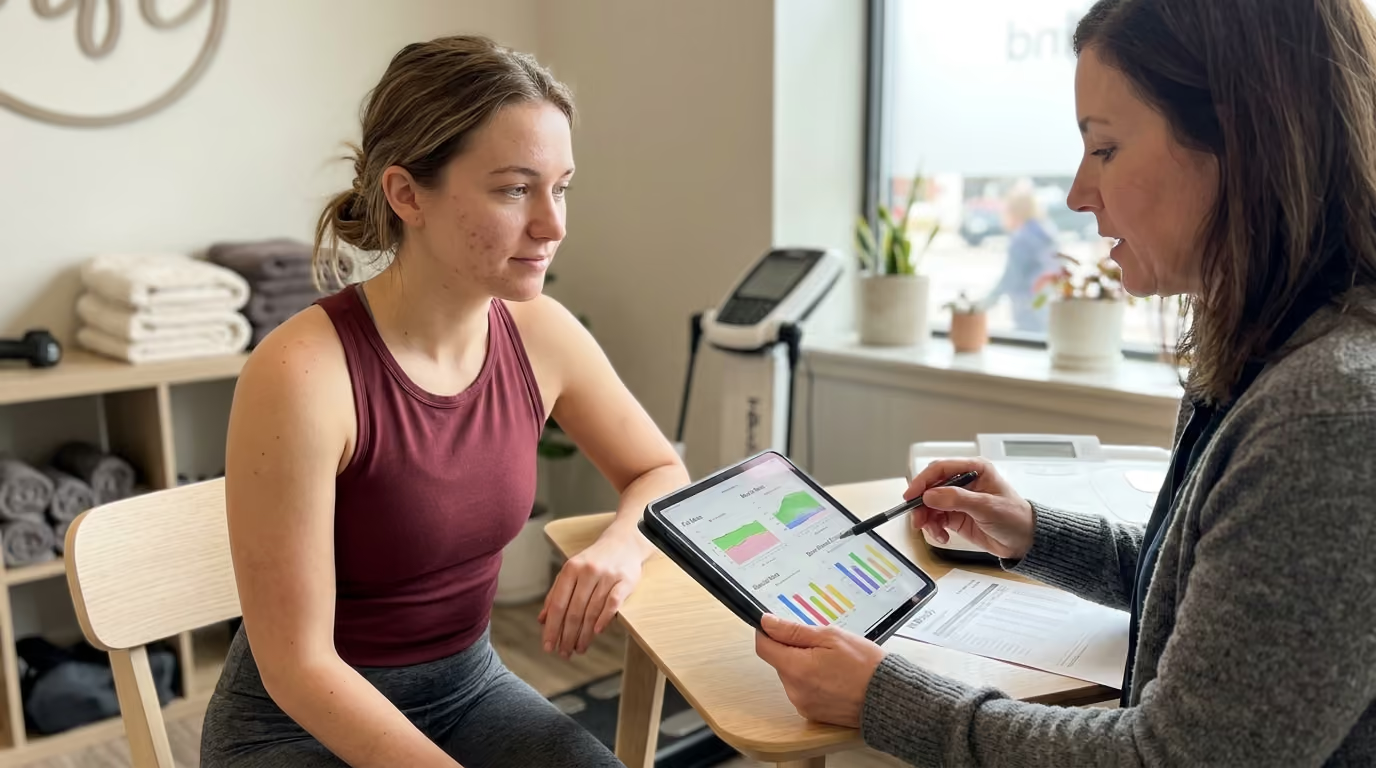

Targeting the three to eight percent muscle loss per decade requires structured strength screening, progressive resistance phases.





Many adults past forty search online for why they suddenly feel slower on stairs or stiff after a short run. They notice that stepping off a curb feels uncertain, or that hoisting a heavy duffel into an overhead bin requires sudden strain. The common assumption is that simple aging is taking its toll. The definitive answer is that your body is experiencing a loss of functional reserve, driven by subtle declines in muscle mass, strength, and explosive power.
Functional reserve is the gap between your maximum physical capacity and the energy demanded by everyday life. When that reserve shrinks, ordinary tasks begin to demand eighty or ninety percent of your maximum output. A simple trip on an uneven cobblestone street transitions from a minor adjustment into a dangerous fall.
Preserving physical autonomy does not require bodybuilder routines or extreme fitness protocols. It requires a linked system where muscle mass provides contractile tissue, strength produces force, power expresses that force rapidly, and balance coordinates movement under shifting conditions.
The primary goal of longevity training is not aesthetic transformation. The true target is building a durable margin of physical safety so you can hike challenging trails, handle international travel, and live without fear of physical limitation.
Skeletal muscle is a critical metabolic and structural organ. Beginning around age thirty, adults lose roughly three to eight percent of their muscle mass per decade without targeted intervention. This rate accelerates significantly after age sixty. By the eighth decade, an untrained individual may lose up to fifty percent of their original muscle mass.
This decline is often hidden by stable body weight. A person can lose five pounds of functional muscle tissue while gaining five pounds of visceral fat, a condition known as sarcopenic obesity. The bathroom scale remains identical, but physical capacity quietly degrades.
Muscle mass provides the raw contractile machinery and acts as a reservoir for amino acids during illness. However, muscle size alone does not guarantee real-world physical capability. Usable physical capacity depends on neuromuscular coordination, tendon stiffness, and joint mobility.
Muscle strength represents the maximum force your muscles can generate against resistance. Research consistently links higher strength to lower mortality risk. A comprehensive meta-analysis revealed that higher grip strength is associated with a thirty-one percent reduction in all-cause mortality, while knee-extension strength provides a fourteen percent lower risk. Strength provides the foundation that keeps daily tasks well below your physical threshold.
Muscle power introduces the element of speed, defined mathematically as force multiplied by velocity. Fast-twitch muscle fibers, which generate rapid bursts of force, atrophy faster than endurance-oriented slow-twitch fibers. A systematic review of forty-four clinical studies demonstrated that muscle power is a superior predictor of daily functional performance compared to strength alone. Recent prospective studies show that relative muscle power serves as a primary marker of healthy survival.
Rate of force development measures how fast your nervous system can recruit muscle fibers within the first few milliseconds of movement. When you miss a step on a flight of stairs, maximal strength cannot help if your nervous system takes a full second to respond. Rapid force development contracts the leg muscles instantly, arresting the fall before injury occurs.
Balance integrates sensory input from your eyes, inner ears, and foot mechanoreceptors to stabilize your center of mass. Mobility provides the usable, active joint range required to express that stability. Training these biological qualities together creates a comprehensive defense against functional decline.
Understanding these biological connections allows you to select smarter interventions. You can review advanced strategies in our longevity and biohacking resource section to tailor your personal regimen.
Evaluating your current physical capacity requires clear, standardized baseline metrics. Clinical frameworks like the revised European Working Group on Sarcopenia in Older People place muscle strength at the beginning of the diagnostic sequence. Mass and physical performance serve as confirming indicators.
Screening allows active adults to spot silent physical deficits before they impair lifestyle and independence. Regular self-monitoring should be performed under identical conditions every three to six months.
Grip strength provides a reliable window into total-body neuromuscular status. Sit upright with your elbow bent at ninety degrees and squeeze an adjustable hydraulic dynamometer with maximum effort for three seconds. Record three attempts on each hand, resting sixty seconds between trials. A score below twenty-seven kilograms for men or sixteen kilograms for women indicates an immediate need for progressive intervention.
This movement pattern measures lower-body force, balance, and coordination. Sit in a standard, armless chair with a seat height of approximately seventeen inches. Cross your arms over your chest and stand up to full extension five times as rapidly as possible. Taking longer than fifteen seconds to complete the five repetitions signals low lower-body power and strength.
The Timed Up and Go assessment evaluates functional mobility, dynamic turning balance, and gait speed. Begin seated in a firm armchair, stand up, walk three meters at a comfortable pace, turn around, return to the chair, and sit down. Completing this sequence in twelve seconds or less represents healthy functional capacity. A time exceeding twenty seconds indicates an elevated risk of stumbling and loss of independence.
Balance should be evaluated systematically across progressively narrower bases of support. Hold each of the following positions for ten seconds without using external support:
Inability to hold the single-leg stance for at least ten seconds is associated with higher fall risk in active adults. Practice this test near a sturdy wall or countertop to ensure safety during self-testing.
A comprehensive longevity training program must systematically build movement quality before introducing heavy loads or high velocities. Jumping directly into intense training after years of inactivity increases injury risk in tendons and joints.
The World Health Organization recommends at least two days per week of muscle-strengthening activity for all major muscle groups. For older adults, guidelines emphasize multicomponent physical activity that combines strength and balance on three or more days weekly.
The initial phase lasts between two and six weeks, focusing on restoring joint range, motor control, and tendon capacity. Work with controlled tempos, completing three to four seconds on the lowering phase of each repetition.
Stop every set three to four repetitions before technical failure. This establishes neuromuscular pathways while protecting unconditioned connective tissues.
Once basic movement mechanics are solid, the focus shifts to mechanical tension and muscle fiber recruitment. This phase builds the contractile engine that supports all dynamic activity.
Select a load that leaves two clean repetitions in reserve at the end of each working set. Meta-analyses show that two to three structured strength sessions per week optimize physical performance and functional independence.
Phase three introduces speed into the movement patterns. Power exercises must always be performed early in the workout when the nervous system is fresh.
The primary technical objective during power training is explosive acceleration during the lifting phase, followed by a controlled deceleration and reset. Never perform power drills in a state of deep muscular fatigue.
The final phase bridges gym performance and daily life demands. It combines strength, power, balance, and spatial awareness into complex, multi-planar tasks.
Integrating these dynamic movements ensures your physical capacities transfer directly to sports, household tasks, and outdoor recreation.
Longevity training proves its worth outside the weight room. A high leg-press number has little value if you cannot safely navigate steep, wet stone steps on vacation. Real-world physical independence requires blending force production with balance and situational awareness.
Consider recreational skiing or mountain hiking. Navigating a steep descent demands eccentric quad strength to absorb impact, ankle mobility to adapt to uneven terrain, and rapid core reflexes to counter sudden slips. If your physical capacity is limited, fatigue sets in within an hour. Joint stress spikes, reaction times slow, and injury risk rises steeply.
Carrying luggage up tight staircases in historic hotels offers another clear example. This everyday travel task demands asymmetric carrying strength, rotational trunk stability, and single-leg balance. Performing regular farmer carries and offset suitcase walks builds the exact postural stability needed for these real-world challenges.
Floor recovery is another critical skill. Getting up from the ground requires hip mobility, push strength, and unilateral leg drive. Practicing controlled floor transitions, moving from a kneeling position to standing without using hands for support, preserves this essential lifelong capability. You can explore structured exercise selections in our strength and physical performance guides to build these patterns systematically.
International travel and outdoor adventures demand high levels of physical resilience. Long flights, heavy bags, disrupted sleep, and unfamiliar terrain expose every weak link in your kinetic chain. Preparing your body for these demands makes travel far more enjoyable.
Long-haul transit places unique metabolic and structural stressors on the body. Prolonged sitting tightens hip flexors, reduces glute activation, and causes fluid pooling in the lower legs. When you step off a ten-hour flight straight into busy airport terminals, your balance and reaction times are compromised.
In our team's experience, managing long-haul travel requires matching physical movement with circadian biology. After a grueling thirty-hour transit to Tokyo, I realized my old strategy of simply powering through was no longer working. I felt foggy and physically depleted for three full days.
I began examining circadian science and realized that timing light exposure and fasting during flights could shift recovery dramatically. Now, our team never boards a long-haul flight without a precise schedule for when to eat, when to hydrate, and when to wear an eye mask. It is the difference between losing the first week of your trip to exhaustion and hitting the ground running.
To maintain physical readiness while traveling, focus on portable training habits:
You can learn more actionable strategies for your next itinerary in our travel and adventure section.
Resistance training creates the stimulus for muscle preservation, but nutrition provides the raw materials for tissue repair. As we age, our muscles become less responsive to dietary protein, a phenomenon known as anabolic resistance. Overcoming this requires higher per-meal protein intake than younger adults need.
The PROT-AGE Study Group recommends that healthy adults over sixty-five consume between 1.0 and 1.2 grams of protein per kilogram of body weight daily. For those engaged in regular resistance training, requirements rise to 1.2 to 1.5 grams per kilogram. The European Society for Clinical Nutrition and Metabolism (ESPEN) provides similar guidelines to support muscle retention and healthy aging.
Protein distribution throughout the day matters as much as total daily volume. Muscle protein synthesis requires reaching a specific intracellular threshold of the amino acid leucine, typically between 2.5 and 3.0 grams per meal. Spreading your protein intake across three to four discrete meals ensures multiple daily activations of the muscle-building pathway.
Focus on high-quality, nutrient-dense protein sources such as wild fish, pasture-raised poultry, lean beef, eggs, and targeted whey supplementation. Plant-based eaters can combine legumes, tofu, tempeh, and pea-rice protein blends to ensure complete amino acid profiles.
Adequate hydration preserves joint lubrication and disc height in the spine, supporting training recovery. For more specific meal-planning frameworks, check our nutrition and metabolism resource hub.
Navigating fitness advice past forty requires separating physiological evidence from gym folklore. Outdated dogmas often steer active adults toward ineffective or counterproductive routines.
Walking is essential for cardiovascular health, mental clarity, and metabolic baseline function. However, walking does not generate enough mechanical load to stimulate bone density, upper-body strength, or fast-twitch motor unit recruitment. Walking must be paired with dedicated resistance training to preserve full-body physical capability.
Many mature adults are advised to lift only light weights with slow, ultra-cautious tempos. While excessive loads with poor form invite injury, avoiding challenge prevents muscular adaptation. As noted, explosive power at moderate loads safely maintains the nervous system reflexes needed to prevent stumbles.
More exercise volume is not always better. Meta-analyses in mature adults show that excessive sets per session increase joint inflammation and central nervous system fatigue without delivering extra functional gains. A minimum-effective-dose approach builds capacity while keeping your joints fresh for weekend adventures.
Balancing on inflatable discs and wobble boards has become a common fitness trend. While helpful for early ankle rehabilitation, balancing on unstable surfaces forces you to use significantly lighter weights, which blunts strength gains. Real-world balance is built through solid-ground movements, including single-leg deadlifts, split squats, and loaded carries.
A popular fitness adage claims that pain is simply weakness leaving the body. In reality, persistent, sharp, or asymmetrical joint pain is a warning signal of excessive tissue stress. Distinguish healthy muscular fatigue from destructive joint inflammation, and modify exercise angles or ranges whenever sharp discomfort appears.
You do not need to live in the gym to build durable functional capacity. A streamlined, highly efficient schedule delivers maximum health and longevity returns in just three to four focused hours per week.
You can review our restorative protocols in our recovery and sleep guide collection to support long-term training consistency.
The broader scientific consensus across gerontology, sports science, and physiology is clear: maintaining muscle mass, strength, and explosive power forms the cornerstone of physical longevity. Preserving these biological assets supports lifelong mobility, metabolic health, and cognitive sharpness.
Begin your progression with realistic, consistent steps. Avoid extreme routines that lead to injury and forced layoffs. Small, repeatable actions sustained over months and years build an unshakeable physical reserve. Explore our living well and longevity strategies to keep your overall lifestyle aligned with your performance goals.
Stay connected for research and practical guidance on longevity, strength, recovery, energy and active living. New ideas to help you stay capable, curious and ready for more.


Explore practical guidance on strength, recovery, energy, travel and longevity for a life that stays active.
explore the Blog