
While basic hydration advice falls short, circadian phase shifting through strategic light, melatonin, and metabolic timing rapidly resolves long-haul jet.





How to cure jet lag fast after an international flight is a query millions of exhausted travelers type into search bars every week. You land after crossing multiple time zones, your eyes burn, your stomach feels unsettled, and your mind is wrapped in a thick mental fog. Most conventional travel advice tells you to drink more water, take random supplements, and push through the exhaustion until local bedtime. That approach rarely works. This guide provides a definitive, research-backed blueprint to eliminate circadian disruption, restore physical performance, and protect your energy across any long-haul itinerary.
Jet lag disorder is a formal circadian rhythm sleep-wake disorder. It happens when your internal biological clock falls out of sync with the external solar cycle and local time at your destination. Research from the Centers for Disease Control and Prevention confirms that jet lag typically emerges when traveling across more than three time zones. Crossing one to three time zones causes travel fatigue, but it rarely produces full circadian misalignment. Travel fatigue resolves with ordinary rest, while true jet lag requires active circadian realignment.
Circadian disruption impacts far more than just sleepiness. Your master biological clock coordinates core body temperature, hormone production, digestion, immune function, and cardiovascular regulation. When you jump across meridians, these internal systems remain anchored to your home departure city. The resulting desynchronization creates daytime somnolence, gastrointestinal distress, brain fog, reduced athletic capability, and fragmented nighttime sleep.
Effective long-haul recovery requires separating your post-flight challenges into three distinct physiological layers. First is circadian phase shifting, which means moving the master body clock to the destination solar day. Second is acute sleep and fatigue management, which protects restorative rest while the clock adjusts. Third is somatic travel recovery, which restores fluid balance, eases vascular strain from prolonged sitting, and regulates metabolic rhythms.
Attempting to treat circadian misalignment with basic stimulants or brute willpower will fail. You can be physically exhausted and desperate for sleep, yet remain wide awake at 3:00 a.m. because your central nervous system believes it is the middle of the afternoon. Real recovery requires targeted biological signals delivered at precise physiological windows.
At the center of your circadian architecture is the suprachiasmatic nucleus, a paired structure of neurons in the hypothalamus. The suprachiasmatic nucleus functions as the central pacemaker for the human body. It synchronizes secondary peripheral clocks found in the liver, gut, muscle tissue, and cardiovascular system. The central clock relies on external environmental cues, known as zeitgebers, to stay tethered to the twenty-four-hour solar day.
Light is the primary zeitgeber for human biology. Retinal ganglion cells in the eye detect environmental photons and transmit direct electrical signals to the suprachiasmatic nucleus. When bright light enters the eyes, it suppresses the synthesis of melatonin in the pineal gland and promotes daytime alertness. However, environmental light is not merely an energizing stimulus. It is an instructive phase-shifting signal whose physiological effect depends entirely on when your internal clock receives it.
The human body clock responds to light according to a precise phase-response curve. Every person experiences a circadian nadir, which is the point of lowest core body temperature. Research documented by the American Academy of Sleep Medicine demonstrates that this temperature nadir typically occurs approximately two to four hours before habitual wake time. The timing of light relative to this physiological nadir dictates whether your biological clock moves forward or backward.
Light exposure received in the biological evening and the hours immediately preceding the temperature nadir triggers a phase delay. A phase delay shifts your body clock backward, causing you to wake up later and fall asleep later. Light exposure received in the biological morning, immediately following the temperature nadir, triggers a phase advance. A phase advance shifts your body clock forward, causing you to wake up earlier and fall asleep earlier.
If you seek bright light at the wrong biological time, you will push your circadian rhythm in the opposite direction of your destination. For instance, waking up at 6:00 a.m. in London after a flight from New York means your body is operating on 1:00 a.m. home time. Stepping into bright light at that moment strikes your system prior to your internal nadir. That mistimed light causes a phase delay, shifting your clock toward California instead of England and worsening your jet lag.
Understanding this biological mechanism is central to effective longevity and biohacking frameworks. You cannot base your light exposure on the wall clock of your destination hotel. You must calculate light timing based on your internal biological clock and its estimated temperature nadir.
The human circadian system does not adapt to eastward and westward travel at the same rate. The internal human clock has an endogenous period slightly longer than twenty-four hours, typically averaging around twenty-four point two hours. Because our natural biology leans toward a longer day, delaying the clock during westward travel is physiologically easier than advancing it during eastward transit.
Eastward travel forces a circadian phase advance. You must compress your day, falling asleep earlier and waking earlier than your baseline routine. Because advancing the body clock is biologically demanding, eastward journeys frequently produce more severe symptoms and longer recovery periods.
Preparation for eastward travel begins three to four days before your flight. You can advance your circadian rhythm by shifting your sleep schedule earlier in thirty to sixty minute increments. Pair this earlier bedtime with bright outdoor light exposure immediately upon waking at home. At the same time, eliminate bright indoor lighting and digital screens early in the evening to allow endogenous melatonin to rise.
When you arrive at an eastward destination, your primary goal is collecting outdoor sunlight during your biological morning while avoiding bright light during your biological night. If you fly from Boston to Rome, your body clock lags six hours behind local Italian time. Upon arrival in the morning, your core temperature nadir has not yet passed. You must wear dark sunglasses during the initial transit hours to prevent a phase delay. Once your biological nadir passes around midday local time, you should seek sustained outdoor sunlight to drive your clock forward.
Westward travel requires a circadian phase delay. You must expand your day, staying awake later into the night and waking later the next morning. While generally easier than eastward adaptation, long westward transits across six or more time zones still generate significant fatigue and early-morning insomnia.
Pre-trip preparation for westward travel involves moving your sleep window thirty to sixty minutes later each day for three days prior to departure. Maximize bright light exposure during your local evening at home, and avoid intense light exposure if you wake up early in the morning. This routine initiates a gentle phase delay before you ever step onto the aircraft.
Upon arriving at your westward destination, the strategy centers on seeking late-afternoon and early-evening light while strictly avoiding early-morning light. If you travel from London to San Francisco, you will naturally wake up around 3:00 a.m. local time because your internal clock believes it is midday. Do not get out of bed to sit in front of bright lights or screens. Remain in a dark room until a reasonable morning hour, then collect your primary sunlight in the late afternoon to lock in the delay.
Light is the single most powerful tool in your travel recovery arsenal. To use light as a biological lever, you must control four specific variables: timing, intensity, duration, and avoidance. Misunderstanding any of these elements renders the entire intervention ineffective.
Outdoor natural daylight provides an intensity ranging from ten thousand to over one hundred thousand lux, depending on cloud cover. In contrast, standard indoor airport and hotel lighting rarely exceeds five hundred lux. Because retinal ganglion cells require robust photon density to trigger complete suprachiasmatic realignment, outdoor daylight provides an exponentially stronger phase-shifting signal than indoor fixtures.
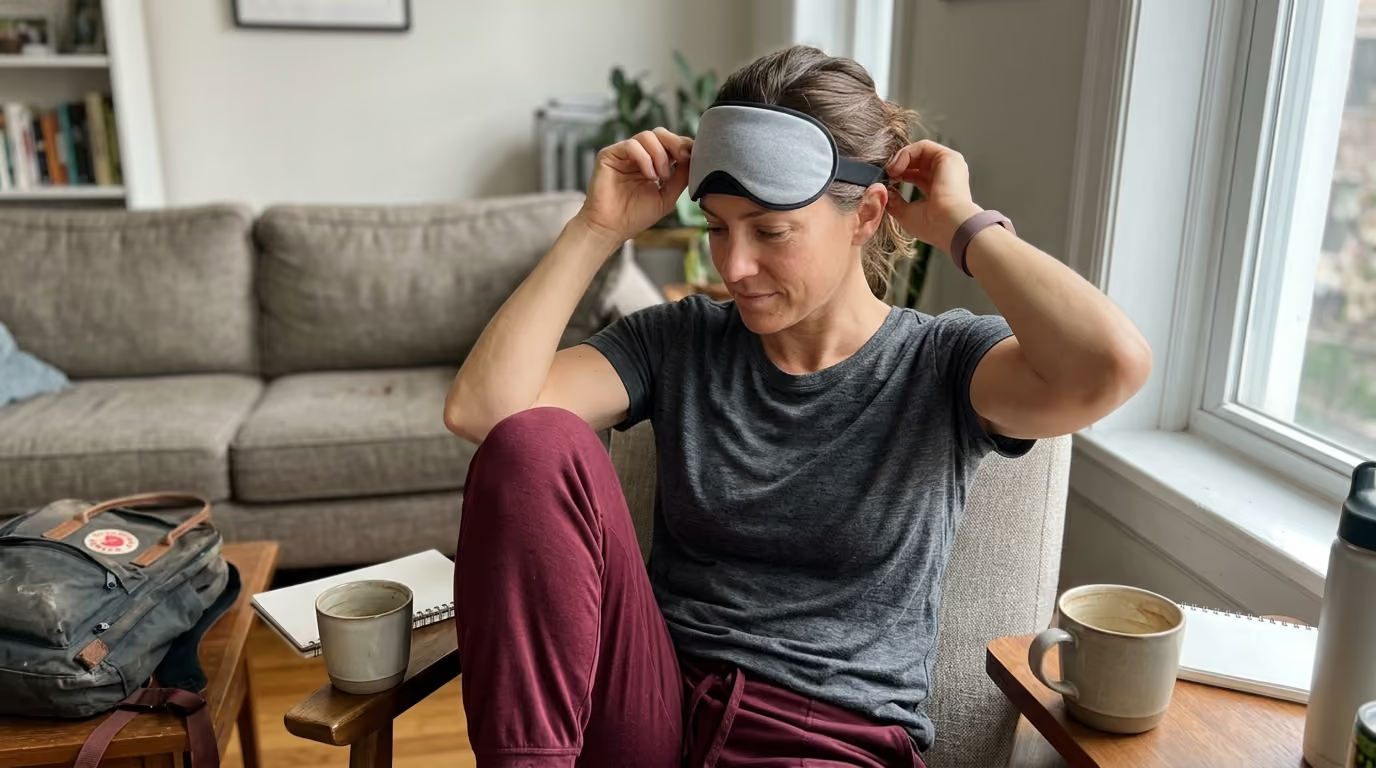
Light avoidance is just as critical as light exposure. Unintended light exposure during your biological night suppresses melatonin production and destabilizes your master clock. High-grade eye masks and total room darkness are non-negotiable tools during transit and hotel stays.
In our experience working with high-performing executives and long-distance athletes, passive travel strategies always break down on multi-leg journeys. After a grueling thirty hour transit to Tokyo, I realized my old strategy of just powering through was no longer working. I felt foggy for three days. I started digging into circadian biology and realized that timing my light exposure and fasting during the flight could completely shift my recovery. Now, I never board a long haul flight without a precise schedule for when to eat and when to put on an eye mask. It is the difference between losing a week of your trip and hitting the ground running.
Integrating targeted sleep and recovery protocols ensures you control your luminous environment rather than letting it control you. Pack polarized sunglasses with high optical density for transit hubs, utilize total-blackout sleep masks in flight, and verify that your hotel accommodation features functional blackout curtains.
For travelers who cannot access morning outdoor sunlight due to extreme weather or business commitments, specialized bright-light therapy devices offer a viable alternative. A clinical-grade light box emitting ten thousand lux of cool-white light positioned at eye level for thirty minutes can initiate a phase shift. However, individuals with retinal disorders, macular degeneration, or bipolar-spectrum vulnerabilities must exercise caution. Bright light therapy can provoke mania in susceptible individuals and should be coordinated with a physician.
Light serves as the primary environmental cue for the central brain clock, but internal hormones and metabolic signals synchronize peripheral organ clocks. Melatonin and meal timing act as secondary pacemakers. When deployed alongside light management, they dramatically accelerate total physiological adaptation.
Melatonin is primarily a chronobiotic agent, which means it modifies the timing of your biological rhythms. It is not an ordinary sedative hypnotic drug. Taking melatonin simply as a sleeping pill without considering your circadian phase will yield disappointing results.
Clinical practice parameters published by the American Academy of Sleep Medicine confirm that timed exogenous melatonin accelerates circadian adaptation for both eastward and westward long-haul flights. A comprehensive Cochrane systematic review revealed that daily doses between zero point five milligrams and five milligrams effectively reduce jet lag symptoms when taken near destination bedtime. The Cochrane analysis noted that while five milligrams produced slightly faster sleep onset, lower physiological doses around zero point five to one milligram were equally capable of shifting the body clock.
For eastward travel, exogenous melatonin acts as an advance signal. You should take a modest dose in the late afternoon of your departure schedule or thirty to sixty minutes before your intended sleep window at the destination. For westward travel, small doses taken during the local destination morning can assist in phase delaying, though light exposure remains the dominant westward driver.
Purchase third-party tested melatonin supplements to ensure dose accuracy. Over-the-counter formulations frequently contain wide variations from their labeled dosages. Melatonin should never be combined with alcohol or central nervous system depressants. Individuals taking anticoagulant medications, immunosuppressive drugs, or managing epilepsy should consult their physician before starting supplementation.
Your digestive organs, including the liver, pancreas, stomach, and intestines, possess intrinsic circadian oscillators. These peripheral metabolic clocks are heavily entrained by nutrient intake rather than retinal light exposure. Eating large, calorie-dense meals during your biological night desynchronizes your liver clock from your suprachiasmatic nucleus. This internal desynchrony produces systemic inflammation, insulin resistance, and profound digestive discomfort.
Applying core principles of nutrition and metabolism during long-haul transit requires intentional meal timing. Adjust your eating windows to match your destination daytime hours as soon as you board the aircraft. If it is 2:00 a.m. at your destination while you are in flight, decline the heavy airline dinner service. Digesting complex fats and carbohydrates while your gastrointestinal tract is biologically dormant impairs sleep quality and exacerbates travel fatigue.
When you arrive at your destination, consume regular, balanced meals containing quality protein, fiber, and healthy fats during local daylight hours. Avoid continuous grazing throughout the evening. Structuring clear meal intervals reinforces peripheral circadian alignment and stabilizes daytime energy production.
Cabin environments inside commercial long-haul aircraft impose significant physiological stress. Commercial cabins are typically pressurized to an equivalent altitude of six thousand to eight thousand feet above sea level. This pressure drop reduces blood oxygen saturation, while circulating cabin air maintains relative humidity levels below twenty percent.
The exceptionally dry atmosphere of an aircraft cabin accelerates insensible fluid loss through the skin and respiratory tract. Passengers quickly experience dry mucous membranes, eye irritation, headaches, and systemic lethargy. Maintaining adequate hydration is necessary for general comfort and cognitive clarity during transit.
However, scientific research from the Centers for Disease Control and Prevention clarifies an important distinction: dehydration has not been proven as a direct cause of travel-associated deep vein thrombosis. Drinking water improves comfort and alertness, but hydration alone is not a substitute for active vascular protection.
Drink plain water or electrolyte-enhanced fluids consistently throughout the flight based on natural thirst. A baseline intake of fifteen to twenty milliliters of fluid per kilogram of body weight spread evenly across a twelve-hour flight provides adequate hydration for most healthy adults. Avoid forced overhydration, which causes frequent nocturnal bathroom visits and fragments precious in-flight rest.
Alcohol consumption during long-haul flights severely impairs travel recovery. While alcohol produces mild sedative effects that may help nervous travelers fall asleep, it fundamentally disrupts sleep architecture. Alcohol suppresses rapid eye movement sleep, increases slow-wave sleep fragmentation, accelerates dehydration through diuresis, and increases upper airway resistance. Combining alcohol with sleep medications or melatonin produces dangerous sedation and severe next-day cognitive impairment.
Caffeine is an effective alertness tool when timed correctly, but it has an elimination half-life averaging five to seven hours. Consuming coffee or caffeinated beverages late in your destination afternoon blocks adenosine receptors and prevents deep restorative sleep. Restrict caffeine consumption to the early hours of your destination morning.
Prolonged seated immobility during long flights causes venous stasis in the lower extremities. Blood pools in the deep veins of the calves, increasing the risk of travel-associated deep vein thrombosis and pulmonary embolism. The CDC recommends deliberate physical movement to stimulate the skeletal muscle pump and maintain healthy circulation.
Perform regular in-seat mobility exercises every sixty to ninety minutes while awake during transit. These simple movements require minimal space and keep venous blood circulating back toward the heart:
Travelers with elevated vascular risk factors should consult a physician before long-haul travel. High-risk profiles include individuals with previous venous thromboembolism, recent orthopedic surgery, active malignancy, pregnancy, use of estrogen-containing therapies, or severe obesity. For these individuals, clinicians may prescribe graduated medical compression socks or prophylactic anticoagulation.
Seek immediate emergency medical attention if you experience localized leg swelling with pain, sudden chest pain, shortness of breath, or unexplained rapid heart rate following long-haul travel.
The travel and wellness sectors are filled with pervasive myths regarding jet lag management. Relying on scientifically unfounded methods wastes valuable time and frequently worsens physiological misalignment.
A frequent claim across travel blogs is that jet lag is simply an extreme form of dehydration. Dehydration causes fatigue, headaches, and physical discomfort, but it is physiologically incapable of shifting the suprachiasmatic nucleus. Conflating dehydration with circadian misalignment leads travelers to consume excessive fluids while completely ignoring the light and darkness cues necessary to reset their internal clock.
Many travelers believe that taking higher doses of melatonin guarantees faster circadian adaptation. Clinical trials demonstrate that five to ten milligrams of melatonin does not shift the human circadian phase any faster than a zero point five milligram physiological dose. Mega-dosing melatonin frequently leads to next-day grogginess, vivid nightmares, morning headaches, and lingering cognitive sluggishness without providing any added phase-shifting benefit.
Popular advice routinely tells all travelers to step into bright morning sunlight immediately after arrival. As detailed in the phase-response curve, morning sunlight advances the circadian clock. If you have traveled westward across eight time zones, your body requires a phase delay. Stepping into bright morning sunlight after a westward flight hits your eyes during the advance zone of your curve, shifting your internal rhythm in the exact wrong direction.
Another common myth is that performing a maximal, high-intensity workout immediately upon arrival will reset the biological clock. Systematic reviews examining exercise in athletic cohorts reveal that while physical movement boosts alertness and relieves muscular stiffness, exercise alone cannot reliably shift circadian rhythms. Forcing a maximal workout while suffering from acute sleep deprivation and altered coordination significantly increases your risk of musculoskeletal injury.
Wearing blue-light blocking glasses while sitting in a brightly lit restaurant or hotel lounge does not neutralize the circadian impact of light. While blue wavelengths around four hundred eighty nanometers maximally stimulate melanopsin-containing retinal cells, high-intensity light across the entire visual spectrum can still suppress melatonin synthesis. Blue-blocking eyewear provides modest protection, but comprehensive light avoidance in dark environments remains far more effective.
Complex protocols spanning multiple days before departure are not always feasible for busy professionals and spontaneous adventurers. When time and schedule constraints prevent multi-day pre-adaptation, executing a streamlined, high-yield routine during transit delivers the vast majority of biological benefits.
This minimal effective dose relies on controlling three high-leverage levers: setting your mental time zone upon boarding, managing your visual environment, and locking in your first destination morning wake time.
Begin your protocol the moment you step onto the aircraft. Change your watch to the local time of your destination city. If the destination is currently experiencing nighttime, put on your high-grade eye mask, insert earplugs, decline meal service, and rest. If it is daytime at your destination, keep your reading lights on, consume your planned meal, stay hydrated, and remain awake.
Upon landing, anchor your schedule immediately. Regardless of how fragmented your flight sleep was, set an alarm and wake up at a normal local morning hour. Do not allow yourself to sleep in late. Step outdoors into direct sunlight within your designated phase-shifting window for at least thirty minutes. Combine this sunlight exposure with brisk walking to promote lower-body circulation.
If overwhelming fatigue strikes during your first afternoon, you may take a single, highly structured nap. Limit this rest to twenty or thirty minutes, and complete it before 3:00 p.m. local time. Setting a firm timer prevents you from entering slow-wave delta sleep. A short nap relieves sleep pressure and restores mental sharpness without stealing the sleep drive you need for the upcoming night.
Take one to three milligrams of high-quality melatonin thirty to sixty minutes before your target destination bedtime during your first three nights. Keep your hotel room completely dark, quiet, and cool, ideally between sixty-five and sixty-eight degrees Fahrenheit. This streamlined framework delivers rapid recovery without requiring complex calculations or disruptive lifestyle changes.
Managing long-haul travel recovery becomes exceptionally critical when planning demanding expeditions, alpine skiing trips, competitive athletic events, or high-stakes international business negotiations. In these scenarios, physical capacity, reaction time, cognitive endurance, and emotional stability must be preserved under extreme time constraints.
Elite athletes and expedition leaders face unique challenges when crossing multiple time zones. Studies evaluating international sports teams demonstrate that acute circadian disruption impairs peak isometric force, sprint velocity, cardiovascular output, and tactical decision-making.
Implementing structured travel and human performance strategies ensures that athletic capabilities remain intact upon arrival. Adjust physical training loads dynamically during the first forty-eight hours post-transit:
On your first day in a new location, restrict physical activity to light aerobic conditioning and joint mobility work. This flushes stagnant fluid, restores tissue compliance, and elevates mood without overtaxing a fatigued central nervous system. Delay heavy maximal strength sessions, complex Olympic lifting, high-velocity plyometrics, and high-altitude alpine ascents until you have secured at least one full night of restorative local sleep.
Wearable physiological trackers provide useful contextual data regarding your physical state. Monitoring daily trends in resting heart rate and heart rate variability helps identify lingering systemic strain. However, wearable recovery scores must not be confused with direct measurements of circadian phase. Base your training decisions on your actual clinical symptoms, balance, mental focus, and movement quality rather than relying solely on a proprietary readiness score.
A specialized travel challenge involves the short-duration business trip lasting forty-eight to seventy-two hours. If you fly across six time zones for a two-day series of meetings and immediately return home, forcing a complete circadian phase shift is counterproductive. By the time your suprachiasmatic nucleus begins adapting to the destination, you will board a return flight and force your biology to reverse the entire process.
For ultra-short trips, clinical consensus from the CDC and the American Academy of Sleep Medicine suggests maintaining home-base biological time whenever possible. Schedule critical meetings during windows that overlap with your home daytime hours. Sleep during periods that align as closely as feasible with your departure time zone, utilize dark sunglasses to shield your eyes from local light during your home biological night, and return home with your primary circadian rhythms intact.
The broader scientific and medical community reaches several clear points of consensus regarding long-haul travel recovery:
By systematically applying these validated scientific principles, you eliminate travel-induced brain fog, maintain peak physical capability, and protect your long-term vitality wherever your global travels take you.
Applying an evidence-based travel protocol requires simple, deliberate preparation before, during, and after your flight. Use this straightforward checklist to organize your recovery strategy for your next long-haul trip.
Stay connected for research and practical guidance on longevity, strength, recovery, energy and active living. New ideas to help you stay capable, curious and ready for more.


Explore practical guidance on strength, recovery, energy, travel and longevity for a life that stays active.
explore the Blog