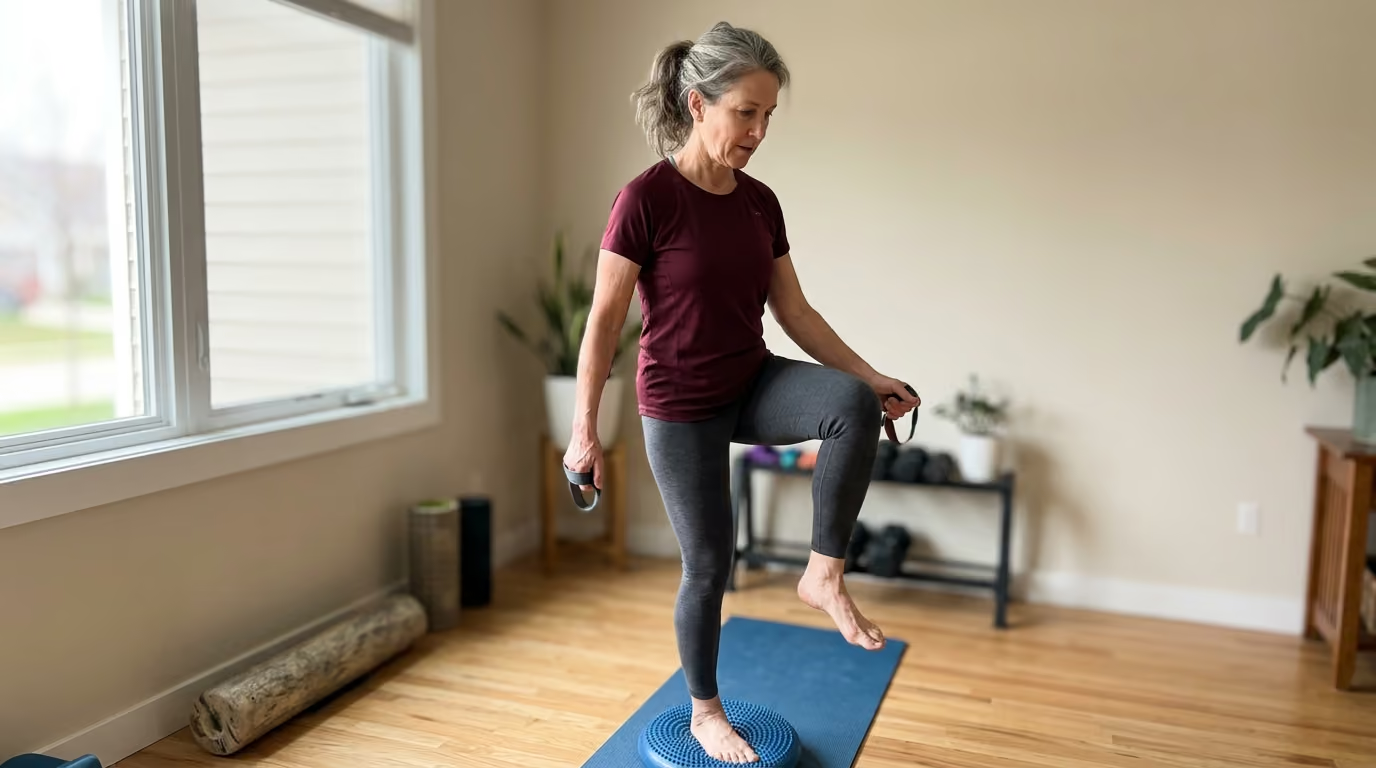

Navigating uneven trails or slick surfaces after forty requires dynamic sensory integration, reactive foot mechanics, and targeted neuromuscular stability.





You are descending a steep alpine trail in late afternoon. The light is fading, your quadriceps are tired from four hours of climbing, and loose gravel shifts suddenly under your downhill foot. In a fraction of a second, your nervous system must sense the slip, choose a recovery strategy, fire the hip and ankle stabilizers, and adjust your center of mass before your knee buckles or your torso pitches forward.
This moment is not decided by how long you can stand motionless on one foot on a plush living room rug. It is decided by dynamic, reactive stability.
For active adults over 40, balance is often treated as an afterthought until a sudden stumble, an awkward ski turn, or a close call on a wet boat deck reveals a quiet decline in physical reserves. True stability is not a single isolated trait. It is a trainable sensorimotor skill that combines foot mechanics, rapid force production, sensory integration, and psychological confidence.
Developing these abilities keeps you moving smoothly through high-consequence environments. Whether navigating slick cobblestones in Europe, backcountry trails, or choppy waters, systematic stability training preserves your freedom of movement for decades to come.
Balance is the active process of taking in sensory cues, generating rapid muscular force, and controlling your center of mass across changing surfaces. It requires continuous coordination between your visual system, inner ear, and sensory receptors in your joints and feet.
As we age past 40, our natural margin for error narrows. Lower-body power declines faster than pure strength, joints stiffen, and sensory feedback from the soles of the feet becomes less sharp. While public health frameworks like the CDC STEADI model focus primarily on preventing catastrophic falls in adults aged 65 and older, the underlying principles apply directly to midlife performance. Training these pathways early prevents the loss of coordination that limits adventurous travel and sport.
A complete balance program must extend beyond static poses. It requires a balanced combination of foot mechanics, lower-body power, reactive stepping drills, and sport-specific movement under mild fatigue.
By dedicating ten to fifteen minutes three times per week to progressive neuromotor work, you can dramatically improve your stability. This guide provides a field-tested manual to assess your baseline, address hidden deficits, and build lifelong stability.
Balance is not a passive state of equilibrium. It is an active, continuous neurological correction. Every step you take requires your brain to process three distinct sensory inputs and translate them into motor commands within milliseconds.
The first stream is your visual system. Your eyes track the horizon, identify surface changes, and measure the distance to obstacles. Vision provides the primary frame of reference for where your body sits in space. When visual cues are degraded by dim lighting, fog, or dark sunglasses, your brain must rely more heavily on its other systems.
The second stream is the vestibular system located within the inner ear. It consists of fluid-filled semicircular canals and otolith organs that detect linear acceleration, gravity, and head rotation. This system functions as your internal gyroscope. It tells you which way is up, even when your eyes are closed or you are swimming underwater.
The third stream is somatosensation, commonly known as proprioception. Specialized mechanoreceptors in your skin, tendons, ligaments, and joint capsules monitor tension, pressure, and joint angles. The soles of your feet are exceptionally dense with these receptors. They constantly inform your spinal cord about ground firmness, slope, and micro-slips.
Your center of mass is the central point of your total body weight. In a standing adult, it generally sits just anterior to the second sacral vertebra. Your base of support is the physical area bounded by the contact points between your feet and the ground.
Stable movement depends on managing the relationship between these two factors. When your center of mass remains within your base of support, you remain upright with minimal muscular effort. The moment your center of mass moves outside that perimeter, you will lose balance unless you quickly reposition a foot or apply immediate corrective force.
When an external force or uneven surface shifts your balance, your nervous system deploys one of three primary strategies based on the size of the disruption.
The ankle strategy manages small, slow perturbations on firm ground. The body sways as a single rigid pendulum, using the calf and anterior shin muscles to make tiny corrections at the foot interface.
The hip strategy handles faster or larger disruptions, especially on narrow or compliant surfaces. The body rapidly flexes or extends at the hips while rotating the trunk to reposition the center of mass without moving the feet.
The stepping strategy is your primary defense against large, sudden perturbations. When the ankle and hip strategies are insufficient, you must take a rapid step in the direction of the fall to establish a new base of support. For high-speed outdoor sports, the speed and accuracy of this recovery step matter far more than static single-leg stamina.
Maintaining dynamic stability requires six physiological and cognitive reserves. If any single reserve is depleted, your margin for error shrinks.
First is your force reserve, which is the baseline muscular strength required to support your body weight across deep joint angles. Second is your power reserve, which is the ability to generate that muscular force rapidly during an unexpected slip.
Third is your mobility reserve, ensuring adequate range of motion in the ankles, hips, and thoracic spine to absorb impacts. Fourth is your sensory reserve, which is the clarity of signals coming from your eyes, inner ears, and foot mechanoreceptors.
Fifth is your cognitive reserve, representing your ability to process environmental cues while multitasking or holding a conversation. Sixth is your confidence reserve, which is the psychological belief in your physical capability that prevents fearful freezing during a misstep.
Many athletic adults assume that because they run, cycle, or practice yoga, their balance needs are fully met. Each of these activities targets different components of the stability system. A comprehensive program categorizes balance into four distinct domains.
Static balance involves maintaining your body position while your base of support remains fixed. Classic examples include a narrow-stance hold, tandem standing with one foot directly in front of the other, and single-leg balancing.
Static training creates the foundational control needed at the foot, ankle, and hip. It allows you to build intrinsic foot strength and practice conscious postural alignment. However, static stability alone will not prepare you for dynamic movement on unpredictable terrain.
Progressing static balance involves gradually narrowing your base of support. You can advance from a standard bilateral stance to a semi-tandem stance, a full heel-to-toe tandem stance, and finally a single-leg stance. Adding head turns, closing your eyes, or reaching outside your center of mass increases the challenge safely.
Dynamic balance is the ability to maintain stability while your body is actively in motion. This includes walking, descending stairs, turning, stepping over obstacles, and transitioning between movement planes.
In dynamic balance, your center of mass is constantly moving outside your base of support and being recaptured by the advancing leg. This domain is central to trail running, technical hiking, skiing transitions, and moving across the deck of a boat.
Key dynamic movements include controlled step-downs, multi-planar lunges, and single-leg hip hinges. These exercises train eccentric leg strength, ensuring your muscles can absorb force smoothly as your body lowers toward the ground.
Reactive balance is your capacity to recover after an unexpected external disturbance. This occurs when you catch a toe on an exposed tree root, slip on hidden black ice, or get bumped in a crowded airport terminal.
Reactive balance relies on reflex arcs and rapid motor program selection rather than conscious deliberation. It requires:
Voluntarily balancing on an unstable foam pad does not adequately train this quality. Reactive capacity requires drills with controlled, unexpected perturbations and rapid step responses in multiple directions.
Anticipatory balance involves postural adjustments made by your nervous system immediately before an intentional movement occurs.
When you prepare to kick a soccer ball, step onto a high boulder, or open a heavy door, your trunk and deep hip stabilizers pre-activate milliseconds before your limb moves. This pre-stiffening stabilizes your spine and pelvis, providing a firm platform for the moving limb.
Without effective anticipatory control, simple actions like reaching for a handrail or lifting a piece of luggage can pull your center of mass off balance. You can explore structured routines in our performance and fitness articles to help integrate these movement patterns.
To organize stability training without unnecessary complexity, we developed the FARMS framework. This system breaks down balance into five manageable components that can be integrated into any weekly routine.
Your feet are the only interface between your body and the ground. The human foot contains dozens of muscles, joints, and thousands of specialized nerve endings. Thick, heavily cushioned footwear can blunt this sensory feedback over time.
Begin by restoring sensory awareness and intrinsic strength. Practice establishing a tripod foot, distributing your body weight evenly across three contact points: the heel, the base of the big toe, and the base of the little toe.
From this stable tripod position, practice the short-foot maneuver. Without curling your toes, gently draw the ball of your foot back toward your heel to lift the medial longitudinal arch. Hold this tension for five seconds while breathing naturally.
Incorporate toe-spreading exercises and controlled single-leg heel raises on a firm, flat surface. Strengthening the flexor hallucis longus and calf complex provides the mechanical stiffness needed to resist sudden ankle rolling.
Stability is a linked kinetic chain. If your ankle lacks dorsiflexion, your knee often collapses inward to compensate. If your gluteal muscles are weak, your pelvis tilts and destabilizes your lumbar spine.
Alignment training reinforces proper tracking across the ankle, knee, and hip joints. Perform slow, deliberate single-leg step-downs from a low four-inch step. Focus on keeping your knee tracking directly over your second toe without letting the arch of your foot collapse.
Add lateral lunges and single-leg hip hinges to strengthen the gluteus medius and deep hip rotators. These muscles stabilize your pelvis horizontally every time one foot leaves the ground.
Because real-world balance disruptions happen fast, your training must include an element of speed. Slow lifting alone cannot fully build reactive power.
Practice multidirectional step-and-hold drills. Stand on two feet, then explosively step forward, diagonally, or laterally onto one leg, immediately sticking the landing and freezing for two seconds. This trains both rapid force generation and eccentric deceleration.
If you have a training partner, use call-out stepping drills. Have your partner call out a direction or color target at random intervals, requiring you to execute an immediate, decisive recovery step.
Incorporate low-amplitude, controlled hops and brisk sit-to-stand transitions from a chair. These movements preserve fast-twitch motor unit recruitment in the quadriceps and calves, which often declines with age.
Isolating single-leg balance on a gym floor is merely preparation for moving through complex, distracted environments. Movement in context challenges your balance while your attention is divided.
Incorporate dual-task training into your weekly routine. Walk across an uneven surface while holding a full glass of water, performing mental arithmetic, or turning your head deliberately from side to side.
Practice stepping over low obstacles placed at irregular intervals. Vary your walking speeds on command, moving from a slow crawl to a brisk stride, followed by an immediate dead stop without taking an extra balance step.
These drills train your brain to prioritize motor stability even when external stimuli compete for your cognitive resources.
The final stage of the framework adapts your stability reserves to your specific passions and environments.
For mountain sports, emphasize eccentric quad deceleration, ankle inversion and eversion stability, and carrying unevenly distributed pack loads. For water sports, emphasize rotational core strength, hip mobility, and balance adjustments when the visual horizon is shifting.
Train in the footwear you actually use for your adventures. Hiking boots, cycling shoes, and trail runners alter sensory feedback in unique ways, and your nervous system must adapt to each.
Balance is the critical factor that determines whether demanding outdoor pursuits feel fluid and exhilarating or exhausting and hazardous. Reviewing specific athletic demands helps highlight how stability training translates to real-world performance.
Uphill hiking is largely an aerobic and concentric strength challenge. Downhill hiking, by contrast, is a demanding balance and eccentric braking task.
Each downhill step forces your quadriceps, patellar tendons, and anterior shins to absorb several times your body weight on an unstable, angled surface. If your eccentric strength or foot proprioception is lacking, you will naturally stiffen your joints, shorten your stride, and lean backward. This defensive posture shifts your center of mass behind your base of support, dramatically increasing your risk of slipping.
To master descents, train progressive step-downs from six to eight inches, focus on slow eccentric split squats, and practice dynamic braking drills on mild outdoor slopes. Carrying a weighted pack during these drills builds the core stiffness required to manage an elevated center of mass.
Alpine skiing requires rapid edge-to-edge transitions, deep hip angles, and immediate reactions to sudden changes in snow texture. Catching an edge or hitting an unexpected patch of crust instantly forces your center of mass away from your skis.
A fit skier with poor reactive stability will often freeze or lean back, unloading the tips of their skis and losing steering control. Recovering from an unexpected deflection requires strong lateral core stability, reactive hip abduction, and rapid eccentric force in the downhill leg.
Dry-land preparation should prioritize lateral skater bounds with stick landings, rotational medicine ball tosses, and deep lateral lunges. These exercises build the strength and confidence required to handle high edge angles safely.
Many experienced road and gravel cyclists possess exceptional cardiovascular fitness and bilateral leg power. Yet some struggle with low-speed bike handling, unclipping from pedals quickly, or maneuvering across loose gravel.
Cycling is a linear, seated activity that provides constant bilateral support. It does not inherently train lateral stability, single-leg stance, or rapid multidirectional stepping. When an unexpected stop occurs on a steep incline, a lack of reactive stepping can lead to a hard fall.
Cyclists benefit from practicing single-leg balance and lateral step-ups while wearing their cycling kit and shoes. Adding low-speed balance drills and parking-lot emergency dismount practice bridges the gap between seated engine power and athletic handling. You can learn more about targeted conditioning in our strength and physical performance section.
Stand-up paddleboarding, kayaking, and sailing present a unique challenge: the ground itself is moving beneath you. This creates continuous sensory conflict between your inner ear, your eyes, and the pressure sensors in your feet.
On a paddleboard, the visual horizon may appear stable while the board tilts beneath your feet. Locking your knees and stiffening your torso will quickly pitch you into the water. Staying balanced requires soft, mobile ankles, dynamic hip articulation, and a fluid torso that lets the board move independently of your upper body.
To prepare for water sports, practice rotational movements on compliant surfaces, perform single-leg reaches, and train fluid weight transfers from foot to foot. These exercises teach your brain to rely on vestibular and somatic cues rather than fixing your gaze rigidly on the water.
Navigating the world as an active adult requires moving through unfamiliar, poorly lit, and physically demanding environments with confidence.
International travel often means walking ten to fifteen miles a day across irregular cobblestones, high curbs, broken flagstones, and polished marble floors. Carrying heavy luggage up narrow hotel staircases further shifts your center of mass and strains your posture.
A lack of ankle mobility and foot strength makes these historic surfaces taxing on the lower back and knees. Practicing multi-directional stepping, loaded carries, and stair step-downs prepares your body for the physical realities of travel.
Fatigue significantly blunts your neurological response times. After crossing multiple time zones, sleep deprivation impairs proprioceptive processing and slows your reactive motor corrections.
Our team has experienced this firsthand during long international transits. After a grueling thirty-hour transit to Tokyo, I realized my old strategy of just powering through was no longer working. I felt foggy for three days, and my reaction time and physical coordination on the city streets were noticeably dulled.
I started digging into circadian biology and realized that timing light exposure and fasting during flights could dramatically speed up recovery. Now, I never board a long-haul flight without a clear plan for light exposure, meal timing, and restorative movement. It is the difference between losing the first week of an adventure to mental fog and hitting the ground running. You can find detailed protocols for managing transit in our travel and adventure articles.
When arriving in a new destination, take ten minutes to walk barefoot on a safe surface, mobilize your ankles, and perform light bodyweight squats. This helps re-establish neuromuscular connections and resets your sensory systems before tackling challenging terrain. For more strategies on rebuilding physical capacity after demanding days, browse our recovery and sleep resources.
Misunderstandings about stability training can lead to wasted effort or a false sense of security. Clarifying these points ensures your training delivers real-world results.
Yoga offers valuable mobility, isometric strength, and static balance benefits. Holding a warrior pose or tree pose develops excellent postural awareness and foot control.
However, yoga rarely includes rapid, unpredictable stepping, explosive deceleration, or sudden recovery from external disruptions. A comprehensive balance plan must combine the control of yoga with dynamic, speed-based reactive drills.
Standing motionless on a flat floor tests only static capacity. While it serves as a helpful baseline, it fails to replicate real-world environments where surfaces shift, the head turns, and momentum must be absorbed.
True stability is dynamic. Prioritize exercises that move your center of mass through space, requiring you to brake and stabilize under variable conditions.
In many gyms, balance training is equated with standing on rubber balance discs or wobble boards. While these tools challenge ankle stability, they do not automatically transfer to athletic performance.
Balancing on a squishy surface trains your nervous system to adapt to an artificially shifting base. Most outdoor slips happen on solid, unyielding surfaces like rock, ice, or packed soil. Building strength on firm ground while moving your body dynamically is far more effective for real-world stability.
Lifting weights is essential for preserving muscle mass and bone density. However, strong quadriceps and glutes cannot prevent a fall if your nervous system cannot detect a slip quickly or fire those muscles fast enough.
Research demonstrates that balance and functional exercise programs yield far more reliable fall-reduction outcomes than resistance training alone. Strength provides the raw force capacity, but neuromotor drills provide the timing and coordination to apply that force when it counts.
Barefoot training on natural surfaces is a fantastic way to awaken foot mechanoreceptors and strengthen intrinsic muscles. However, your adventures will usually take place in specialized footwear like stiff mountain boots, cycling cleats, or ski boots.
Footwear alters joint leverage and dampens tactile feedback. While you should include some barefoot stability work at home, make sure to perform advanced dynamic drills in the actual shoes you use for your sports.
Hesitation and fear after a slip are often treated as mental hurdles. In reality, fear of falling is frequently a rational response by your nervous system detecting a decline in physical reserves.
When ankle mobility, reaction time, or leg power drops, your brain recognizes that your margin for error has shrunk. It responds by making you move cautiously and stiffly. Rebuilding physical strength and reactive stepping restores natural confidence, breaking the cycle of avoidance and deconditioning.
You do not need hours of daily practice to build and maintain exceptional stability. Consistency and progressive challenge matter far more than long, exhausting sessions.
The World Guidelines for Falls Prevention recommend structured, progressive balance and functional training at least three times per week. Integrating ten to fifteen minutes of focused neuromotor drills into your existing warm-ups or strength sessions provides a highly effective dose.
Before starting, establish a simple baseline to track your progress over time. Perform these assessments in a clear space near a wall or sturdy counter for safety:
This sample routine integrates neuromotor, strength, and reactive elements across the week.
For more frameworks on building resilient movement patterns, visit our longevity and biohacking resources.
Public health and sports science organizations broadly agree on the value of targeted neuromotor exercise. The American College of Sports Medicine and the World Guidelines both emphasize that balance, agility, and coordination training should be standard components of lifelong fitness.
Data underscores the importance of this work. Falls remain the leading cause of injury-related hospitalizations and accidental deaths among older adults. In the United States alone, the CDC reports roughly 3 million emergency department visits annually for older adult falls, with falls accounting for over 80 percent of hip fracture hospitalizations.
A comprehensive Cochrane systematic review demonstrated that exercise programs incorporating progressive balance and functional training reduce the overall rate of falls by 24 percent. While much of this research focuses on individuals over 65, building strong physical reserves in your 40s and 50s helps prevent these vulnerabilities from developing in the first place.
Balance training is a safe, proactive pursuit for most active adults. However, sudden or unexplained changes in your balance require professional medical evaluation. Consult a physician or physical therapist if you experience:
A qualified clinician can review medications, evaluate your inner ear function, and design an individualized physical therapy program to help you rebuild your movement foundations safely.
Return to this guide whenever you prepare for a demanding seasonal sport, transition to new terrain, or notice hesitation during your outdoor adventures.
Maintaining physical stability is a lifelong practice that rewards consistency, patience, and mindful progression. By building your sensory, muscular, and reactive reserves today, you ensure that every environment you explore remains fully open to you.
Stay connected for research and practical guidance on longevity, strength, recovery, energy and active living. New ideas to help you stay capable, curious and ready for more.


Explore practical guidance on strength, recovery, energy, travel and longevity for a life that stays active.
explore the Blog