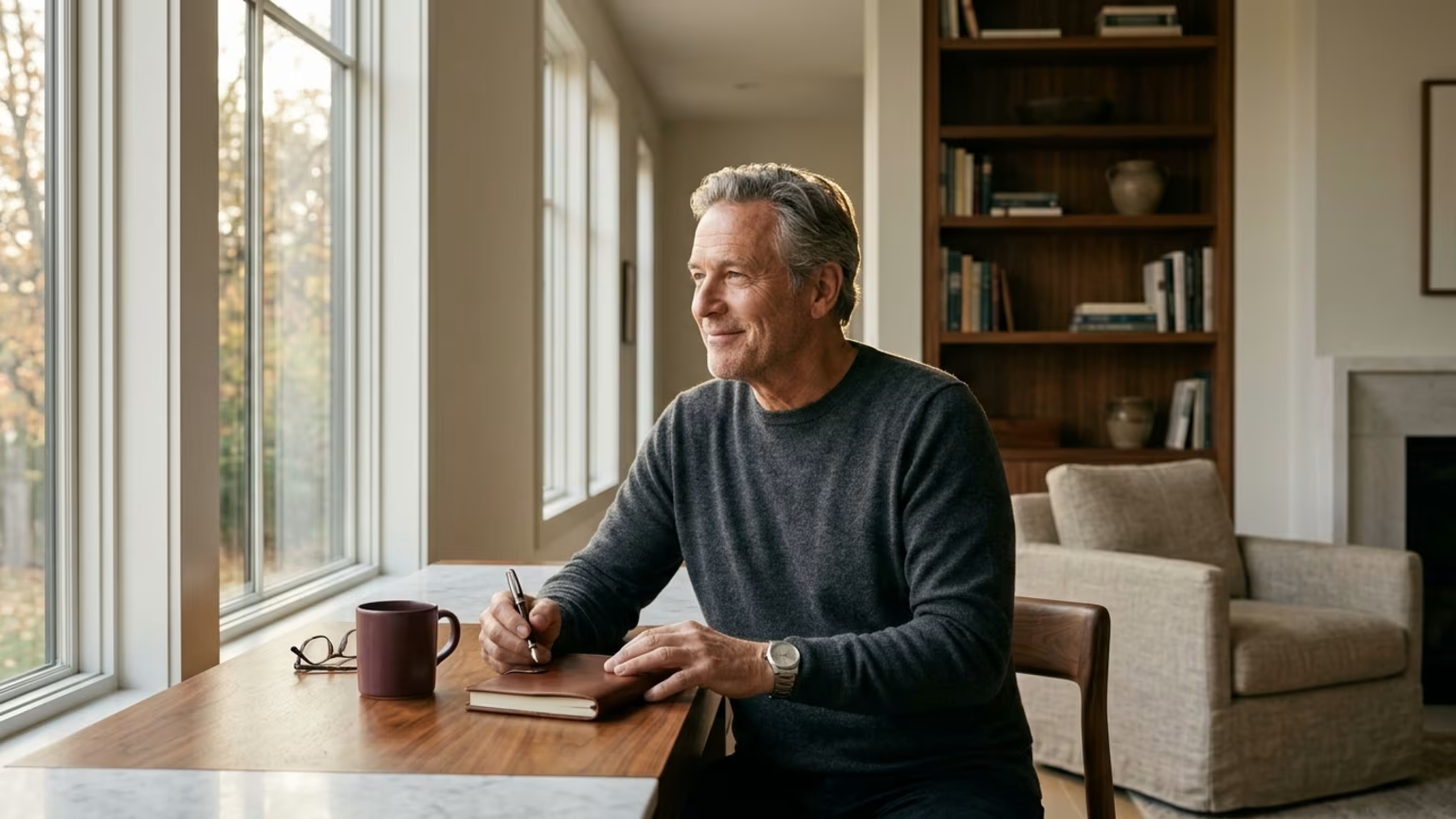

A new study links delaying retirement by one year to an 11% lower mortality risk. Learn how preserving daily structure supports active aging and longevity.





On September 11, 2026, the New York Post reported on new research from the Journal of Epidemiology & Community Health revealing a compelling statistic about aging and work. The study found that delaying retirement by just one year was associated with an 11% lower risk of all-cause mortality among healthy older adults. For the affluent professional who values their physical independence, this finding challenges the traditional dream of an early, abrupt exit from the workforce. Rather than viewing retirement as a sudden stop, active adults must strategically design their transition to preserve the inherent structure of daily employment.
Many successful individuals assume that leaving the stress of a daily commute will automatically improve their physical health. However, an entirely unstructured life can sometimes accelerate physical decline by removing forced daily movement. The transition away from full-time work requires a deliberate strategy to maintain the social interaction and mental demands that employment naturally provides. Without a clear plan, the sudden loss of routine can severely impact physical readiness and overall vitality.
The recent analysis utilized comprehensive data collected from 1992 to 2010 through the Health and Retirement Study. This nationally representative longitudinal panel of U.S. adults aged 50 and older is conducted biennially. The ambitious research project examines health, economic status, and aging across the population. It operates with significant sponsorship from the National Institute on Aging and the Social Security Administration.
The Health and Retirement Study collects detailed information on health conditions, family connections and personal financial status. Researchers analyzed 2,956 older adults from this massive dataset to understand the specific relationship between retirement timing and mortality. They divided participants into healthy and unhealthy retirement groups based on a specific subjective metric. Participants who said poor health was "not important at all" in their decision to retire were classified as healthy retirees.
Within the healthy-retiree group, 466 people retired before age 62. Another 483 individuals in this specific healthy cohort retired later at approximately age 67. The healthy retirees who postponed their exit by one year demonstrated an 11% lower risk of all-cause mortality. This notable association remained intact even after researchers accounted for various health, lifestyle and demographic factors.
Interestingly, the reported mortality association was smaller but still distinctly present among unhealthy retirees. Among this group, approximately 252 participants retired at age 61. Another 297 individuals in the unhealthy cohort retired after age 68. These unhealthy retirees experienced a 9% lower risk of all-cause mortality when they worked longer.
The later-retiring participants shared several highly favorable characteristics compared to other study subjects. They were described as more active, less likely to smoke and less likely to have chronic health conditions. They were also more likely to have a lower body-mass index and report better overall health. These pre-existing differences mean the results show an association rather than direct proof that employment itself extends human life.
One proposed explanation is that work naturally provides identity, financial resources and cognitive stimulation. Leaving a demanding career may suddenly remove these vital support systems for certain individuals. Recent research using Health and Retirement Study data has also examined life purpose and mortality. This illustrates a much broader scientific interest in the psychological and social dimensions of healthy aging.
Furthermore, a separate 2026 systematic review synthesized 54 peer-reviewed quantitative studies on community-dwelling populations. This massive review involved 252,206 participants and examined functional social support alongside physical activity. The findings highlight the broader relevance of social connection and daily activity to healthy aging research. Preserving these connections requires intentional effort once the automatic proximity of colleagues disappears.
For professionals managing their daily routines, preserving a set schedule for eating and activity is crucial for metabolic function. This concept aligns closely with recent insights into how keeping a consistent routine protects the body over time. Readers can learn more about this by reviewing how meal timing linked to longevity impacts cardiovascular mortality in adults over 40. A structured life clearly supports the physiological rhythms necessary for sustained health and independence.
For the worldly adult, retirement is often viewed as a gateway to extensive travel and outdoor adventure. The New York Post cited a 2024 IHG Hotels & Resorts poll involving 2,000 retired Americans to illustrate this trend. This poll found that many respondents were traveling more, pursuing hobbies and completely redesigning their lives after leaving work. However, the physical demands of international travel require a robust foundation of daily physical readiness.
When professionals lose the structured routine of a demanding career, their incidental physical activity often plummets drastically. Commuting, walking between meetings and managing a rigid schedule all force the body to maintain basic endurance. Without this constant stimulus, individuals may experience a rapid decrease in cardiovascular fitness and joint mobility. This physical decline makes it significantly harder to adapt to high-altitude environments during demanding mountain treks.
Maintaining a structured daily routine is absolutely critical for sustaining energy during physical pursuits like skiing or hiking. When a person steps away from full-time work, they must proactively build a new daily framework. A deliberate schedule ensures the body remains thoroughly conditioned for the spontaneous demands of aggressive travel. Implementing such routines is a core component of choosing active leisure routines to protect long-term cognitive capability.
The sudden removal of professional obligations can also disrupt vital sleep architecture and recovery patterns. Work forces a relatively consistent wake-up time, which helps regulate the body's internal circadian clock. When that requirement vanishes, sleep schedules often become erratic and lead to poorer recovery after physical exertion. Consistent sleep is non-negotiable for those who want to spend their later decades skiing or hiking. Readers planning demanding itineraries can maintain this capability by carefully navigating European travel risks with strategic preparation.
Active aging guidance commonly emphasizes maintaining physical function, participation and independence rather than focusing exclusively on chronological age. For active adults, the practical trend is toward designing later life around multiple overlapping sources of purpose. This approach often involves a strategic mix of part-time work, entrepreneurship, sport and community participation. Treating retirement as a phased transition rather than a strict binary event helps preserve crucial social and physical networks.
Consider implementing a one-year retirement runway to gently test your new lifestyle before fully committing. A professional might reduce their weekly hours, shift into an advisory role or begin consulting independently. This phased approach maintains intellectual engagement and structured social contact while freeing up valuable time for physical training. It allows the body and mind to adapt gradually to a new rhythm without the shock of complete inactivity.
The ultimate goal is to measure success by function and independence rather than simply by total years employed. A sustainable plan should actively protect sleep, recovery, strength and financial security simultaneously. By keeping a foot in the professional world, individuals can confidently fund their adventures while maintaining sharp cognitive skills. Taking control of this transition ensures you remain capable and ready for the physical demands of an active future.
Meaningful engagement does not strictly require paid employment, but it does require deliberate and structured planning. A person with a physically hazardous job should discuss work and retirement decisions with qualified professionals to ensure safety. However, for those in flexible roles, preserving a connection to meaningful work offers a powerful tool for aging well. This ongoing engagement provides a reliable anchor that keeps the body resilient and the mind perpetually sharp.
Instead of viewing retirement as an abrupt end to professional life, active adults should design a phased transition that deliberately preserves the daily structure and social connection necessary to sustain a capable, independent future.
Stay connected for research and practical guidance on longevity, strength, recovery, energy and active living. New ideas to help you stay capable, curious and ready for more.




Explore practical guidance on strength, recovery, energy, travel and longevity for a life that stays active.
explore the Blog