
MIT researchers demonstrate that precisely timed pink-noise bursts can increase slow brain waves during sleep, pointing toward future active recovery tools.





On September 9, 2026, new research published in Science Translational Medicine revealed an innovative approach to overnight brain recovery. Researchers at the Massachusetts Institute of Technology reported that brief bursts of pink noise during sleep can increase the amplitude of slow electrical brain waves. This peer-reviewed study offers fascinating insights for active adults who rely on efficient rest to maintain their physical independence. It points toward a future where non-invasive acoustic interventions could actively support tissue repair and cognitive sharpness. We depend on deep restorative sleep to stay fully capable during demanding travel days.
Sleep provides a highly active period of physiological maintenance. During non-REM sleep, our brains produce slow electrical waves. These specific waves become much more prominent during the deeper stages of our nightly cycle. The MIT researchers wanted to test whether they could strengthen these electrical waves without waking the sleeper.
To accomplish this goal, the team utilized a specialized acoustic protocol. The auditory characteristics of pink noise make it uniquely suited for sleep studies. Unlike white noise, which broadcasts all frequencies at equal intensity, pink noise drops in volume as the frequency rises. This natural acoustic profile mimics the soothing sounds of steady rainfall or ocean waves.
The researchers selected this gentle profile specifically to avoid startling the sleeping subjects. The research team did not simply play continuous ambient audio throughout the night. Instead, they delivered extremely brief 50-millisecond bursts of pink noise. The volume of these bursts was carefully controlled.
The sound was not loud enough to wake the participants during the experiment. The precise timing of the acoustic intervention proved to be the most critical variable. The auditory bursts were synchronized exactly to the peaks of each individual participant's slow brain waves. Delivering this timed intervention required sophisticated laboratory monitoring equipment.
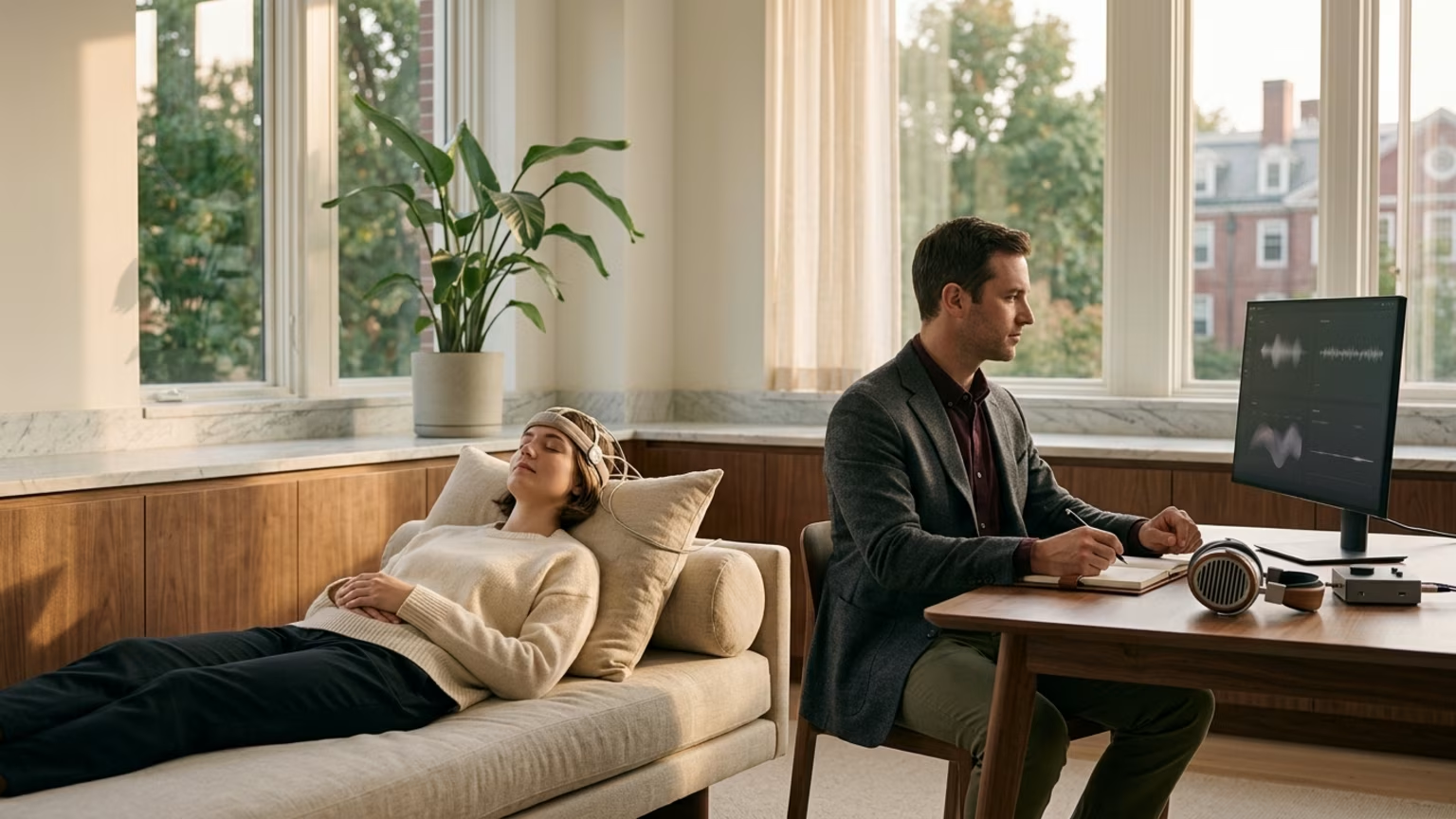
The experimental design required a complex technological setup. The final analysis included 14 healthy volunteers. The team combined electroencephalography, known as EEG, with functional magnetic-resonance imaging. This combination allowed them to measure both slow electrical activity and cerebrospinal-fluid movement simultaneously.
It represented a significant technical achievement in sleep research methodology. Because MRI equipment can interfere with EEG signals, the researchers faced a major technical hurdle. They successfully developed rapid signal-processing and timing methods. This specialized software allowed them to identify slow-wave peaks accurately while participants rested inside the scanner.
The synchronized acoustic intervention successfully increased the amplitude of both the slow electrical waves and the cerebrospinal-fluid waves.
This specific fluid movement plays a vital role in human performance. The researchers proposed that stronger slow waves influence the rhythmic constriction and dilation of brain blood vessels. This continuous mechanical action may act as a pump that drives cerebrospinal fluid through the brain tissue. Cerebrospinal-fluid movement is directly associated with the brain’s natural waste-clearance processes.
The brain lacks a traditional lymphatic system for clearing cellular waste. Instead, it relies entirely on this specialized fluid dynamic to maintain a healthy internal environment. Throughout the day, continuous mental and physical exertion produces high levels of metabolic byproducts. Cerebrospinal fluid rushes in to wash these accumulated byproducts away from the delicate neural tissue during deep rest.
The MIT researchers noted that enlarging this cerebrospinal-fluid flow wave during sleep had not previously been achieved through this type of intervention. The MIT spotlight characterizes the research as a potential way to strengthen the waves that help clear debris from the brain. However, the publication emphasized that researchers still need to determine whether the process actually produces more restorative sleep.
This new intervention builds on significant earlier work by the same research group. Previous studies by Laura Lewis and her team showed that cerebrospinal-fluid waves are closely coupled with slow brain waves during sleep. In those earlier experiments, researchers simply observed the natural relationship between electrical activity and fluid movement. Using precisely timed sound, they successfully moved from passive observation to active manipulation.
Senior author Laura Lewis offered an excellent physical comparison for the underlying mechanism. Lewis compared the precise timing of the auditory stimulus to pushing a child on a swing at the exact right moment. A correctly timed push can make the swing travel much farther. Conversely, poorly timed stimulation may not have the same enhancing effect at all.
Lewis stated that the researchers are now excited to bring the technology to clinical populations. They hope to observe similar increases in cerebrospinal-fluid flow outside the initial healthy volunteer group. Lead author Joshua Levitt also discussed the long-term biological rationale behind the ambitious project. Levitt linked brain-waste clearance to conditions involving the accumulation of proteins such as amyloid and tau.
Levitt suggested that improving this clearance could potentially help prevent disease-related buildup in the future. It is important to view these statements as directions for future research rather than established clinical facts. The current experiment showed increased wave amplitudes rather than improved memory, cognition, or verified disease outcomes. The available report does not establish that the intervention actually increased the physical clearance of specific waste products in humans.
Maintaining physical independence over the decades requires more than just regular exercise. It demands a rigorous approach to recovery that matches the intensity of our active lifestyles. The natural age-related decline in slow-wave sleep makes recovery slightly more challenging for adults over forty. Finding nonpharmacological tools to maximize our limited rest windows has become a primary focus in healthy aging research.
Active adults understand that compromised rest quickly diminishes physical capacity. As our team often notes, strategic timing changes everything about performance.
"After a grueling thirty hour transit to Tokyo, I realized my old strategy of just powering through was no longer working. I felt foggy for three days. I started digging into circadian biology and realized that timing my light exposure and fasting during the flight could completely shift my recovery."
"Now, I never board a long haul flight without a precise schedule for when to eat and when to put on an eye mask. It is the difference between losing a week of your trip and hitting the ground running."
This new MIT study reinforces that precise timing matters just as much for auditory stimulation. True physiological enhancement requires sophisticated, closed-loop technology. Many active travelers rely on basic audio apps to mask disruptive hotel noise. However, simply playing uninterrupted pink noise will not replicate these laboratory findings.
A functional consumer system must detect a physiological event and deliver stimulation at a specific phase of that event. An ordinary sleep app simply cannot monitor your slow brain waves in real time.
Efficient physical recovery dictates our energy for demanding environments. When we hike at high altitudes or spend long days skiing, our nervous system accumulates metabolic stress. If closed-loop technology can reliably increase cerebrospinal fluid flow, active adults might recover faster between heavy training sessions. This ambition matches the active traveler’s recovery framework perfectly.
Here at WealthAtPlay, we prefer nonpharmacological tools that support the body's natural resilience mechanisms. The technology may eventually leave the laboratory setting for everyday consumer use. Levitt has started a company seeking to develop a home-use device. He envisions a wearable tool, such as a headband, that could deliver auditory stimulation at the appropriate time.
Until these validated systems arrive, consumers should remain skeptical of basic audio tracks promising overnight brain detoxification. The MIT protocol’s defining feature was precise individual timing. The best strategy for athletic recovery after 40 relies on absolute consistency. You need a reliable schedule, a dark room, and adequate time dedicated to rest.
Advanced stimulation will eventually augment this foundation rather than replacing it entirely. The current MIT findings represent an exciting proof-of-mechanism result for the future of human performance. By concentrating on protecting recovery through midlife, we ensure we remain fully capable for our next adventure. People with significant sleep disruption should view experimental sound stimulation as a research topic rather than a self-treatment option.
While we wait for closed-loop wearable devices to hit the market, worldly travelers should continue protecting their sleep environment using established fundamentals to ensure sustained daytime capability.
Stay connected for research and practical guidance on longevity, strength, recovery, energy and active living. New ideas to help you stay capable, curious and ready for more.



Explore practical guidance on strength, recovery, energy, travel and longevity for a life that stays active.
explore the Blog